
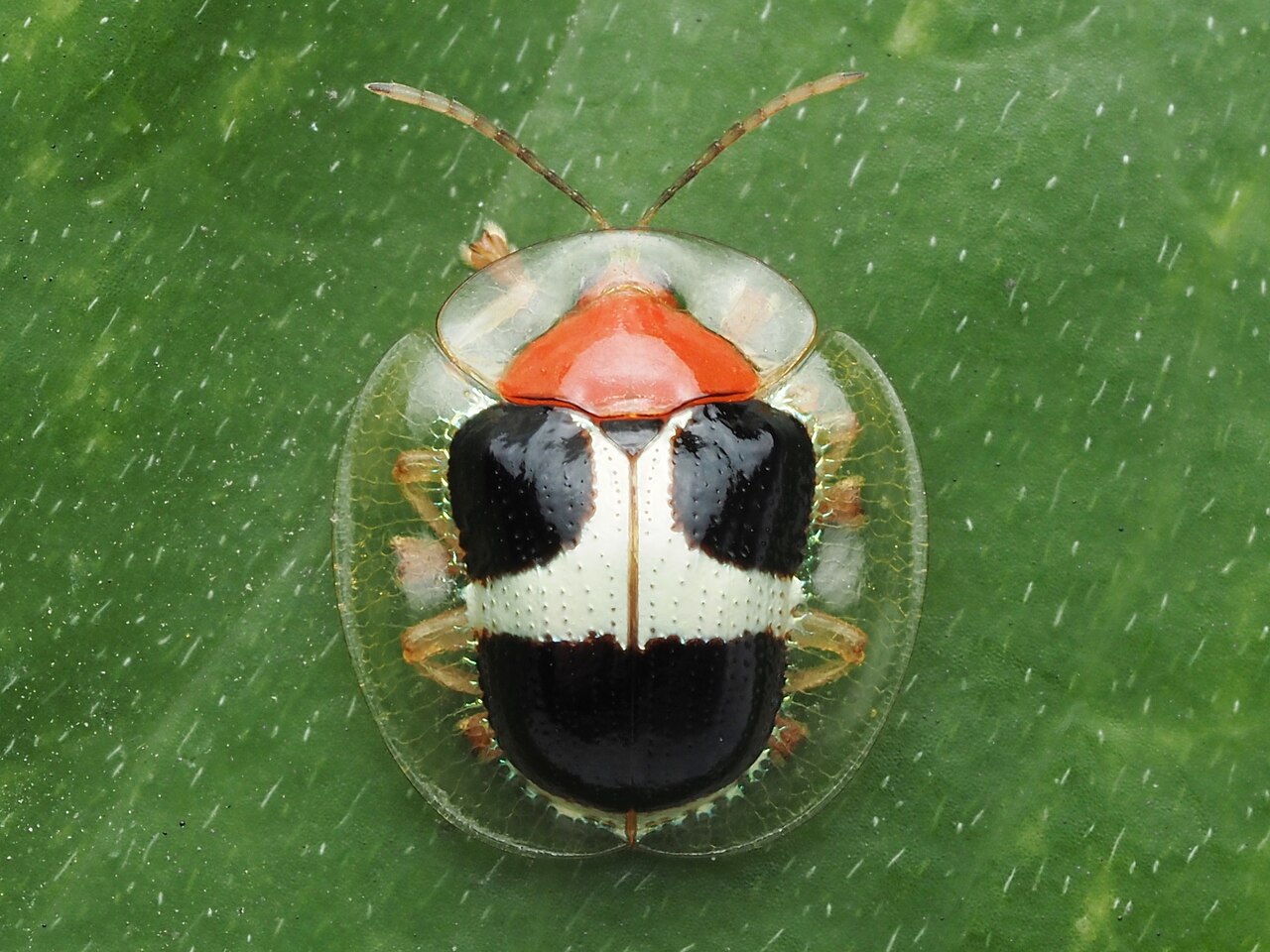
Tortoise beetles cannot digest their food without help. A bacterium called Stammera supplies the enzymes that break down plant cell walls, and the partnership goes back to the Paleocene. Over that time the bacterium has shed almost everything it does not need, down to a genome of 0.24 megabases, which leaves it dependent on the beetle for nearly everything else.
That creates a problem at the one moment the partnership has to be renewed. The symbiont is not passed inside the egg. The mother deposits it on the outside, and it has to survive there, exposed, for up to 11 days before the developing embryo takes it in on the final day.
Why it matters: A bacterium with almost no metabolic capacity has to endure days of drying and osmotic stress in the open. Either it has hidden reserves, or the host is doing something to keep it alive.
An old gene doing a new job
A group at the Max Planck Institute for Biology in Tübingen, working with the John Innes Centre, found the answer in a gene family with no obvious connection to symbiosis. Yellow proteins are known across insects for pigmentation, behaviour, development and immunity.
In these beetles, a female-specific member of that family builds the gelatinous spheres in which Stammera travels. Its expression is confined to the glands in the ovaries that hold the symbiont, where the protein is assembled into a matrix and secreted as the eggs are laid. The bacterium is not merely deposited alongside the material; it is embedded in it.
The co-option makes sense once you look at what Yellow proteins already do elsewhere. In honeybees a relative of this family forms the structural basis of royal jelly. In flour beetles Yellow waterproofs the adult cuticle, and in tiger mosquitoes it protects eggs from drying out. Gelling and water retention are established properties of the family. The beetles have pointed them at a bacterium.
Removing it
The test was to knock the gene down in females using RNA interference and then see what happened to their eggs at two humidities, 60 percent as a control and 45 percent as the dry condition. Both fall within the range the beetles actually experience across their native range in Panama, Costa Rica, Colombia and Brazil, which matters: this is not an artificial extreme.
At normal humidity nothing much happened. In the dry condition, symbiont numbers in eggs from knockdown mothers had fallen significantly by day nine, while both control groups held steady. The matrix is what carries the bacterium through drying.
What failure looks like from inside
The more interesting experiment sequenced the bacterium's own gene expression across the same conditions. In the control comparison, no genes differed at all. Under low humidity in Yellow-deficient eggs, one gene stood out sharply: rpoC, which encodes a core subunit of RNA polymerase, the machine that transcribes genes.
Losing that is not one function failing. It is the transcription apparatus itself faltering, and the wider pattern matched, with expression broadly depressed across the genome rather than in any specific pathway. In related bacteria, mutations in this gene impair adaptation to exactly this kind of osmotic stress.
So the sequence runs: no matrix, water leaves, solutes concentrate, and the bacterium's core machinery gives out. Earlier work had shown Stammera switches on stress-tolerance genes while it waits outside the host, which had suggested it was managing on its own. As García-Lozano and colleagues write in Nature Communications, our data indicate its intrinsic defenses are insufficient without host-derived protection. The bacterium tries; it is not enough.
There is also a neat piece of evidence that the arrangement is old rather than recent. Comparing the evolutionary trees of the beetles' Yellow proteins and of their symbionts, the two branch in step, which is what long co-diversification looks like: as beetle lineages split, their bacteria split with them, and the protein tracked alongside.
What the study can't say yet
Knocking down the gene does several things at once. Sphere integrity is disrupted, the shape changes, and the symbiont is left more exposed, so the experiment cannot separate protection by hydration from protection by physical enclosure. The authors favour water buffering, reasoning from what Yellow proteins do in other insects, which is an inference from relatives rather than a measurement here.
The transcriptional collapse is likewise a correlation observed under stress rather than a demonstrated cause of death. Whether the drop in polymerase subunit expression is what kills the population, or a symptom of cells already failing, is not resolved.
The co-diversification claim rests on the two family trees matching, symbiont and protein. Congruent phylogenies are consistent with partners evolving together, and are also what you get from any process that keeps them associated. The authors put cross-species matrix compatibility forward as the experiment that would test it, and do not run it.
Quick questions
Why not just keep the bacterium inside the egg? Many insects do. These beetles do not, and the paper does not explain why. It documents the workaround rather than the reason for needing one.
What does gene co-option mean? An existing gene being recruited to a new function, rather than a new gene evolving. It is common, and usually the new job exploits a property the protein already had.
What's the one-line takeaway? A pigment-family protein, made only by females and only in the organs that hold the symbiont, forms the gel that keeps an obligate gut bacterium alive during the days it spends outside the beetle.
García-Lozano et al. "Yellow protein co-opted to sustain obligate symbiosis in leaf beetles." Nature Communications, 2026;17(1). doi.org/10.1038/s41467-026-76942-1
PubMed PMID: 42686759.
Image: Tortoise beetle, Belize, Beetlebetty, CC0, via Wikimedia Commons.
Comments