Engineered immune cells have transformed treatment for some blood cancers and barely dented solid tumours. The reason is mostly logistical rather than biological. A CAR cell is built to recognise and kill a specific target, but once infused it goes wherever the circulation takes it, and the fraction that reaches a tumour buried in tissue is small. Making the cells better killers does not fix that. Getting them to the right place might.
A group at the Harbin Institute of Technology has taken the blunt engineering route: load the cells with iron and push them with a magnet. Natural killer cells carrying an engineered receptor were fed magnetic iron oxide nanoparticles, turning each cell into what the authors call a biohybrid microrobot, and an external rotating magnetic field then drove swarms of about five million of them roughly eight centimetres through the spinal canal of a living animal. Switching the field pattern switched the swarm's shape, from a dense vortex suited to travelling to a flat ribbon that spreads out on arrival.
Why it matters: Cancer that spreads to the membranes around the brain occurs in about 5% of patients, cannot be surgically removed, and has few options. The scale here is the part that matters most: a clinical dose of CAR therapy is around ten million cells, so steering five million of them is the same order of magnitude as a real treatment rather than a microscopy demonstration.
The study, by Wu et al. at the Harbin Institute of Technology, with co-authors at the Max Planck Institute for Intelligent Systems and elsewhere, appears in Science Advances. The receptor was assembled from standard parts and inserted using a transposon system rather than a virus.
Two shapes for two jobs
The swarm behaviour is the engineering core. A dense rotating cluster travels well but covers little ground once it arrives; a dispersed sheet covers ground but will not move far as a unit. Rather than choosing, the team drives the same population into either configuration by changing the magnetic field input, using a generator mounted on a robotic arm so the field can follow the animal's anatomy. Populations from ten thousand up to a million cells were moved this way, with the reconfiguration happening on demand.
In mice with tumours seeded in the membranes around the brain, the sequence ran as designed: injected into the spinal fluid at the base of the spine, the cells were driven upward in vortex mode and then spread across the target in ribbon mode. Imaging showed the magnetically driven cells overlapping the tumour signal, while cells left to distribute passively stayed near the injection site.
The result that undercuts the headline
Treatment began six days after the tumours were established, with every group also receiving systemic cytokine support so that survival differences could not be attributed to the cells' own signalling. Untreated mice all died after day eleven, with tumour signal rising about 9.8-fold over four days. Mice given the magnetically steered engineered cells had the strongest tumour suppression, with signal falling to 28.4% of its peak, and all survived past day thirteen.
Buried in that comparison is the finding worth sitting with. Magnetically actuated NK cells carrying no engineered receptor at all still outperformed conventional engineered cells delivered the ordinary way. If plain cells that are steered beat targeted cells that are not, then most of the benefit on display is coming from the delivery rather than from the receptor, and the paper's own framing agrees, crediting magnetic propulsion for the improved tumour accumulation. That is a useful result, but it is a result about transport, not about a better cancer drug.
What the study can't say yet
The monkey work is where expectations need adjusting hardest. The cynomolgus monkeys were healthy: they had no tumour, received no therapy, and served only to show that a swarm this size can be tracked moving through a primate-sized spinal canal under live angiographic imaging. The authors label it exactly that, providing a proof-of-feasibility demonstration in a nonhuman primate anatomical setting. Even that tracking was partial, since because of the limited observation field of DSA imaging, it is challenging to visualize the subsequent migration of the cells beyond the imaged segment. The injection level also differs between the species, so the human equivalent of the procedure is not quite the one performed.
The mouse survival window is short. Groups are compared at day thirteen, and the treated animals had not died by then, which establishes a delay rather than a durable outcome. The cells themselves came from a single healthy donor, who is one of the paper's authors, so donor-to-donor variability is untested. And the authors are direct about what has not been checked at all, writing that Dedicated repeated-cycle assays quantifying swarm size retention, cell viability, chemotaxis, and cytotoxicity after prolonged actuation will be required before clinical translation. Whether a cell stuffed with iron and dragged through fluid by a magnet is still a competent killer afterwards is, on this evidence, an open question.
Quick questions
How close is this to patients? Not close. No animal with a tumour was treated at primate scale, the longest survival comparison runs under two weeks, and the basic question of whether magnetic handling damages the cells is explicitly deferred.
If the magnet does the work, why include the engineered receptor? The combination still performed best, so the receptor adds something. The point is that the ranking puts steered-but-plain cells above targeted-but-passive ones, which locates the bottleneck in delivery.
What is the one-line takeaway? Engineered immune cells loaded with iron were steered about eight centimetres through a spinal canal at roughly half a clinical dose and suppressed brain-membrane tumours in mice for as long as the experiment ran, with the primate demonstration being navigation in healthy animals and the durability of both the cells and the effect still untested.
Wu et al. "Therapeutic-scale CAR-NK microrobots with programmable swarm navigation for targeted solid tumor therapy." Science Advances, 2026. doi.org/10.1126/sciadv.aef9412
PubMed PMID: 42886800. Full text: PMC13674493.
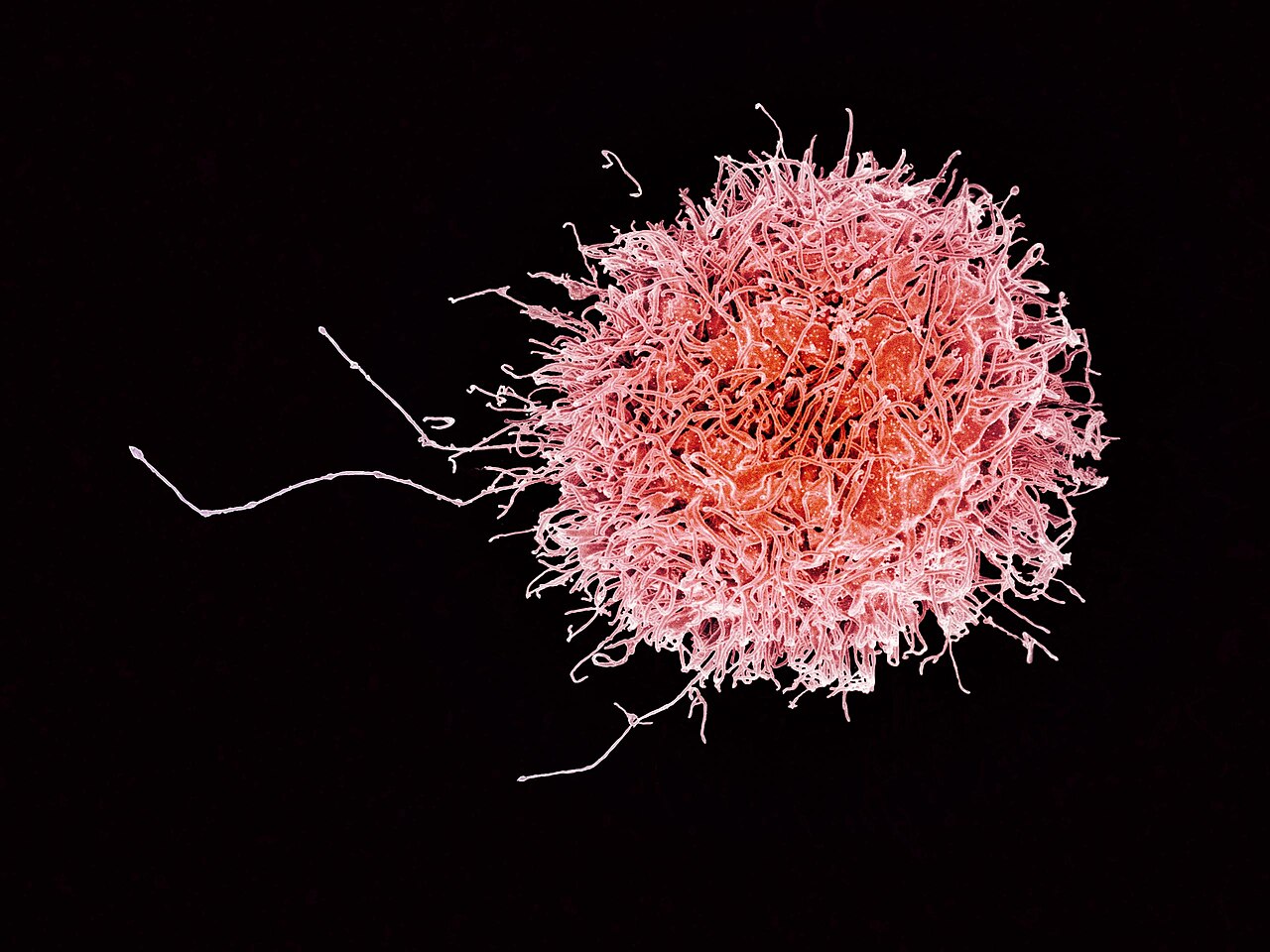
Image: human natural killer cell. NIAID, CC BY 2.0, via Wikimedia Commons.
Comments