The hard part of wiring sunlight into a bacterium is not catching the photons. It is getting the resulting electrons to somewhere the cell can use them. Attach a light-absorbing material to the outside of a cell and absorption is easy to tune but the electrons have a membrane in the way. Grow a semiconductor inside the cell and the electrons arrive where they are wanted, but you have little control over the particle's optical properties. Most microbial biohybrids have picked one side of that trade.
A group at the National University of Singapore, with collaborators in Shenzhen and Nanjing, has built one that does both at once, borrowing its layout from anoxygenic photosynthesis. In that ancient arrangement, antenna complexes absorb light and funnel the energy into a separate reaction centre where charges actually separate. Here the antenna is a coat of charged conjugated-polymer nanoparticles stuck electrostatically to the outside of E. coli, and the reaction centre is cadmium sulfide grown inside the cell's periplasm, the compartment between its two membranes, right next to the electron transport chain. Under light the combination produced up to about 30 times more malate than plain bacteria.
Why it matters: Using light to push a microbe's metabolism toward a chosen product would let chemical manufacture draw on energy that does not come from feedstock. The interesting result here is not the yield, which is small, but the demonstration that an external antenna and an internal reaction centre can be made to work as one unit.
The study, by Yang et al. at the National University of Singapore, with collaborators at the Shenzhen Institutes of Advanced Technology and Nanjing University, appears in Science Advances. Every result is in flasks of engineered bacteria under a lamp.
Two parts, built separately
The antenna side is straightforward polymer chemistry. Three related polymers were made by stitching a fluorene unit to phenylene, to a sulfone-bearing fused ring, or to thiophene, which shifts how far into the visible spectrum each absorbs. Because bacterial surfaces are negatively charged, the polymers were given positive trimethylammonium groups so they would stick, then precipitated into nanoparticles 107 to 124 nanometres across with surface charges up to +29 millivolts.
The semiconductor side exploits something the bacterium already does. Fed cadmium, E. coli generates hydrogen sulfide through its own cysteine metabolism, and the two react to nucleate cadmium sulfide crystals in place. Electron microscopy with elemental mapping put those particles in the periplasm rather than the cytoplasm, which is the detail that matters: it sits them beside the inner membrane where the electron transport chain is, while keeping them out of the cytoplasm's metabolic machinery.
What the combination produced
Malate was the readout, chosen because making it through the reductive branch of the citric acid cycle consumes ATP, so output tracks how much energy the cell has available. Under white light at 4.5 milliwatts per square centimetre the full assembly beat every control.
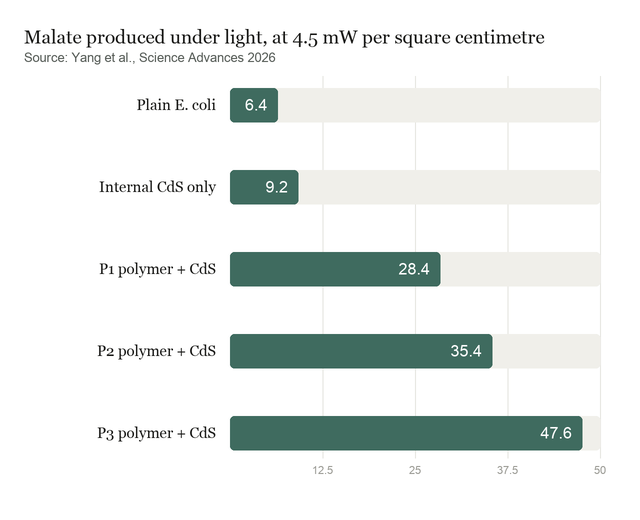
Those are the numbers worth holding onto, because the headline multiple is calculated against a very small denominator. Plain cells made 6.4 milligrams per litre; the best combination made 47.6, which is 7.4-fold. The near-30-fold figure comes from a separate experiment at the highest light intensity tested, normalised to the bacterial control. Both numbers are real, and both describe a process whose absolute output is a rounding error by industrial standards.
The control that explains the architecture is the polymer on its own. Without internal cadmium sulfide, polymer-coated cells went from 8.2 to 9.4 milligrams per litre in the dark up to 11.3 to 14.0 under light, which the authors call minimal. The external antenna by itself barely does anything; it only matters once there is something inside to hand the energy to. Measurements of internal ATP and of the NADH to NAD ratio rose in the same order as the yields, which is the expected signature if light is adding reducing power.
What the study can't say yet
The largest caveat is one the authors state outright rather than bury. This is not photosynthesis, artificial or otherwise: The demonstrated process is the light-enhanced conversion of glucose into malate, with glucose serving as both the carbon source and the primary metabolic energy source, while illumination provides an auxiliary input. Sugar is still the fuel. Light is a modifier that redirects where the carbon goes, and the polymer pathway also needs a sacrificial electron donor such as cysteine or ascorbate to work at all.
How much the light actually contributes is unquantified. The authors are explicit that separating the energetic contributions of glucose and illumination would need a full carbon and energy balance, including absorbed photon flux and glucose consumption, and that a techno-economic assessment should wait until after process optimisation. Nothing here establishes that the light is worth what it costs to deliver.
The mechanism is inferred rather than resolved. Lifetime imaging shows the polymer and the crystals are photophysically coupled, and because they are too far apart for electrons to tunnel directly, the authors read that as energy transfer rather than electron transfer. Band positions show electron injection from polymer to crystal is energetically downhill, but feasible is not the same as demonstrated, and the paper says plainly that the relative contribution of each pathway remains to be elucidated.
Then there is the material. The reaction centre is cadmium sulfide, and cadmium is toxic and carcinogenic. The paper does not report toxicity or long-term stability data, and its closing line treats this as a mechanistic model from which more biocompatible systems might later be developed, which is a fair description but also an admission.
Quick questions
Is this a way to make chemicals from sunlight? Not yet, and not as built. It is a way to make a sugar-fed bacterium produce somewhat more of one chemical when you shine a light on it.
Why grow the crystals inside the cell instead of adding them? Position. Formed in the periplasm they sit against the inner membrane where the electron transport chain runs, so photo-generated electrons have a short trip to something that can use them.
What is the one-line takeaway? Splitting a biohybrid into an outside antenna and an inside reaction centre, the way anoxygenic photosynthesis does, raised a bacterium's output of one chemical several-fold, on a sugar diet, in milligram quantities, using a toxic semiconductor.
Yang et al. "An anoxygenic photosynthesis-inspired dual biohybrid for light-enhanced chemical production." Science Advances, 2026. doi.org/10.1126/sciadv.aef4504
PubMed PMID: 42826201.
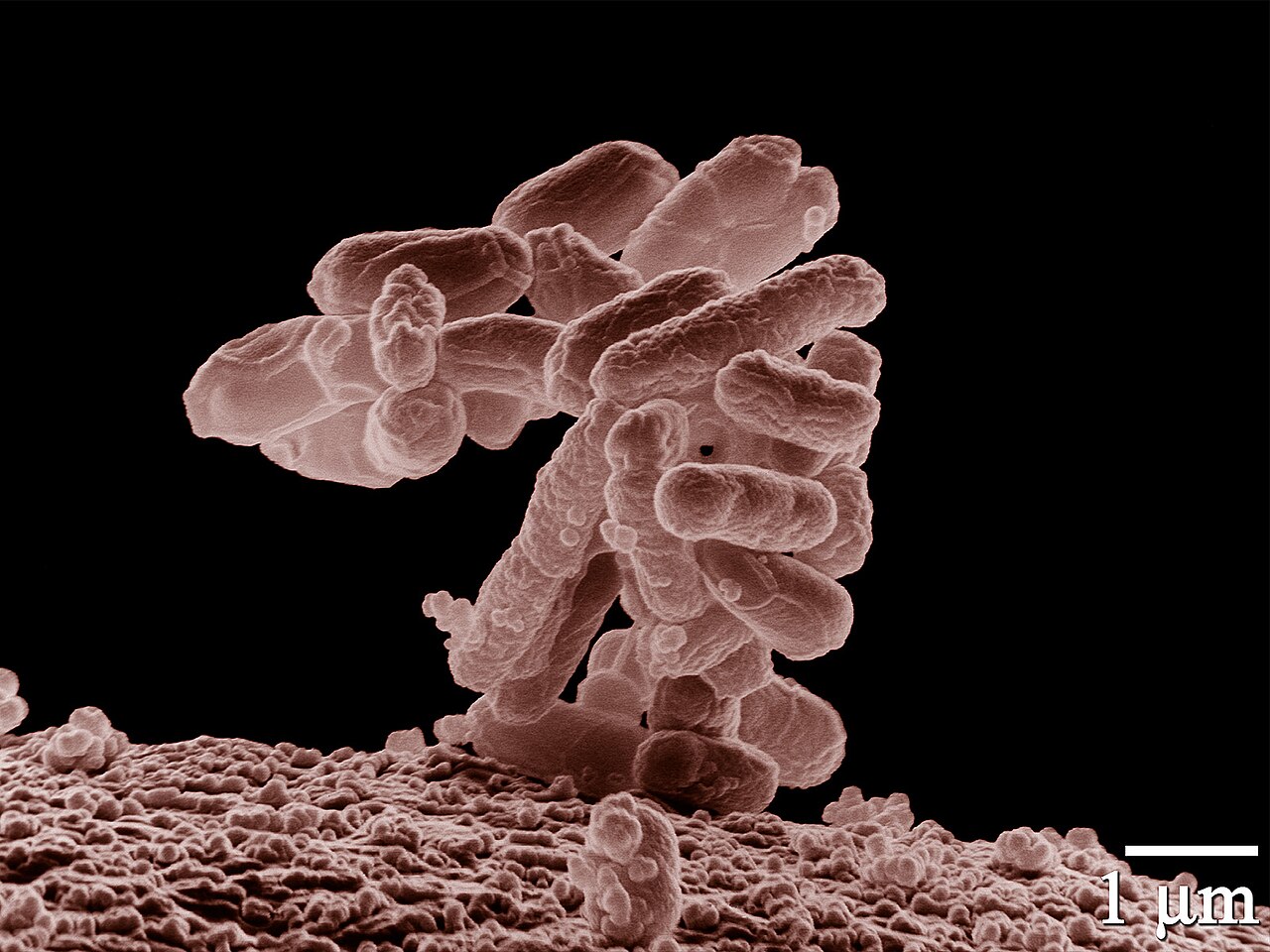
Image: Escherichia coli at 10,000x magnification. Eric Erbe, public domain, via Wikimedia Commons.
Comments