

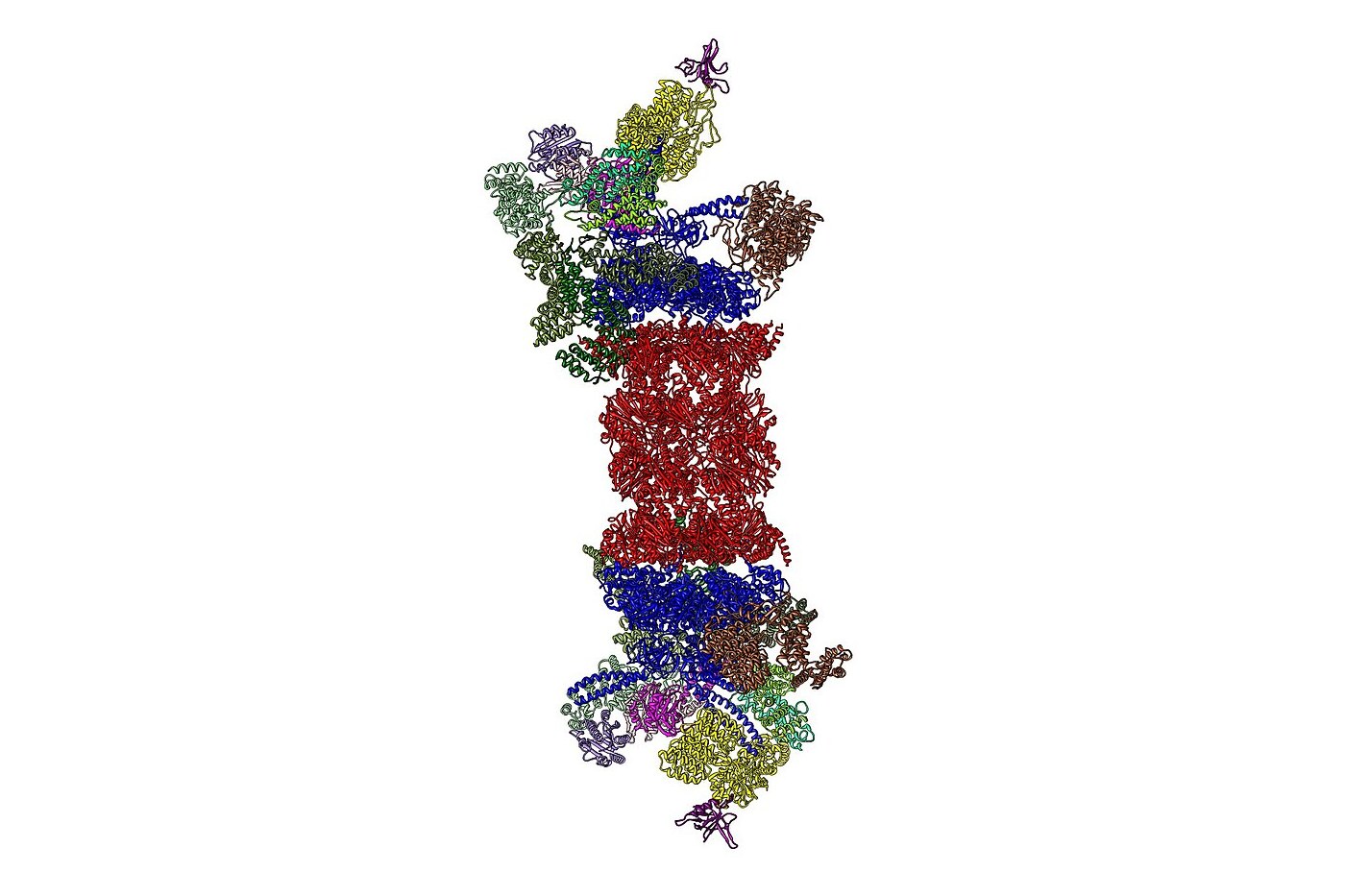
Most drugs work by sticking to a protein and blocking it. That only helps if the protein has a pocket worth blocking, which leaves a long list of disease proteins untouched. The alternative is to destroy the protein instead, and for a decade the way to do that has been to borrow the cell's own labelling system: tag the target with a chain of ubiquitin, the molecular marker that sends a protein to the shredder.
A team at Seoul National University has built a version that skips the tag. Their system, Protea-Tac, grabs the target and delivers it straight to the shredder itself, the 26S proteasome, without the ubiquitin step. In cells it cleared several unrelated proteins, and in mice carrying tumours it slowed tumour growth.
Why it matters: Every ubiquitin-based degrader depends on recruiting one of the cell's roughly 600 tagging enzymes, and only a handful work well enough to build drugs around. Bypassing that step removes the bottleneck, and with it one common route by which tumours become resistant.
The study, by Park et al., appears in Science Advances. The design is simple to describe: fuse a piece of the proteasome's own receiving dock, the protein that normally recognises ubiquitin chains, to a small antibody that grips the chosen target. The result plugs into the proteasome and drags the target in behind it.
What it degraded, and what it left alone
The team swapped the antibody end to point the same machine at different proteins, including c-Fos and BRD4, two cancer-associated regulators, and versions of TDP-43 and tau, proteins that accumulate in neurodegenerative disease. Changing target meant changing one module, which is the useful property for a platform.
Two checks matter more than the list. First, the engineered receptor integrated into proteasomes without disturbing them: the particles kept their structure and their normal cutting activity, so the tool does not simply poison the shredder. Second, the degradation did not run through ubiquitin, which the authors verified mechanistically, and it was selective rather than indiscriminate, with unrelated proteins left standing.
In mice, tumour cells engineered to make the degrader grew substantially more slowly than controls, and the effect was reproduced when the degrader was delivered rather than built in, using a virus or lipid nanoparticles.
The approach is not as exotic as it sounds. A handful of proteins are already destroyed by the proteasome without any ubiquitin tag, so the machinery tolerates substrates arriving by other routes. What is new here is a general tool that puts a chosen protein on that route deliberately.
Recruitment is not the whole job
A negative result in the paper is worth as much as the positive ones. Some versions that bound the proteasome perfectly well still failed to destroy anything, and lengthening the flexible linker between the two halves did not rescue them. The authors draw the careful conclusion: recruitment to the proteasome is necessary but not invariably sufficient for productive degradation.
The reason is that the proteasome does not chew whatever it holds. It needs a loose, unstructured stretch of the target to thread in first. A protein with no such handle can be delivered to the door and still not go through, which means each new target will need testing rather than assuming the platform transfers.
What the study can't say yet
The biggest gap is what Protea-Tac is. Ubiquitin-based degraders are small molecules, so they can be swallowed. Protea-Tac is a protein, so it has to be produced inside the patient's cells from delivered genetic material, by a virus or a nanoparticle. That places it alongside gene therapy rather than pills, with the delivery, dosing and duration problems that come with it. Nothing here shows it reaching a tumour that was not engineered in advance or directly injected.
The tumour work was also done in NSG mice, which lack a working immune system. That is standard for growing human tumour cells, but it means these experiments cannot show how an immune system would react to a foreign engineered protein made inside its own cells, which is a central question for anything delivered this way.
Some of the targets were carrying laboratory tags, with the antibody gripping the tag rather than the natural protein. That is a fair way to prove the machine is modular. It is not the same as showing an antibody can be raised against each disease protein in its native form, which is the step every future target would need.
And degrading a protein is not the same as treating a disease. Slower tumour growth in mice is an early signal, measured over weeks in animals whose tumours were built for the experiment.
Quick questions
How is this different from a PROTAC? A PROTAC pulls a target next to a tagging enzyme so the cell marks it for destruction. Protea-Tac removes that middle step and hands the target directly to the proteasome.
Does it damage the proteasome? Not in these experiments. The engineered receptor joined the particle while leaving its structure and cutting activity intact.
What's the one-line takeaway? A genetically encoded degrader delivered proteins straight to the proteasome without ubiquitin tagging and slowed tumour growth in mice, but it is a protein that must be delivered into cells, not a pill, and some targets resisted it despite being successfully recruited.
Park SH, Jang Y, Lee SY, et al. "Ubiquitin receptor-mediated, ubiquitin-independent targeted protein degradation via 26S proteasomes." Science Advances, 2026;12(38):eaeh0227. doi.org/10.1126/sciadv.aeh0227
PubMed PMID: 42758827.
Illustration: 26S proteasome structure, by FridoFoe, CC BY-SA 3.0, via Wikimedia Commons.
Comments