
Forecasts of how climate change will redraw the map of life usually work one species at a time. A reed either persists in a region or it doesn't. But a widespread plant is not one uniform thing, and if its internal varieties differ in heat tolerance, the species can hold its ground on the map while being quietly replaced from within.
A study of the common reed in China set out to test that. Phragmites australis lines wetlands across most of the world and is a foundation species: it builds the habitat other species live in, holds sediment, and moves carbon and nutrients through the marsh. In China it exists as several genetic lineages that differ in the number of chromosome sets they carry. The team found that the heat-tolerant lineage is also the one gaining ground genetically, and the one projected to gain the most habitat as the climate warms.
Why it matters: If one lineage replaces another inside a species' existing range, every map still shows the same reed in the same marshes. What changes is the plant's biology, and with it the habitat it builds. That kind of turnover is invisible to forecasts that treat a species as a single unit.
The work, by Liu et al. at Shandong University with colleagues in Beijing, Helsinki and Louisiana, appears in eLife. It combines three lines of evidence that are rarely used together: population genomics on 495 individual plants, common-garden experiments at four sites, and distribution modelling built on 837 occurrence records.
One reed, three lineages, different heat limits
The three lineages are not equally equipped for heat. Measured on their photosynthetic machinery, the octoploid FEAU lineage, which carries eight sets of chromosomes, tolerated temperatures 1.3°C higher before damage began and 0.8°C higher at the point where half of function was lost, compared with the cold-adapted tetraploid CN lineage with four sets. FEAU also produced more total biomass in three of the four gardens, which is the more practical measure: it is not merely surviving heat, it is growing more.
A degree or so sounds slight. It is not nothing in a marsh, where summer surface temperatures already reach the limits of these plants, and the gap applies every hot day rather than on average.
The genetics point the same way
The second result is what makes this more than a physiology comparison. Where the lineages meet, they interbreed in both directions, but not evenly. Plants of mixed ancestry carried a significant bias toward FEAU, 61.1% of their genome on average, which is the pattern expected when hybrids preferentially breed back into the octoploid parent. Genes are flowing toward the heat-tolerant lineage, not away from it.
The third line, habitat modelling, projects that under the high-emission SSP5-8.5 scenario by 2070, highly suitable habitat for FEAU expands by 18.6%, while the cold-adapted CN lineage gains far less and the subtropical SW lineage stays roughly where it is. Three independent methods, pointing the same direction, is the strongest thing about this paper. The authors also note that field observations already show FEAU expanding in a plateau lake.
What the study can't say yet
The most important limit is one the authors state themselves, and it concerns why FEAU wins. The heat-tolerant lineage differs from its relatives in chromosome number, but also in evolutionary history, geographic origin and genetic background, and these cannot be pulled apart here: ploidy is correlated with, rather than experimentally separable from, the broader genetic identity of each lineage. So this is not evidence that doubling a genome confers heat tolerance. It is evidence that this particular lineage has it.
They apply the same discipline to the garden results, writing that the common garden results should be interpreted as lineage-associated rather than ploidy-causal performance differences. Four gardens is also a small number of environments, and biomass favoured FEAU in three of them, not all four.
The habitat projections are correlative. A model of this kind learns where a lineage is found today and where similar climates will exist in 2070; it does not simulate competition, water management, grazing or the wetland drainage that decides the fate of a great many marshes. Nor does a projection of suitable habitat show that plants will actually get there and establish.
Finally, replacement is inferred rather than observed. The genetic bias and the thermal gap make lineage turnover plausible, and one lake supports it, but nobody has yet watched one lineage displace another across a region over time. That would take repeated sampling of the same marshes for years.
Quick questions
What is a ploidy lineage? Plants often carry duplicated sets of chromosomes. The reeds here have four sets (tetraploid) or eight (octoploid), and those groups also differ in ancestry, so "octoploid lineage" names a whole genetic identity, not just a chromosome count.
Is this an invasion? No, and that is what makes it interesting. The same species has been in these wetlands all along. The shift is happening inside its native range, between varieties of itself.
What's the one-line takeaway? A heat-tolerant, eight-chromosome-set lineage of common reed out-tolerates, out-grows and out-breeds its cold-adapted relative, and is projected to gain 18.6% more suitable habitat by 2070 under high emissions, which would change the marsh without changing which species is in it.
Liu L, Sheng W, Wang Y, et al. "Asymmetric introgression and thermal advantage jointly drive climate-mediated lineage turnover in a mixed-ploidy reed." eLife, 2026;15. doi.org/10.7554/eLife.112160
PubMed PMID: 42765460.
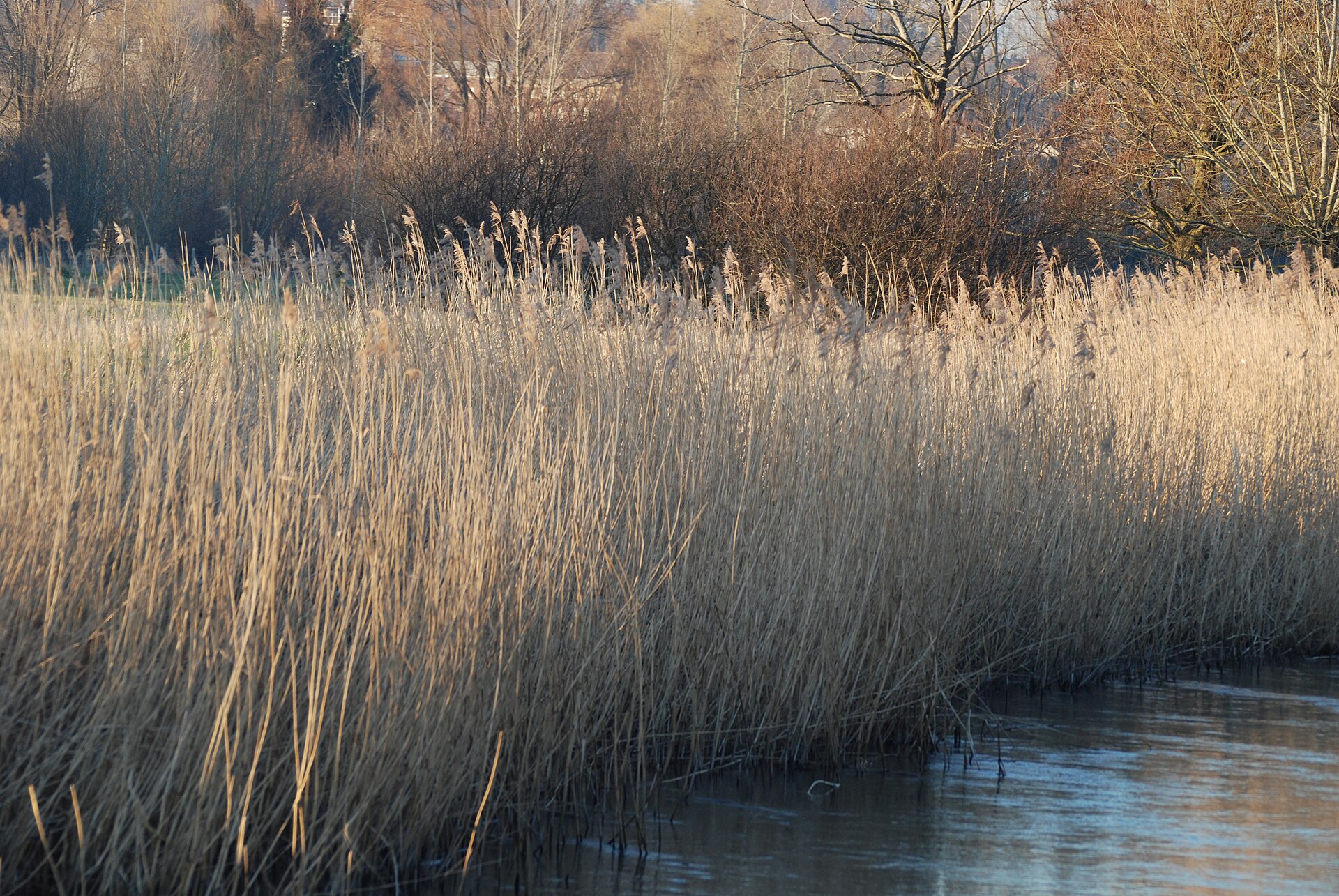
Photograph: Reed beds on the River Nadder at Harnham, by Col.51, CC BY-SA 3.0, via Wikimedia Commons.
Comments