
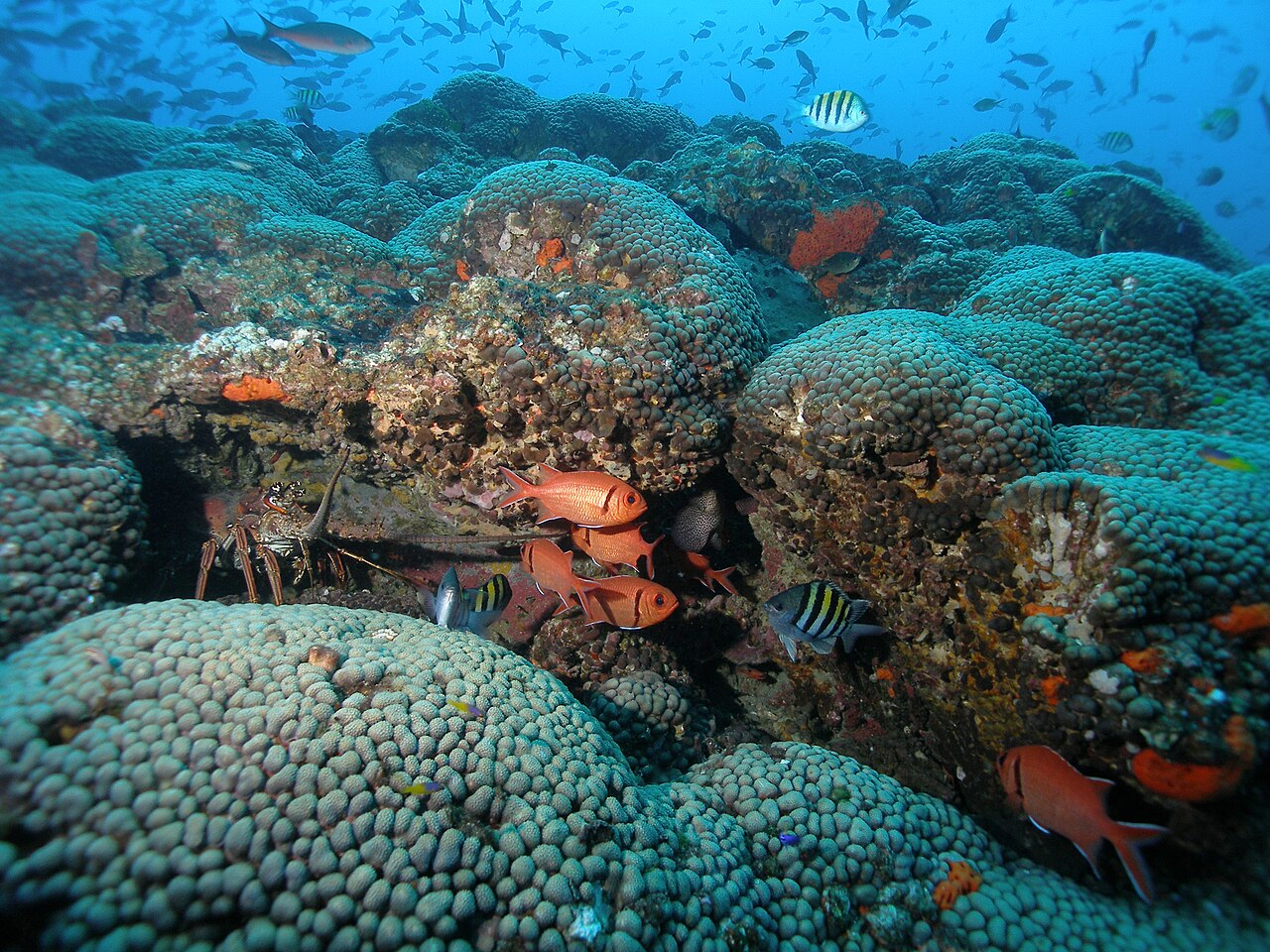
The Flower Garden Banks sit about 200 kilometres off the Texas-Louisiana coast, on salt domes rising from the floor of the Gulf, their shallowest coral starting some 20 metres down. With more than half the seabed covered in living coral, they are the healthiest reefs on the continental United States margin, and the usual explanation is distance. Too far offshore for fishing pressure, too far from land for runoff. Recent disease outbreaks have made that explanation harder to sustain.
A team led from the Max Planck Institute for Chemistry tested it directly, by reading nitrogen out of the coral skeleton itself. Corals trap organic matter as they build, and the nitrogen isotopes in that trapped material record where the nitrogen came from: river-borne nitrogen carries a heavier signature than open-ocean nitrate. Two cores, read year by year, span 1753 to 2023. The record is flat for a century, then begins climbing around 1850, then climbs much faster after 1960. In the two most recent decades, a majority of the nitrogen arriving at these supposedly isolated reefs came down the Mississippi.
Why it matters: Reef management treats nutrient pollution as a coastal problem and heat as the offshore one. This says farm nitrogen from the middle of a continent reaches reefs 180 kilometres out to sea, and arrives in the same years the heat does.
The study, by Jung et al., appears in Science Advances. Its control is what makes it readable. A third coral core from Cayo Santa Maria in northern Cuba, covering 1777 to 2015, records the same ocean basin without the Mississippi. Both records share a roughly 64-year oscillation matching Atlantic Multidecadal Variability, the natural rhythm you would expect. Only the Gulf record departs from it, and only after 1850.
A watershed written into limestone
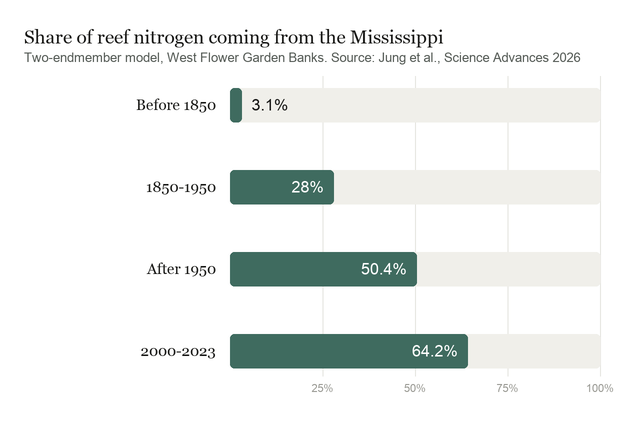
Feeding the measurements through a two-source mixing model turns the isotope curve into a percentage. Before 1850 the Mississippi contributed 3.1% of the nitrogen reaching the reef, a figure indistinguishable from zero given the uncertainty. Between 1850 and 1950 it rose to 28%. After 1950 it reached 50.4%, and across 2000 to 2023 it averaged 64.2%.
The dates line up with agricultural history rather than with anything oceanographic. The first rise follows the Guano Islands Act of 1856, under which the United States claimed 103 islands and cays to mine fertiliser, the first widespread use of imported nutrients in the basin. It steepens after the Great Raft, a centuries-old log jam on the Red River, was cleared in the 1870s, and after levee construction began in 1882, both of which sent water to the Gulf faster and with less chance for nutrients to be taken up along the way. The sharpest rise begins with the Green Revolution and synthetic fertiliser in the 1960s. Across the instrumental period the coral record tracks national nitrogen use closely, with an adjusted R-squared of 0.647.
One detail in the timing is doing real work. After the nineteenth-century expansion, changes on land preceded the reef signal by several years, consistent with nitrogen accumulating in soils and groundwater and seeping out slowly. After the 1960s that lag collapses to roughly zero. Drainage, river engineering and heavy application turned a watershed that stored nitrogen into one that flushes it.
Why nitrogen matters when the water is also too hot
The reef's worst recent years were 2016 and 2022, both disease outbreaks, and 2022 to 2023, bleaching. Those are also the years when the Mississippi share exceeded 60% and heat stress passed 8 degree heating weeks, the threshold for severe bleaching. In 2010, when heat alone crossed that line, corals bleached but no widespread disease followed.
The mechanism the authors invoke is established elsewhere. Extra nitrogen favours turf and fleshy algae, which leak far more dissolved organic carbon than coral does; that carbon feeds fast-growing bacteria carrying virulence genes; those bacteria create local low-oxygen zones that kill coral tissue, which opens space for more algae. Independent surveys of the sanctuary have recorded rising turf algal cover. Mississippi water also runs nitrogen-rich relative to phosphorus, above the ratio plankton use, which pushes an already phosphorus-poor offshore reef further out of balance.
What the study can't say yet
The percentages are model output, not measurements, and the model has two fixed endpoints and wide error bars. The modern figure carries an uncertainty of plus or minus 22 percentage points, so "about two-thirds" is the honest reading, not 64.2%. The abstract's range of 60 to 80% is looser still than the results section supports.
The link to reef damage is co-occurrence across a handful of years, not a test. Four bad years overlapping high nitrogen and high heat is suggestive, and it is also four years. The DDAM feedback that would explain it was worked out on other reefs; nothing here measured bacteria, dissolved carbon or coral tissue at the Flower Garden Banks. Dating also softens with depth, with chronology accurate to the year only back to 1932 and drifting by one to two years per century before that.
Attribution to farming is strong but not exclusive. The authors are careful that the N signal exported to the Gulf is not attributable to a single source but instead reflects the combined influence of dominant nonpoint agricultural inputs, smaller yet measurable wastewater contributions, and long-term hydrologic modifications across the basin. Sewage treatment accounts for perhaps 8 to 9% of the load, and millions of septic systems are not counted at all. What is firm is the reach: modern coral reef ecosystems, even those located more than 180 km from shore, are influenced by intensified agricultural production across the Mississippi Basin.
Quick questions
How can a coral record the past? It lays down annual skeletal bands and traps organic matter inside them. The nitrogen in that trapped material keeps the isotopic signature of its source, so a core read year by year is a dated archive of what the water carried.
Does reducing fertiliser help if the ocean keeps warming? This cannot answer that, but it suggests nutrient loading is the lever within reach. Heat is global and slow to change; the nitrogen arriving from the Mississippi is a policy variable, and a target to cut it by 60% was set in 2001 and missed.
What's the one-line takeaway? Coral cores spanning 270 years show Mississippi-derived nitrogen rising from near zero to roughly two-thirds of the supply at reefs 180 kilometres offshore, peaking in the same years those reefs bleached and fell sick.
Jung J, DeLong KL, Montagna P, et al. "Increasing nitrogen loading in the Gulf of Mexico undermines coral reef resilience." Science Advances, 2026;12(37):eaef2841. doi.org/10.1126/sciadv.aef2841
PubMed PMID: 42715316.
Image: reef scene, Flower Garden Banks National Marine Sanctuary. National Marine Sanctuaries, public domain, via Wikimedia Commons.
Comments