

Marine heatwaves are the ocean extreme that gets attention, and the evidence that they damage fisheries has been oddly mixed. Some studies find large effects, others little. A group at the University of British Columbia and the University of Bern suggests part of the reason is that heat has been studied on its own, while the ocean does not deliver it that way.
Their analysis covers more than 6,500 catch time series, 1,246 species and 254 regions from 1993 to 2019, and asks a deliberately narrow question: when an unusually hot year happens, or an unusually unproductive one, or both, how much does the chance of an exceptionally poor catch go up?
Why it matters: Fisheries planning treats stressors one at a time because that is how they are usually measured. If two ordinary-sized extremes combine into something larger than either, planning built on single-hazard estimates is set too low.
What the numbers say
Framing it as odds rather than tonnage keeps the question answerable. An extreme year is one in the hottest or least productive tenth of that location's own history, and the outcome is whether catch fell into its own extreme low.
Heat alone matters, and it matters most when it persists. Two consecutive hot years raised the odds of an extreme low catch by 40 percent, with a confidence interval from 20 to 65 percent. Low productivity alone was weaker, registering only when a year was the least productive in its entire series.
Together they are worse. A hot year followed by the least productive year on record pushed the odds ratio to 1.8, roughly an 80 percent increase, well beyond either hazard separately.
One result cuts against intuition and is worth dwelling on. Using the most extreme conditions in the historical record did not raise the odds any further than the ordinary hot-year threshold did. More heat did not mean proportionally more damage, which points to a threshold being crossed rather than a dose being increased. That is a different shape of risk than a smooth trend, and it is easier to miss.
Checking it before believing it
The productivity figures are not measurements but model estimates, and different models disagree. Rerunning the whole analysis with five alternative products shifted effect sizes by about 2 to 3 percent, with a coefficient of variation of 0.024 across products. The conclusion does not depend on which model you pick.
Fishing effort is the other obvious confound, since a bad catch year might just mean fewer boats. Effort data do not exist for every species and region, but restricting the analysis to where they do gave consistent climate effects.
There is also a nice piece of physical reasoning. Surface temperature extremes predicted declines in bottom-dwelling species, which sounds wrong until you consider that surface and deep layers are coupled, and repeating the analysis with bottom-layer temperatures gave the same answer.
Where the risk lands
The effect is not spread evenly. Tropical and subtropical regions showed the sharpest increases in the likelihood of extreme low catches, which is the opposite of a comfortable result: those are the waters where fish supply the largest share of dietary protein and where fleets are least able to follow stocks elsewhere or switch to something else.
The species affected compound that. Those flagged as disproportionately at risk include ones that matter for food security and for conservation, and the countries carrying the most exposure are among the least equipped in monitoring capacity and scientific infrastructure to see a bad year coming. The authors' recommendations follow from this rather than from the climate signal itself: early warning systems, harvest rules that can be adjusted mid-season, and diversifying which species a fishery depends on.
What the study can't say yet
The most important limitation is about what is being counted. Catch is not fish. It reflects how many fish there were, and also who was fishing, under what quota, with what fuel price and what management response. As Cheung and colleagues write in Nature Communications, because reconstructed catch integrates ecological, economic, and governance influences, estimated odds ratios reflect socio-ecological system responses rather than purely biological stock responses. A closure triggered by a bad year appears in this data as a bad year.
The models are associations, not mechanisms. The paper offers plausible biology, heat impairing growth and reproduction especially in early life, poor productivity limiting food, with effects surfacing years later as weak cohorts reach fishing age. None of that is demonstrated here.
Other pressures are absent. Overfishing, habitat loss and deoxygenation were not included, and the authors expect these would act synergistically, which makes their estimates conservative rather than cautious in the usual direction.
The projections carry the heaviest assumption: that the relationship between extremes and catch holds steady into the future. Species may adapt and management may improve, and either would break it.
Quick questions
What is an odds ratio? A comparison of how likely something is under two conditions. An odds ratio of 1.8 means an extreme low catch was about 80 percent more likely in those years than in normal ones.
Why does ocean productivity matter for fish? It measures how much microscopic plant life the ocean is producing, which is the base of the food web. Less of it eventually means less food for everything above.
What's the one-line takeaway? Hot years and unproductive years each raise the risk of a failed catch, and arriving together they raise it far more, with the largest burden falling on tropical fisheries in countries least equipped to absorb it.
Cheung et al. "Large fisheries declines linked to compound and extreme climate events." Nature Communications, 2026;17(1). doi.org/10.1038/s41467-026-77077-z
PubMed PMID: 42680769.
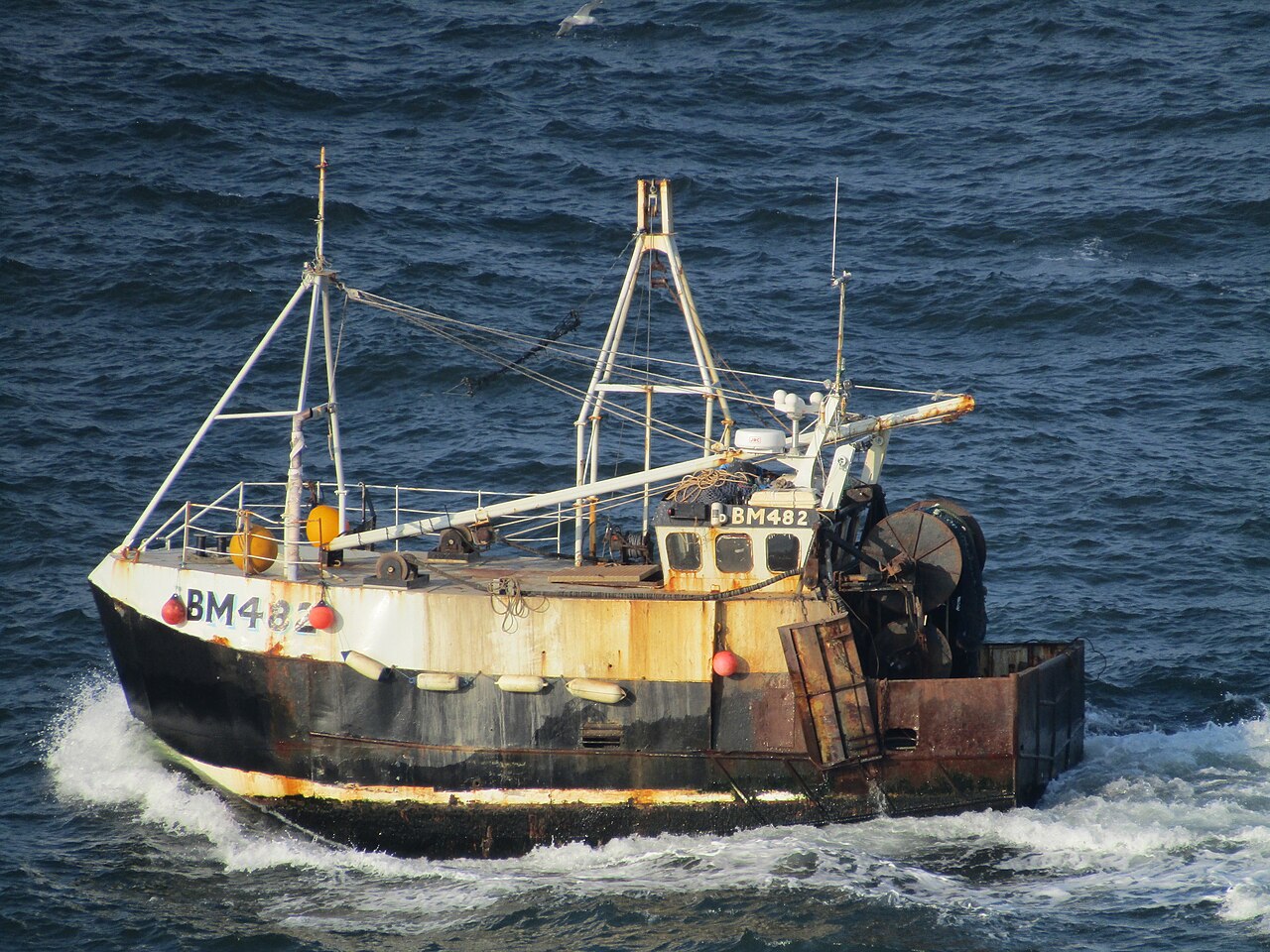
Image: Brixham trawler off Berry Head, Partonez, CC BY-SA 4.0, via Wikimedia Commons.
Comments