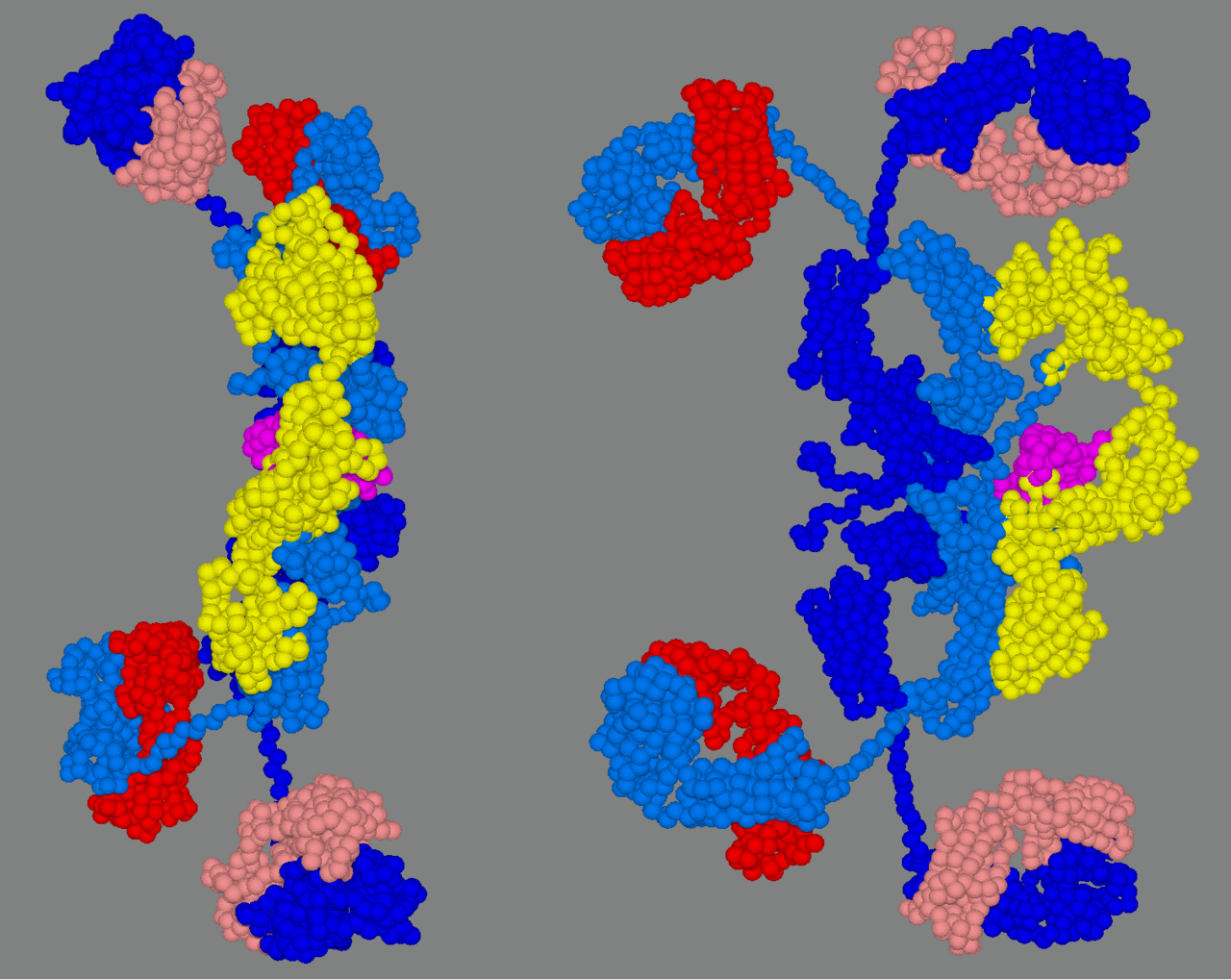
Handing someone else's antibodies to a patient is one of the oldest tricks in medicine, and it is still how people with inherited antibody deficiencies stay out of hospital. It is also the stopgap reached for when a new virus appears and a vaccine is a year away. The method has an awkward mismatch at its centre, though. The antibodies are drawn from blood, so they are mostly IgG, and they are delivered into a vein. Respiratory viruses arrive at the lining of the nose and airway, where the dominant antibody is a different molecule altogether: a paired, reinforced form called secretory IgA that barely features in blood-derived products.
A group at McMaster University went looking for that molecule in the one place it is abundant and freely given. Pooling donations from 120 lactating people through milk banks in Indianapolis and Pittsburgh, they accumulated roughly 15.6 litres of milk, purified about a litre of it into a polyclonal secretory IgA preparation, and sprayed it into the noses of mice. Against an influenza A challenge the mice were completely protected, including mice genetically unable to make antibodies of their own.
Why it matters: People with conditions such as common variable immunodeficiency need repeated intravenous infusions for life, which are expensive and have to be given in a clinical setting. A nasal preparation sourced from donated milk is a different logistical proposition entirely, and it puts the antibodies where respiratory viruses actually land.
The study, by Tugg et al. at McMaster University, appears in Science Advances. Two of the seven authors work for Lactiga US Inc., the company behind the preparation being tested, which readers should weigh when reading the enthusiasm.
Breadth that outran the donors' own infections
The preparation showed activity against respiratory syncytial virus, adenovirus and influenza A, and within influenza it recognised both of the two major structural groups of the surface protein. The striking case was a highly pathogenic avian H5N1 lineage, which the antibodies recognised despite no known exposure of donors to this strain. The authors read that as evidence the pool contains antibodies against conserved features shared with avian viruses, which is the main theoretical argument for a polyclonal product over a designed monoclonal one.
Worth noting is a deliberate choice in how the milk was gathered: donors were not screened for recent infection or vaccination, matching standard practice for blood-derived immunoglobulin, where donors are also not selected for what they happen to have been exposed to. The breadth therefore came from pooling many people's histories rather than from recruiting convalescent donors, which matters because it is the version that could be scaled.
Protection without clearing the virus
Here the paper does something unusual and worth crediting: it reports a result that complicates its own headline. Treated mice showed no clinical signs of illness while controls accumulated up to three signs by seven days after infection. But measuring virus in the lungs found that Unexpectedly, there was no statistically significant difference in viral titers in the lungs of PBS- and LCTG-001-treated mice at 6 DPI.
So the animals were protected while carrying comparable amounts of virus. What differed was the inflammatory response: treated lungs had significantly lower levels of interferon gamma, interleukin-6 and interleukin-10. The abstract describes a transient early reduction in viral burden followed by sustained improvements in lung tissue, and the word carrying the weight is transient. By day six the viral difference has gone and what remains is a milder reaction to a similar amount of virus. That fits the mechanisms the authors emphasise, which are not neutralisation but interference with the viral enzyme neuraminidase and the recruitment of neutrophils.
What the study can't say yet
The largest gap is a species problem the authors state plainly: our murine models do not fully recapitulate human IgA biology. Mice lack CD89, the receptor on myeloid cells through which IgA in humans triggers neutrophil activation, phagocytosis and respiratory burst. As they put it, The absence of this receptor in mice means that the contribution of SIgA's Fc-dependent mechanisms in our in vivo studies was likely underrepresented. Their reading is that the mouse results are a conservative underestimate of human performance. The other reading is that the mechanism they propose was never actually tested in a living animal equipped to use it, since the neutrophil activation was demonstrated outside the body using human cells.
Two further limits constrain what can be claimed. The challenge experiments combined preventive and treatment dosing in one regimen, so the study cannot separate protecting an uninfected animal from treating an infected one. And the product is not a defined drug: as a donor-derived product, LCTG-001 is inherently polyclonal and subject to batch-to-batch variability, with the authors noting that different donor cohorts or collection times may yield SIgA with different specificity profiles. Everything reported here describes one batch from one set of donors. A matched comparison against IgG from the same donors, which would separate the molecule from the source, was not possible because those samples were not available.
Quick questions
Does this mean breast milk prevents flu? No. This is a concentrated, purified antibody preparation sprayed into the nose of a mouse, several processing steps removed from milk as consumed, and no person has been treated.
If virus levels were unchanged, in what sense did it work? The mice stayed well and their lungs showed less inflammation and damage. That is a real outcome, but it is a different claim from stopping the infection, and it is the claim the data supports at day six.
What is the one-line takeaway? Secretory IgA pooled from 120 milk donors recognised several respiratory viruses including an avian influenza strain none of the donors had met, and fully protected mice from influenza illness without measurably reducing lung virus, in animals that lack the receptor the proposed mechanism depends on.
Tugg et al. "Polyclonal breast milk-derived secretory IgA confers broad antiviral protection against multiple respiratory viruses." Science Advances, 2026. doi.org/10.1126/sciadv.aef3207
PubMed PMID: 42873867. Full text: PMC13666013.
Competing interests: two authors are employees of Lactiga US Inc., which develops the preparation studied.
Image: 3D structure of secretory IgA1. McortNGHH, CC BY-SA 4.0, via Wikimedia Commons.
Comments