
The obstacle to phage therapy is not finding a virus that kills the bacterium. Phages that destroy drug-resistant strains are straightforward to isolate, and in a naive animal they work: in this study, every untreated mouse died of Acinetobacter baumannii within 24 hours, while every phage-treated mouse survived, matching the antibiotic. The obstacle is the second course. A phage is a large foreign particle, and the immune system learns it.
A team at the Wuhan Institute of Virology asked a more precise question than whether antibodies interfere. A phage is built from several proteins, and antibodies against different parts need not do the same thing. They found that of five structural components, only two produce antibodies that matter, and each disables a different step of the infection.
Why it matters: Phage therapy is one of the few options left for infections that antibiotics cannot touch, and it usually requires repeated dosing. If only specific phage proteins provoke the antibodies that cause failure, that is a narrow target to engineer around rather than a general problem with the immune system.
The study, by Xue et al. at the Chinese Academy of Sciences, with colleagues in Poland, appears in PLOS Biology. The model phage, AbP20, infects multidrug-resistant A. baumannii, a hospital pathogen near the top of the World Health Organization's priority list.
Two proteins out of five
To create the antibodies, the team gave mice daily injections of phage for seven consecutive days, waited four weeks, then infected them. Those mice had high levels of phage-specific antibodies with strong neutralising activity, and phage treatment failed.
The useful part came from splitting the phage into its components and raising antibodies against each. Antibodies against the fiber and the nozzle caused therapeutic failure. Antibodies against the portal, capsid and adaptor did not. That is not a subtle preference: these two are the parts that touch the bacterium. The fiber is how the phage grips its target, and the nozzle is how it injects its DNA once attached.
The mechanisms match the anatomy. Fiber antibodies blocked adsorption, so the phage never latched on. Nozzle antibodies let it attach but blocked genome injection, so it latched onto a bacterium it could not kill. Two antibody populations, two different points of failure, the same outcome.
Neutralisation is only half of it
Both antibody types also did something a neutralisation assay would miss. They clumped phages into large aggregates, and those aggregates were eaten by macrophages far more readily than free phage. Notably, this happened through a route that did not require the Fc receptor, the usual handle by which immune cells grab antibody-coated particles. So the antibodies both disarm the phage and accelerate its removal.
That distinction has a practical consequence the authors tested directly. They evolved a variant of AbP20 that escapes neutralisation better, which is the obvious engineering response. It only partially rescued treatment. The escape variant was still cleared by macrophages at the same accelerated rate, because escaping the blocking function does nothing about the aggregation-and-clearance function. Fixing one of two mechanisms recovers part of the effect, which is what the data show.
What the study can't say yet
This is a mouse study of one phage against one bacterial species, and the antibodies were raised by an aggressive schedule: seven consecutive daily doses into the abdominal cavity, then a four-week wait. That is designed to produce a strong antibody response, not to mimic a treatment course. It shows what happens when immunity is fully established; it does not say how many doses a patient could receive before reaching that state, which is the number a clinician would want.
Whether the same two proteins dominate for other phages is also unsettled, and the paper's own literature review suggests they may not. In a staphylococcal phage, only baseplate immunisation produced neutralising serum; for the well-studied T4 phage, antibodies against head proteins neutralise, while in AbP20 the capsid antibodies did not. Each phage may have its own vulnerable parts, and would need mapping the same way.
One technical caveat the authors raise themselves concerns endotoxin, the bacterial cell-wall contaminant that comes along in phage preparations and activates immune cells on its own. They addressed it by holding endotoxin dose constant across comparisons rather than removing it, which supports the comparison between groups without excluding an endotoxin contribution to the absolute level of macrophage activity.
The broader framing is the authors' own: phages are recognized by the host as foreign antigens and can be rapidly cleared by the immune system or neutralized by specific antibodies, thereby losing their antibacterial activity. This paper locates where in the particle that recognition does its damage.
Quick questions
Does this mean phage therapy does not work? No. In first-time treatment it worked as well as antibiotics here. The failure appears once the immune system has built up antibodies against that particular phage.
What could be done about it? The paper points at two routes: engineering the fiber and nozzle so existing antibodies no longer recognise them, and switching between phages with different fibers and nozzles rather than re-dosing the same one. Neither is tested here beyond the partial rescue of the escape variant.
What's the one-line takeaway? Antibodies against just two of a phage's structural proteins, the fiber and the nozzle, are enough to make phage therapy fail in mice, and they do it by two mechanisms, so escaping neutralisation alone only partly restores the treatment.
Xue H, Li X, Rao G, et al. "Antibodies targeting phage fiber and nozzle proteins impair Acinetobacter baumannii phage therapy by blocking infection and promoting immune clearance." PLOS Biology, 2026;24(9):e3004009. doi.org/10.1371/journal.pbio.3004009
PubMed PMID: 42771684.
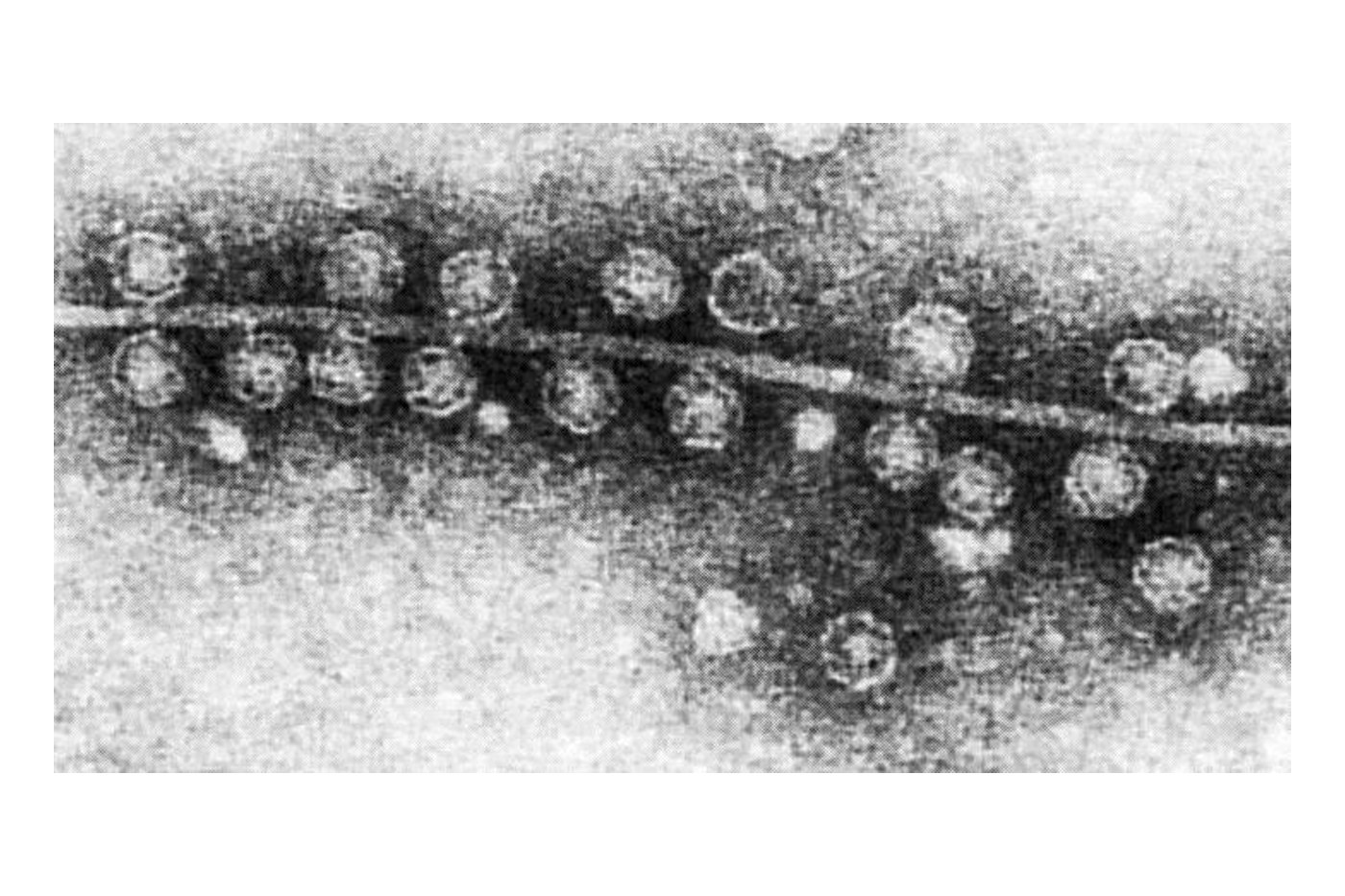
Image: Bacteriophage Qβ attached to the sex pilus of E. coli. Dr Graham Beards, CC BY-SA 3.0, via Wikimedia Commons.
Comments