Neurons do not come back. That single fact sets the ceiling on recovery from stroke, trauma and neurodegeneration, and it is why one line of regenerative research has spent a decade asking whether the brain's other cells could be persuaded to become neurons in place. Glial cells divide readily, sit everywhere in the tissue and, under the right single transcription factor, have been reported to switch lineage outright. Among the most striking of those reports was that microglia, the brain's resident immune cells, could be turned into neurons by a factor called NeuroD1, with measurable improvement in recovery after injury.
A group at Fudan University set out to test that claim with methods designed to remove the main way it could be an artifact, and concluded it does not hold. Across genetic lineage tracing, repeated live imaging of the same cells and single-cell sequencing, microglia forced to express NeuroD1 stayed microglia. What NeuroD1 did instead was kill them.
Why it matters: Glia-to-neuron reprogramming is being developed as a treatment strategy, and the strength of the preclinical evidence determines whether it reaches patients. A negative result produced with better controls than the original is worth more here than another positive one, because the failure mode being ruled out is a labelling error that would look exactly like success.
The study, by Li et al. at Fudan University in Shanghai, appears in eLife. All of it was done in mice.
The artifact the design was built to exclude
Earlier work delivered NeuroD1 to microglia using viruses, and that is the weak joint. The authors report that the viral tools available for microglia are not clean: they transduce neurons and astrocytes off target, and this held across both lentivirus and adeno-associated virus in serotypes 6, 8 and 9, regardless of whether a Cx3cr1 or a Cd68 myeloid promoter was used. If a virus intended for microglia also lands in a neighbouring neuron, that neuron will carry the label and the factor, and will be counted as a converted microglia. The conversion would be an accounting error.
To cut the virus out, the team bred the system into the animals. Mice carrying an inducible Cre driver in microglia, under either the Cx3cr1 or the Tmem119 promoter, were crossed with a line that switches on NeuroD1 together with a green fluorescent reporter. A drug then activates the system, so every labelled cell is one that was a microglia at the moment of labelling, with no vector to stray.
Labelled cells kept the shape of microglia, with the finely branched processes and small cell bodies characteristic of the type. Sorting them and sequencing their transcriptomes returned no neuronal cluster, under normal conditions or after injury. They continued to express microglial genes including P2ry12, Hexb and Tmem119, and did not express neuronal markers such as Rbfox3 and Tubb3. The authors' summary is flat: All observations across these methods revealed that NeuroD1-expressing cells retained their microglia identity and cannot convert into neurons.
The cells disappear, and that matters
One objection to a negative result like this is that a converting cell might shut off the reporter partway and vanish from the count. Two-photon imaging answers that by following individual cells through the skull: the same labelled cells were imaged every four days from day 18 to day 30, and rather than transforming, they progressively disappeared.
The reason was cell death. The proportion of reporter-positive cells that were also positive for a marker of apoptosis rose from roughly 0.01% in control animals to 1.7% at day 18 in the NeuroD1 animals. As the authors put it, sustained expression of NeuroD1 facilitated microglia apoptosis in vivo. That reframes the original claim in a specific way. A factor that kills the cell it is placed in is not a reprogramming factor that needs optimising; the cells are leaving the experiment rather than changing identity.
The functional test agreed. After a moderate traumatic brain injury to the motor cortex, mice expressing NeuroD1 in microglia performed no better than controls on grip strength or on the rotarod. If new neurons were being made in useful numbers, that is where it should have shown.
What the study can't say yet
This is a bounded negative. Conversion was tracked over a defined window of weeks, and a window cannot exclude a process slower than itself, particularly one that might need a longer repair phase after injury than the experiment allowed. The claim the data supports is that NeuroD1 does not convert microglia into neurons on the timescales and in the conditions tested, which the authors state as evidence that our findings provide strong evidence that NeuroD1 alone is not sufficient to induce microglia-to-neuron conversion, with the word alone doing real work.
The result is also specific. It concerns one factor in one cell type in mice, and says nothing about whether astrocytes or other glia can be reprogrammed, which is a separate and larger literature. And because the forced expression killed the microglia, the experiment cannot fully separate a cell that will not convert from a cell that did not live long enough to try.
Quick questions
Does this kill the idea of brain repair by reprogramming? No. It removes one specific route, microglia to neurons via NeuroD1, and leaves the broader approach untouched. Its wider contribution is methodological: a negative result showing that viral labelling can manufacture the appearance of conversion.
Why trust this over the earlier positive studies? Because of what the design excludes rather than what it finds. Virus-free labelling cannot mislabel a neighbouring neuron, and following the same cells over time catches the disappearance that a snapshot would miss.
What is the one-line takeaway? Microglia made to express NeuroD1 stayed microglia and then died rather than becoming neurons, and the brain-injury recovery previously attributed to the conversion did not appear, though the tested window cannot rule out something slower.
Li et al. "In vivo virus-free lineage tracing and live imaging reveal that NeuroD1 does not reprogram microglia into neurons." eLife, 2026. doi.org/10.7554/eLife.112083
PubMed PMID: 42886204. Full text: PMC13675009.
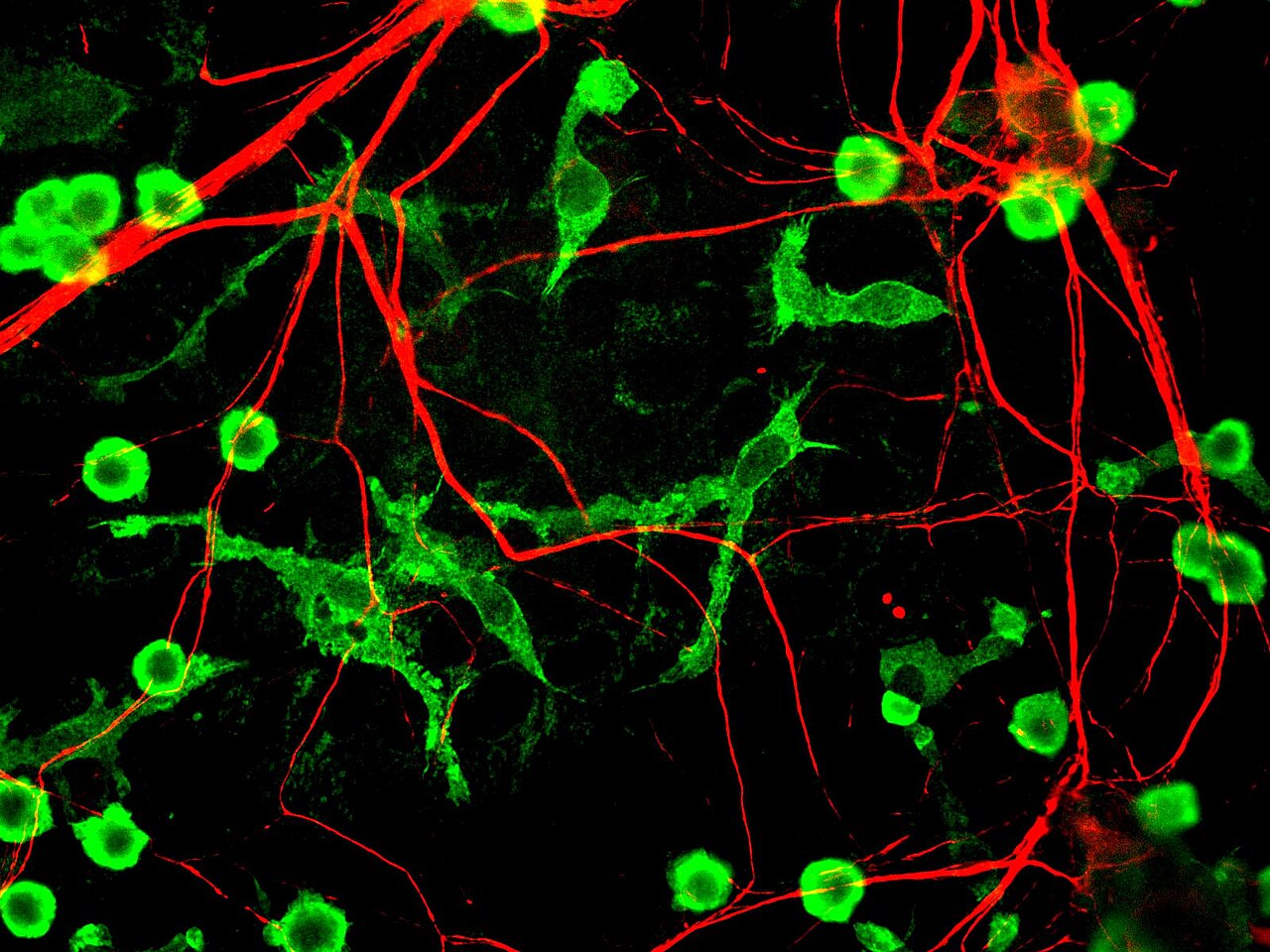
Image: microglia and neurons. GerryShaw, CC BY-SA 3.0, via Wikimedia Commons.
Comments