Parkinson's disease is treated as a dopamine problem because its most recognizable symptoms are. Tremor, rigidity and slowness respond to levodopa, and when the drug stops working well enough, deep brain stimulation of the subthalamic nucleus often restores some of the benefit. The axial symptoms are the exception. Postural instability and the gait disturbance that produces freezing and falls respond poorly to both, which is a clue that they are not purely a dopaminergic failure.
A team at University Hospital Wuerzburg has been pursuing a different target: the vestibular nucleus complex in the brainstem, the relay that turns signals from the inner ear into postural control. Working in mice, they mapped where its excitatory neurons project, then activated those neurons optogenetically in a Parkinson's model and measured what happened to gait. Stimulation at threshold intensities restored more naturalistic walking patterns.
Why it matters: Falls are among the strongest determinants of disability and mortality in Parkinson's, and they are driven by exactly the symptoms current treatment addresses least. A target outside the dopaminergic system is worth mapping carefully even if the eventual therapy looks nothing like this experiment.
Why axial symptoms are a separate problem
The clinical picture that motivates this is specific. Levodopa reliably improves bradykinesia and rigidity, and subthalamic deep brain stimulation extends that benefit when the drug response becomes unreliable. Neither does much for postural instability, and freezing of gait can worsen under stimulation in some patients. That dissociation is the central observation: symptoms sharing a diagnosis do not share a mechanism, and treating the disease as uniformly dopaminergic leaves the most dangerous part of it untreated.
As Hartig and colleagues report in Nature Communications, the vestibular system is a reasonable place to look for the missing circuit. It carries head position and acceleration signals that postural control depends on, it degrades in Parkinson's, and unlike the basal ganglia it can be reached from outside the skull with surface electrodes. What has been missing is a map of how it talks to the motor system, which is what this study supplies.
Where the vestibular nuclei actually connect
The anatomy is the more durable contribution. Tracing Vglut2-defined excitatory neurons revealed extensive bilateral projections into precisely the circuitry Parkinson's disrupts: the thalamus, and within it the centromedian-parafascicular complex, alongside subthalamic territory including the parasubthalamic nucleus and zona incerta, plus targets in the midbrain and caudal medulla. Input runs back from sensorimotor cortex, brainstem, subthalamus and, as expected, cerebellum.
That matters because the centromedian-parafascicular complex and the zona incerta are not incidental structures. They sit inside the basal ganglia loops that deep brain stimulation targets, which means the vestibular nuclei are wired into the same motor machinery rather than running alongside it. The team confirmed the connections were functional rather than merely anatomical by showing that optogenetic activation raised cFos activity in those downstream targets.
Dose is the whole experiment
Vestibular stimulation has an obvious failure mode: push it hard and you induce the sensation of spinning, which degrades balance rather than improving it. The design turns on avoiding that. Stimulation was delivered at sub-symptomatic and threshold-level intensities, deliberately below what produces overt vestibular symptoms, mirroring how non-invasive vestibular neuromodulation is dosed in people.
Within that window, unbiased pose and motion analysis showed increased behavioural modularity and more locomotion, and in the Parkinson's model the same stimulation favoured naturalistic gait patterns through improved motor coordination. Above the window, the effects blended into the disorganized posturolocomotor changes you would expect from overdriving a balance system.
What the study can't say yet
The authors are unusually careful about what their own result means, and the caveat is worth quoting rather than paraphrasing. They note that the apparently improved stability during walking in our mice might come from improving vestibular contributions to balance, which is the effect with the best human evidence in parkinsonian states, rather than from improving gait itself. Better balance and better gait look similar when what you measure is walking, and the study cannot separate them.
The anatomical tracing was also done in healthy mice, so any disease-related remodelling of vestibular projections in the parkinsonian brain is invisible here. That is a real gap, since the circuit being stimulated in the disease model is assumed rather than shown to match the one that was mapped. And optogenetic activation of a genetically defined neuron population is not what a clinical device does. Non-invasive vestibular stimulation in humans is far less selective, which is part of why, as the authors observe, clinical trials of it have produced mixed results.
A mouse model of Parkinson's is finally a model of the motor phenotype, not of the disease. It does not reproduce the decades-long progressive neurodegeneration in which axial symptoms emerge, and gait restored in a mouse over minutes says nothing about durability.
Quick questions
Could this become a treatment? Not directly. Non-invasive vestibular stimulation already exists and has performed inconsistently in trials; this work explains the circuit it may act through and suggests dose is critical, which is a step toward testing it properly rather than a therapy.
Why target balance rather than dopamine? Because the symptoms that cause falls respond poorly to dopamine replacement and to deep brain stimulation, implying they depend on circuits those treatments do not reach.
What's the one-line takeaway? Excitatory vestibular nucleus neurons project straight into the thalamic and subthalamic hubs Parkinson's disrupts, and stimulating them below the threshold for dizziness restored more natural gait in parkinsonian mice, though the authors caution the gain may be balance rather than gait.
Hartig et al. "Vestibular nucleus stimulation for ameliorating locomotor dynamics in a Parkinsonian mouse model." Nature Communications, 2026;17(1). doi.org/10.1038/s41467-026-76183-2
PubMed PMID: 42552316.
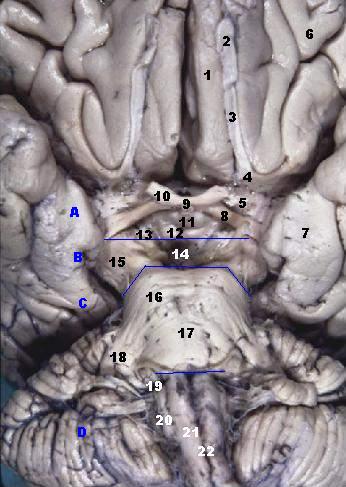
Image: Human brainstem, anterior view, John A. Beal, CC BY 2.5, via Wikimedia Commons.
Comments