
Plant breeding treats disease resistance as something to maximise. Find a resistance gene, move it into a crop, and the stronger the response it produces the better. The trouble is that a gene which stops a pathogen completely also applies the maximum possible selection pressure on that pathogen to evolve around it, and for potato late blight this has happened again and again. Most resistance genes introduced from wild relatives have been defeated within years.
One has not. The R8 gene, taken from the wild species Solanum demissum, has maintained its efficacy in the field for nearly a century and sits in durably resistant varieties grown in Europe, the United States and China. What makes that strange is that R8 is unremarkable in structure, a standard member of the NLR family that produces the same kind of immune receptor as the genes that failed. The durability has to come from somewhere other than the protein.
Why it matters: Late blight caused the Irish famine of the 1840s and remains the most damaging disease of potatoes worldwide. A century of durable resistance is the outcome breeding wants and rarely achieves, so understanding why this one lasted is worth more than another gene that works for five years.
A team at Huazhong Agricultural University, with collaborators at the University of Dundee and the James Hutton Institute, reports as Nie et al. in Science Advances that R8 comes with a brake, and that the brake is built from its own relatives.
Genes that only work by getting in the way
Sitting near R8 in the genome are sequences known as resistance gene analogs, close relatives that look like immune receptor genes. These R8 gene analogs lack independent resistance functions. On their own they protect against nothing. What they do is interfere with R8.
They interfere in two places. They disturb how R8 recognises Avr8, the protein the pathogen delivers into plant cells and which R8 exists to detect. And they disrupt NRC2, a helper protein that R8 depends on to convert recognition into a response, preventing it from assembling into the oligomers it must form and from associating properly with the cell membrane. Push these analogs to high levels by stable overexpression and R8 resistance breaks down, in potato and in the laboratory relative Nicotiana benthamiana alike.
The interpretation the authors offer inverts the usual breeding logic. We propose that this endogenous regulation balances the intensity of R8 -mediated immunity, likely reducing selection pressure on the pathogen population and prolonging resistance durability. On this reading R8 has lasted a century not despite being held back but because of it. A resistance that stops the pathogen outright rewards any mutant that escapes detection, and that mutant sweeps. A resistance deliberately kept partial leaves the pathogen able to reproduce, so the advantage of escaping is smaller and the selective sweep never gets going.
This also explains a feature of R8 that has long looked like a weakness. Its resistance is quantitative and incomplete rather than absolute, and on this account the incompleteness is the point.
What the study can't say yet
The mechanism and the evolutionary story are established to very different standards, and the gap between them is the main thing to hold onto. That these analogs dampen R8 signalling is shown directly, with a molecular route through Avr8 recognition and NRC2 assembly. That the dampening is why the gene has survived a century of pathogen evolution is a proposal, and the word the authors use is "likely".
Testing it would require something this work does not contain: pathogen populations tracked over time across plants differing in analog dosage, showing that escape mutants arise more slowly where the brake is intact. No such comparison is reported. The durability observation comes from a century of field history, the mechanism from the laboratory, and nothing yet links them causally.
The experimental tool also runs the wrong way. Stable overexpression pushes analog levels far above normal and breaks resistance, which shows that too much brake is enough to defeat R8. It does not show that the natural amount is tuned to an optimum, which is the claim the durability argument actually needs.
Much of the molecular dissection was done in Nicotiana benthamiana, a tobacco relative used because it is easy to work in. It is not potato, and NLR signalling is notoriously sensitive to genetic background. The finding was confirmed in potato for the overexpression result, which is the important one, though the finer mechanistic steps rest partly on the model.
A practical caution follows for anyone tempted to act on this. Removing the brake to strengthen R8 would be the obvious move and is precisely what the hypothesis warns against, since a stronger R8 would restore the selection pressure that defeated every other resistance gene. That is an argument against a breeding strategy, not evidence for one, and it rests on a mechanism whose evolutionary consequences remain untested.
Quick questions
What is an NLR protein? A plant immune receptor that detects molecules a pathogen injects into the cell and triggers a defence response, often local cell death. Most race-specific resistance genes in crops encode one.
Why would weaker resistance last longer? Because evolution responds to pressure. A gene that blocks a pathogen completely makes any escape mutant enormously advantaged, so escape spreads fast. Partial resistance leaves the pathogen viable and the advantage of escaping smaller.
What's the one-line takeaway? The potato resistance gene that has held for nearly a century comes with nearby relatives that weaken it, and the authors propose this self-imposed brake is what stopped the pathogen from being forced to evolve around it.
Nie J, Liu L, Qi Y, et al. "A built-in brake for plant immunity: Resistance (R) protein-mediated immunity is fine-tuned by R gene analogs." Science Advances, 2026;12(38):eaeh7029. doi.org/10.1126/sciadv.aeh7029
PubMed PMID: 42748256.
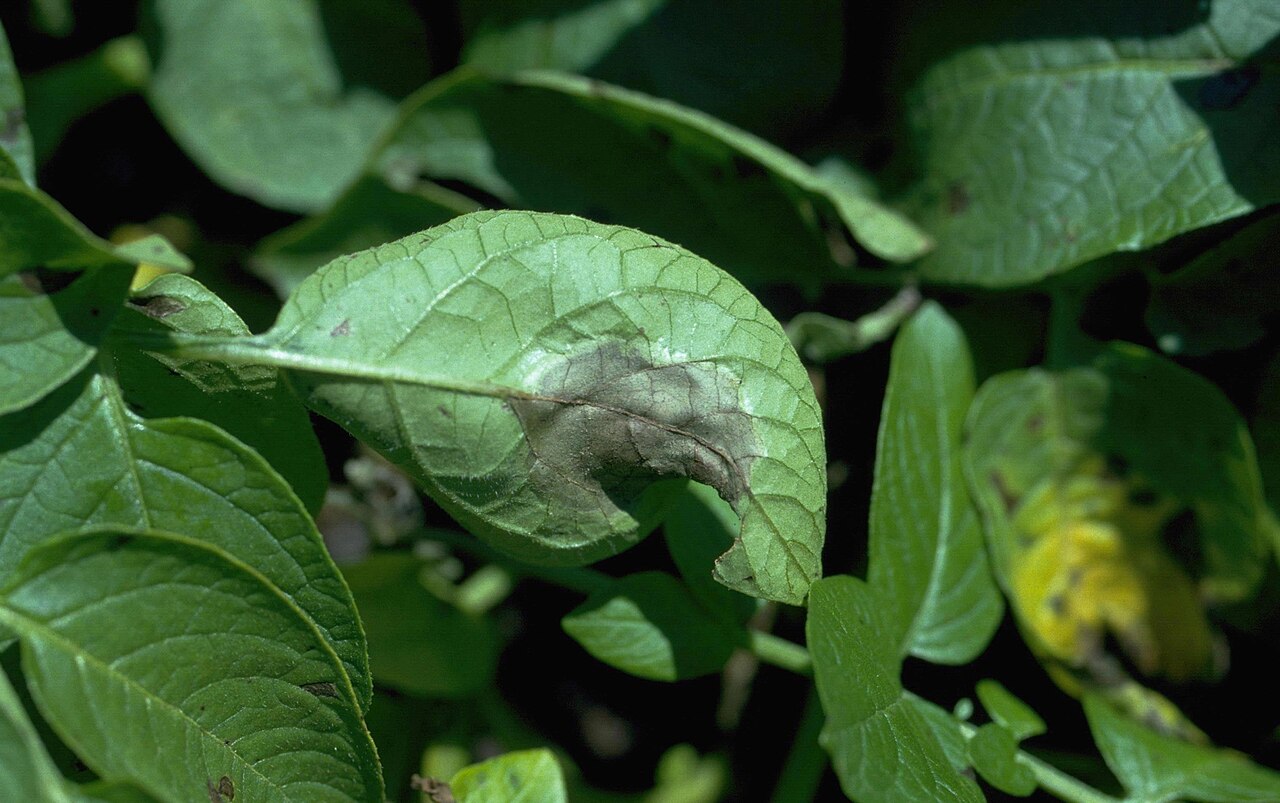
Image: late blight on potato leaf. Howard F. Schwartz, Colorado State University, CC BY 3.0 US, via Wikimedia Commons.
Comments