Centromeres are the last part of most genomes to be assembled, and rye has been a hard case even by that standard. Its genome runs to roughly seven billion bases, more than twice the human figure, and the great majority of it is repetitive. Sequencing produces millions of near-identical fragments, and software asked to reconstruct a chromosome from them cannot tell one copy of a repeat from the next, so centromeres come out as gaps.
A consortium led from the Leibniz Institute of Plant Genetics and Crop Plant Research has now closed them. Combining four sequencing technologies on the inbred line Lo7, they produced an assembly of 6.76 gigabases with a contig N50 of 128 megabases and, for the first time, all seven rye centromeres assembled through. What the finished centromeres contain is the more interesting result.
Why it matters: Rye is grown for tolerance to cold and poor soils, and is crossed into wheat for exactly those traits. A reference genome that resolves its most repetitive regions is a working tool for that breeding, and the centromeres turn out not to be inert filler.
Why four technologies rather than one
Each method used here fails differently, which is the reason to combine them. PacBio HiFi reads are long and highly accurate but not long enough to span the largest repeat arrays. Oxford Nanopore reads run longer at lower per-base accuracy. Hi-C does not read sequence at all; it measures which pieces of DNA sit near each other in the folded nucleus, which orders and orients contigs that sequence alone cannot place. BioNano optical mapping supplies a physical scaffold to check that ordering against.
The value shows in the corrections rather than the additions. The new assembly fixes misorientations present in its predecessor, meaning stretches of the previous reference were arranged backwards. Rye-specific satellite repeat families were reconstructed as continuous blocks rather than collapsed, and their chromosomal positions were checked independently by fluorescence in situ hybridization, an old technique that puts a physical label on a real chromosome. Confirming a computational assembly by looking at the chromosome under a microscope is the right kind of check.
What the centromeres contain
Centromeres in cereals are built largely from retrotransposons, sequences that copy themselves through an RNA intermediate and paste the copy elsewhere. Most are ancient and inactive, molecular fossils. In rye, two families stand out as both abundant and recently active, which means they have been inserting new copies on a timescale short enough to still be legible in the sequence.
The comparison that gives this weight is wheat, rye's close relative and the crop it is bred into. Wheat's centromeric retrotransposons do not show the same recent activity. Two closely related grasses, then, differ in whether their centromeres are still being actively rebuilt, which is a real difference in genome dynamics rather than an artefact of how well each was assembled.
What is still missing, measured
The paper is careful about its own limits in a way worth noting. The assembly is described as near-complete but explicitly not telomere-to-telomere. Subtelomeric regions on two chromosome arms remain unfinished and contig gaps persist, both caused by the same repetitive sequence that made the project difficult.
Rather than leave that qualitative, the team measured the genome independently by flow cytometry, which estimates DNA content physically and owes nothing to assembly. That gave 7.06 gigabases against the 6.76 assembled, a shortfall of roughly 300 megabases. As Chen and colleagues report in Nature Communications, this suggests that a substantial proportion of the assembly-size discrepancy is attributable to unresolved or collapsed repeat-rich genomic regions. Roughly 4 percent of the genome is still unaccounted for, and they say where it probably went.
What the study can't say yet
This is one inbred line. Rye is normally outcrossing and highly heterozygous, and Lo7 was chosen precisely because inbreeding removes the variation that defeats assemblers. A single inbred reference therefore describes one genome rather than the species, and structural variation between rye lines is likely to be substantial in exactly the repetitive regions this work resolved.
Recent activity of the centromeric elements is also inferred from sequence divergence, not observed. Insertions that differ little from each other are read as young because they have had less time to accumulate mutations, which is a sound inference resting on assumptions about mutation rate. No transposition was watched happening. And about 5 percent of the assembly is annotated only as repeat fragment, which the authors suspect are short tandem repeats their tools could not classify, so a portion of what was assembled remains unidentified rather than understood.
Quick questions
Why is rye's genome bigger than a human's? Because of repetitive sequence, chiefly transposable elements that have copied themselves over millions of years. Genome size tracks repeat content far more than gene number.
Why do centromeres resist assembly? Because they consist of long arrays of near-identical repeats, and software reconstructing a chromosome from overlapping fragments cannot tell which copy a given fragment came from.
What's the one-line takeaway? A 6.76-gigabase rye assembly resolved all seven centromeres for the first time and found two retrotransposon families still recently active there, unlike in wheat, with about 300 megabases of repeat-rich sequence still unresolved.
Chen et al. "Unveiling centromeric retrotransposon dynamics through a high-quality rye genome assembly." Nature Communications, 2026;17(1). doi.org/10.1038/s41467-026-76753-4
PubMed PMID: 42603802.
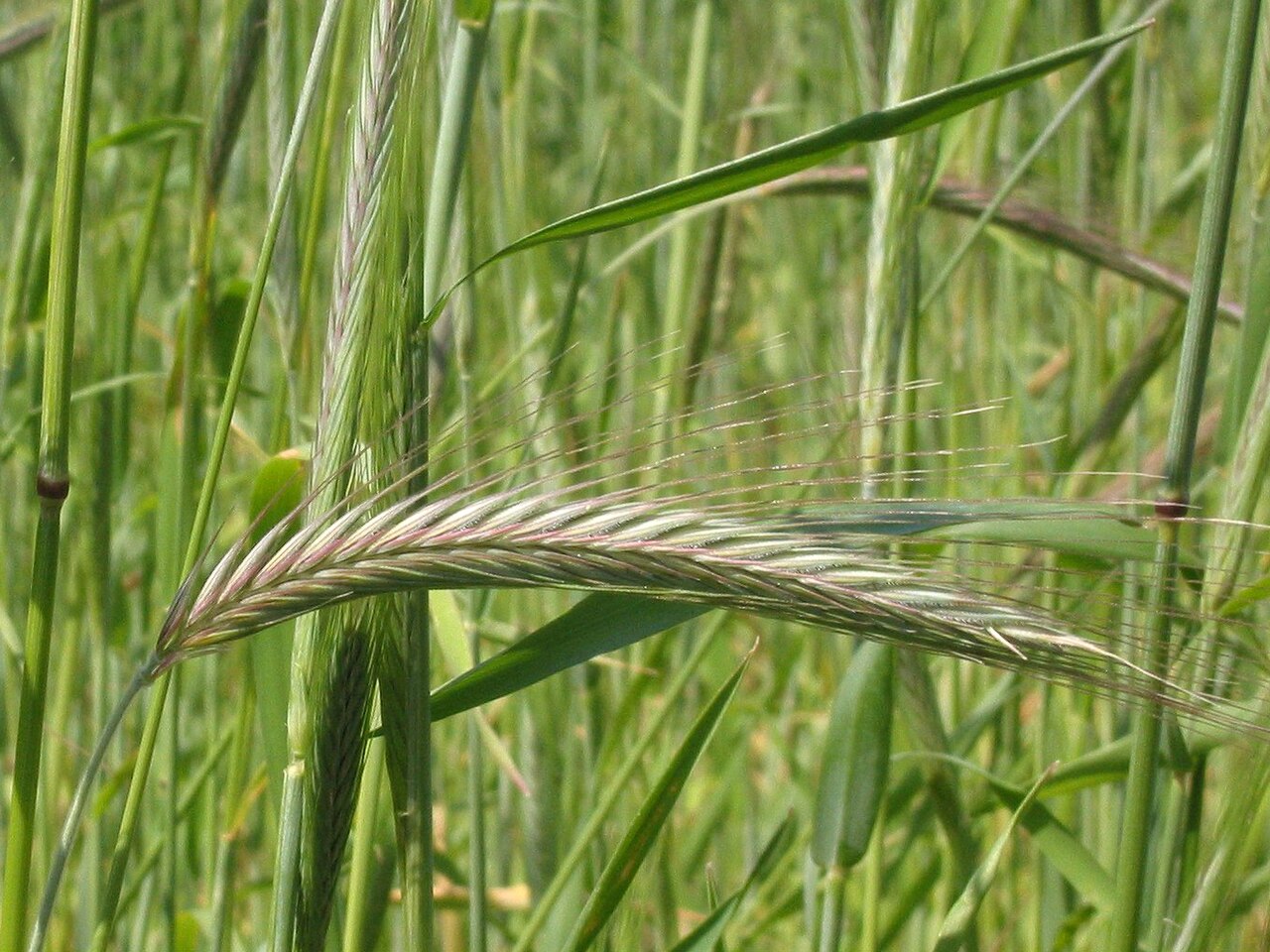
Image: Ear of rye (Secale cereale), Rasbak, CC BY-SA 3.0, via Wikimedia Commons.
Comments