
A root growing through soil is working blind. It has no eyes, no nose, and no way to back up. Every centimetre it commits to is a decision it cannot easily undo, made in the dark, surrounded by rocks, old roots, fungal threads and the slow rot of last season's leaves. Botanists have catalogued the senses it uses to steer: toward water, toward gravity, away from salt, around obstacles it touches. Each of these is a tropism, a growth response that turns an environmental cue into a change of direction, and together they are the closest thing a root has to navigation.
It turns out roots have been using one more, and nobody had named it. Long before a root reaches a patch of decaying plant matter, it swerves. It is not touching the rot, and it is not detecting the microbes directly. It is reading the acid they leave behind, and steering around a hazard it has never made contact with.
Why it matters: Decomposing matter is where soil is richest in nutrients and also where it is most dangerous, thick with the microbes that cause root disease. Knowing that roots actively avoid it, and exactly how they sense it, hands plant breeders a lever on one of agriculture's oldest problems: how a crop's roots find their way through real, messy, living soil.
Writing in Science, Bao et al. at Northwest A&F University, with a collaborator at the Institute of Science and Technology Austria, give the behaviour a name: saprotropism, from the Greek for rotten. As they put it, it is a previously unrecognized growth response that enables roots to actively bend away from decaying plant-derived matter.
The chemistry of a warning sign
The signal begins with fungi. As they break down dead plant material, decomposition releases organic acids, and those acids seep outward into the soil around the decaying patch. The result is a stable pH gradient, a halo of acidity that gets stronger the closer you get to the rot. It is, in effect, a chemical contour map, and it exists at a distance from the hazard itself. That is what lets a root pinpoint decay without ever touching it. The signal is also durable rather than fleeting, which matters for something that grows as slowly as a root tip: a gradient that holds steady for days is one a plant can actually act on.
Reading that map falls to the epidermal cells, the outermost skin of the root. They sense the acidic gradient through what plant biologists call the root meristem growth factor peptide-receptor module, a small signalling protein and the receptor that catches it. The elegant part is what happens next. The root has to convert a fact about the outside world, that one side is more acidic than the other, into a physical action. It does this by making its own internal chemistry lopsided.
How a plant turns a gradient into a turn
The cells redistribute abscisic acid, the hormone plants lean on in hard times, so that it accumulates unevenly across the root tip. That asymmetry is then decoded structurally: it drives a reorganization of the microtubules, the internal scaffolding that determines the direction in which a plant cell stretches. Change the scaffolding on one side and the cells there elongate differently from their neighbours on the other. The tip bends. The root drives around the pothole.
It is worth pausing on how indirect that chain is. An outside pH difference becomes an inside hormone difference, which becomes a change in cellular architecture, which becomes a curve in a growing organ. No brain, no nerves, no muscle. Just chemistry translated, step by step, into a change of course.
What the study can't say yet
This is laboratory work on plant roots in controlled conditions, and the abstract reports no numbers at all, no bend angles, no distances at which a root first reacts, no proportion of roots that successfully avoid a patch. Those details live in the full paper, not in the summary, so the size of the effect is not something to state confidently from here.
The bigger open question is agricultural. Avoiding decay in a dish is not the same as navigating a field, where rotting matter is also the nutrient supply a crop depends on. A root that flees every decomposing leaf would be avoiding its own fertiliser. Presumably real roots strike some balance between the nutrients and the risk, and this work does not claim to have measured where that line sits, or whether breeding for stronger saprotropism would help a harvest or hurt it.
Quick questions
Why would a root avoid decaying matter at all, when rot means nutrients? Because decomposition sites are also crowded with microbes, including the ones that cause root disease. The paper frames these as potentially hostile niches, so a root that keeps its distance is trading some nutrition for safety.
Is the root sensing the microbes themselves? No, and that is the neat part. It reads the organic acids that fungal decomposition releases into the surrounding soil, which is why it can detect the hazard without contact.
What's the one-line takeaway? Roots have a previously unnamed sense that lets them smell rot as acidity and steer around it, translating an outside pH gradient into a hormone imbalance and finally into a physical bend.
Bao et al. "Roots navigate around decay regions by sensing local pH gradients." Science, 2026. doi.org/10.1126/science.adw6568
PubMed PMID: 42424472.
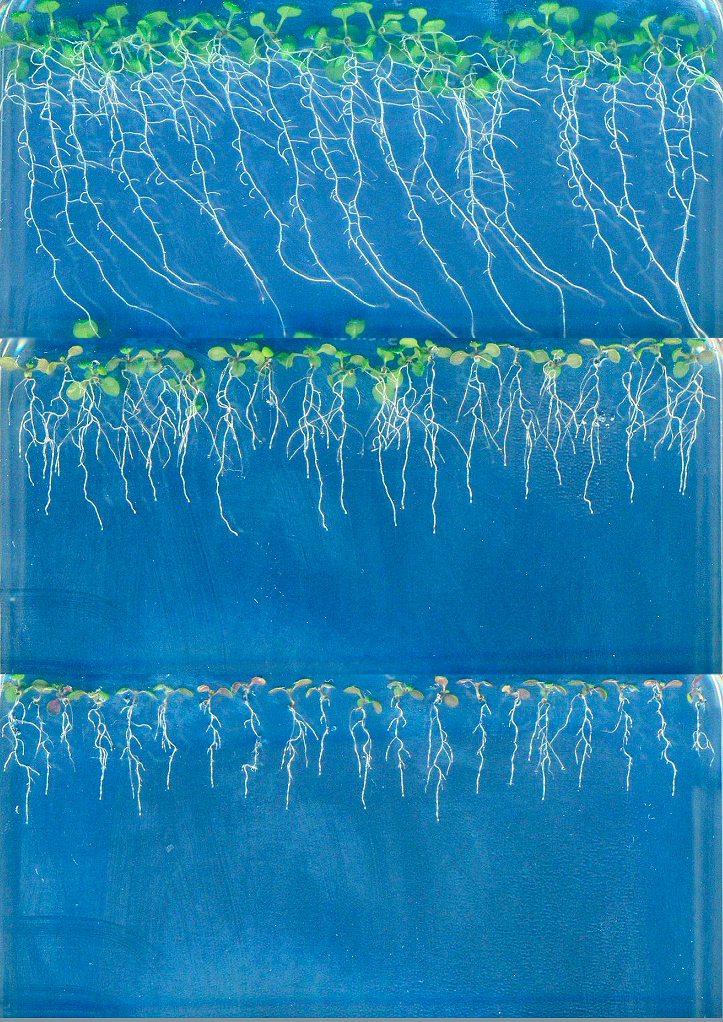
Image: Arabidopsis thaliana roots grown in vitro. Alena Kravchenko, CC BY-SA 4.0, via Wikimedia Commons.
Comments