Checkpoint inhibitors reset the odds in melanoma and lung cancer by releasing brakes on T cells that are already inside a tumour. Prostate cancer has been the standing exception. Its tumours carry few mutations, admit few T cells and recruit immune cells that actively suppress attack, a combination described in the field as immunologically cold. Trials of drugs targeting PD-1, PD-L1 and CTLA-4 have produced modest responses at best, and the question has been whether a stronger push on the same levers would change that.
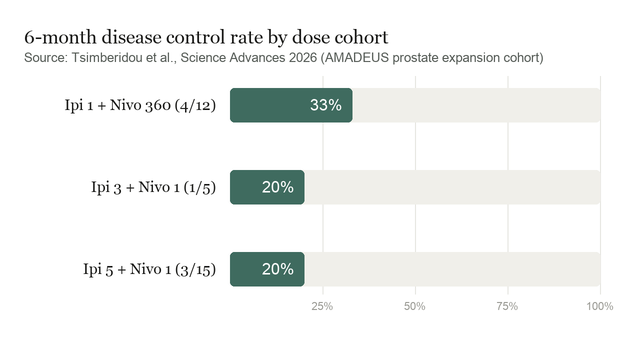
An expansion cohort of the AMADEUS trial has now tested the stronger push directly, by escalating the dose of the CTLA-4 antibody ipilimumab alongside the PD-1 antibody nivolumab in 32 men whose metastatic prostate cancer had stopped responding to hormone therapy. More ipilimumab did not help. Disease control at six months was 33% in the lowest-dose group, 4 patients of 12, against 20% in each of the two higher-dose groups.
Why it matters: Metastatic castration-resistant prostate cancer has a median life expectancy of about two years and no curative option, and dose escalation is the obvious thing to try when a drug underperforms. The finding that the gentlest regimen did as well as the harshest, with fewer people stopping treatment because of side effects, is the kind of negative result that changes which doses get taken forward.
The study, by Tsimberidou et al. at the University of Texas MD Anderson Cancer Center and the Parker Institute for Cancer Immunotherapy, appears in Science Advances. Bristol Myers Squibb, which makes both drugs, part-funded the work and has an author on the paper.
What escalating the dose actually bought
The trial's two co-primary endpoints were disease control at six months and the change in the proportion of CD8 T cells inside the tumour, the cells the drugs are meant to mobilise. Across all cohorts that proportion rose by a median of 5.0%, so the drugs were doing something measurable to the tumour's immune content. What the extra ipilimumab did not do was convert that into better control of the cancer.
Toxicity did not scale neatly either, which is the paper's more surprising observation. Every patient had at least one adverse event, most often fatigue at 40.6% and rash at 34.4%. Severe events, grade 3 or 4, occurred in 75.0% of the lowest-dose cohort, 60.0% of the middle one and 66.7% of the highest, so the overall rate did not climb with dose. Two deaths, from cardio-respiratory arrest and myocardial infarction, were judged unrelated to treatment by the investigator.
The difference showed up instead in who could stay on the drug. Nine patients, 28.1%, stopped because of an adverse event, and of the seven discontinuations judged treatment-related, five were in the highest-dose group. All three discontinuations caused by immune-mediated colitis were in that group. The authors' summary is that Although higher ipilimumab doses were tolerable, the lowest-dose combination matched them on disease control and immune activation with a better safety profile.
A signature that marks the patients it will not help
The biomarker arm is where the paper reaches past this one trial. Patients whose disease progressed early carried higher baseline expression of a gene signature associated with TREM2, a receptor on suppressive macrophages. The authors report that Early disease progression was associated with increased expression of a TREM2-associated myeloid gene signature, and that the same signature was significantly enriched in two independent prostate cancer datasets, which is what lifts it above a pattern found in 32 people.
That points at a specific reason these drugs underperform in prostate cancer. If the obstacle is a suppressive myeloid environment present before treatment starts, then releasing the brakes on T cells cannot be enough on its own, and the proposed route forward is combining checkpoint drugs with agents that target those macrophages. None of that is tested here.
What the study can't say yet
The cohorts are too small to compare, and the authors say so in terms that should be quoted rather than paraphrased: This study was not powered for direct comparisons between treatment cohorts, and all such comparisons should be interpretated as exploratory. The middle group contained five patients, so its 20% is one man. Reading a dose-response relationship off three numbers with denominators of 12, 5 and 15 is not something the data supports.
Several other limits compound that. Patients were not randomly assigned to the cohorts, matched tumour samples from before and during treatment were limited, the cohorts enrolled at different times, and the nivolumab dose varied between them, so the comparison is not clean even setting size aside. A supporting analysis of immune cell composition found no statistically significant differences, which the authors attribute to the limits of bulk gene-expression data for resolving individual cell types.
Quick questions
Does this mean immunotherapy works in prostate cancer? It means a subset of heavily pretreated men had durable disease control, and that the drugs measurably changed the tumour's immune content. It does not establish benefit against any comparator, because there was no control group.
Why would a lower dose be as good? Unclear from this data. The immune activation and the disease control were similar, so the extra drug may simply have exceeded what the target can respond to while still adding gut toxicity.
What is the one-line takeaway? Raising the ipilimumab dose added side effects without adding benefit in 32 men with castration-resistant prostate cancer, and a TREM2-linked myeloid signature present before treatment marked those who progressed early, on cohorts far too small to compare and explicitly labelled exploratory.
Tsimberidou et al. "Immune biomarkers of response and resistance to ipilimumab and nivolumab in metastatic castration-resistant prostate cancer." Science Advances, 2026. doi.org/10.1126/sciadv.aee8730
PubMed PMID: 42873849. Full text: PMC13666023. Trial registration: NCT03651271.
Chart: BioDaily, from the disease control rates reported in the paper.
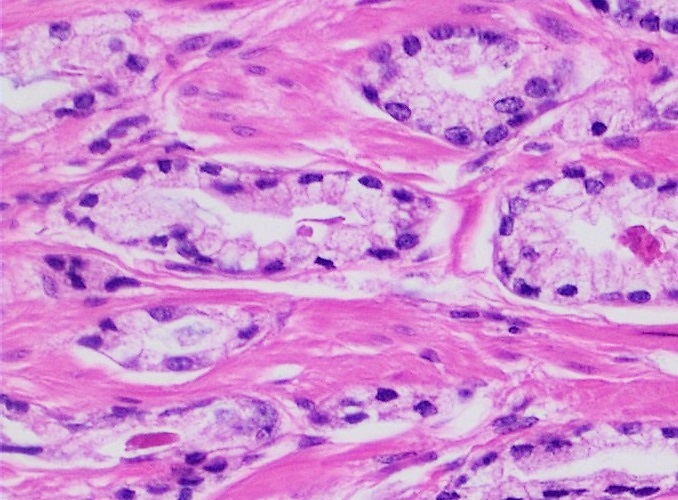
Image: prostate adenocarcinoma, acinar pattern. Mikael Haggstrom, CC0, via Wikimedia Commons.
Comments