The obstacle to a blood test for Parkinson's disease is not that the culprit protein is absent from blood. It is that almost all of it comes from the wrong place. Alpha-synuclein, the protein that misfolds and clumps into the Lewy bodies that define the disease, is abundant in circulation, but roughly 95% of it is made by red blood cells. Any brain-derived signal sits under that background, and even mild hemolysis during a blood draw can swamp it.
A team at KAUST and the University of Oxford tried to sidestep the background by measuring only alpha-synuclein carried inside extracellular vesicles that display L1CAM, a surface marker used to enrich for vesicles shed by neurons. They then read three forms of the protein with an organic electrochemical transistor sensitive enough to detect attomolar quantities in buffer. In 57 blinded serum samples, the device's pre-set rules assigned 50 to the correct group, an accuracy of 87.7%, with 86.8% sensitivity and 89.5% specificity.
Why it matters: Parkinson's is usually diagnosed from motor symptoms, years after neurons have begun to die, so a cheap blood test that flags the disease in its prodromal phase would open a window for treatments that may only work early.
The study, by Chang et al. at King Abdullah University of Science and Technology and the University of Oxford, appeared in Science Advances and drew its serum from the Oxford Discovery cohort, recruited between 2013 and 2024.
How a transistor amplifies a handful of molecules
An organic electrochemical transistor uses a polymer channel whose current depends on ions taken up from the surrounding liquid, controlled by a gate electrode. Here each gold gate carried an antibody for one target: total alpha-synuclein, the aggregated form, or the form phosphorylated at serine 129 (pSer129), a chemical tag strongly associated with pathological deposits. A fourth gate carried an antibody against GFP, a jellyfish protein absent from human serum, as a negative control. When the target binds, the gate's surface potential and capacitance shift, and the transistor's high transconductance turns that small change into a large change in current. Against purified standards, the limits of detection were 457 attomolar for total alpha-synuclein, 12.7 attomolar for aggregates, and 11.3 attomolar for pSer129. The team's previous electrochemiluminescence assay, by comparison, left most clinical samples below its detection range for pSer129.
One result deserves attention. With patient vesicles, the gate capacitance moved in the opposite direction from what purified protein produced. The authors attribute this to aggregation-prone cargo forming a thicker, ion-permeable layer, and support it with zeta-potential measurements (about −6 mV for the clinical sample against −20 to −15 mV for the commercial standards). Plausible, but it means calibration curves built on purified protein do not translate directly into concentrations in patient material.
What the three readouts showed
The cohort contained 22 healthy controls, 25 people with isolated REM sleep behavior disorder (iRBD), and 19 with diagnosed Parkinson's. iRBD, in which people act out their dreams, is one of the strongest known predictors of synucleinopathy; up to 80% of patients convert to Parkinson's or a related disorder within 12 years. Aggregated alpha-synuclein rose in both iRBD and Parkinson's, which makes it a candidate marker of synucleinopathy in general. The pSer129 signal stayed near control levels in iRBD and rose only in diagnosed Parkinson's, which is the study's most interesting biological observation: it suggests phosphorylated protein in neuronal vesicles may track later disease rather than the prodromal stage.

In the blinded test, 15 of 16 Parkinson's samples, 18 of 22 iRBD samples, and 17 of 19 controls met the classification criteria. For single markers, the reported area under the ROC curve was 0.98 for separating Parkinson's from controls and 0.96 for pSer129 separating Parkinson's from iRBD.
Reading the numbers carefully
Several details temper these figures. First, the abstract's headline, 90.9% accuracy with 88.6% sensitivity and 90.9% specificity, is higher than the blinded result reported in the main text, and the paper does not make the relationship between the two figures obvious. The blinded 87.7% is the number to anchor on. Second, the classification rules were described as defined a priori, but "based on our preliminary clinical testing," and the discussion says they drew on the team's pilot results. If those pilot samples came from the same cohort, the thresholds were not set independently of the data they were later judged on, which tends to inflate accuracy.
Third, the small samples show in the confidence intervals: two of them extend to 1.02, above the maximum possible AUC of 1, which signals a normal approximation stretched past what roughly 20 samples per group can support. The neural-network classifier's 90% accuracy comes from a stratified 20% hold-out, which is roughly a dozen samples, so a single misclassification moves the figure by about eight percentage points. Fourth, the groups differ in composition: one woman among 19 Parkinson's patients and one among 25 iRBD patients, against six among 22 controls, and the iRBD group is about five years older on average. Neither difference is adjusted for. Finally, the authors report sensor-to-sensor coefficients of variation of up to 40% near the detection limit, which they attribute to hand fabrication, and the transistor readout correlated only moderately with the established electrochemiluminescence assay (R² = 0.53).
What the study can't say yet
The title speaks of early prediction, but nobody in the iRBD group was followed to see who developed Parkinson's, so the study shows that the device separates groups already defined clinically, not that it forecasts conversion. The cohort included no patients with multiple system atrophy or dementia with Lewy bodies, the other synucleinopathies that iRBD can lead to, so whether the pattern is specific to Parkinson's is untested. The tested population was 57 people from a single cohort. The authors are direct about this: it is important to note that the clinical sample size is small, and further validation of the assay performance and sensitivity is required in a larger independent cohort. Vesicle capture is still done at the bench, so the 40-minute readout is not yet a point-of-care test. The authors declare no competing interests.
Quick questions
Does this detect Parkinson's before symptoms? Not demonstrated. Aggregated protein was elevated in people with iRBD, a high-risk prodromal group, but no one was followed over time.
What's the one-line takeaway? A sensitive transistor assay found phosphorylated alpha-synuclein in neuron-derived blood vesicles that rose only in diagnosed Parkinson's, a promising signal that still needs a larger, independent cohort.
Chang T, Jiang C, Yan S, et al. "Electronic profiling of neuronal extracellular vesicles enables early prediction of Parkinson's disease." Science Advances, 2026. doi.org/10.1126/sciadv.aee4525
PubMed PMID: 42814818.
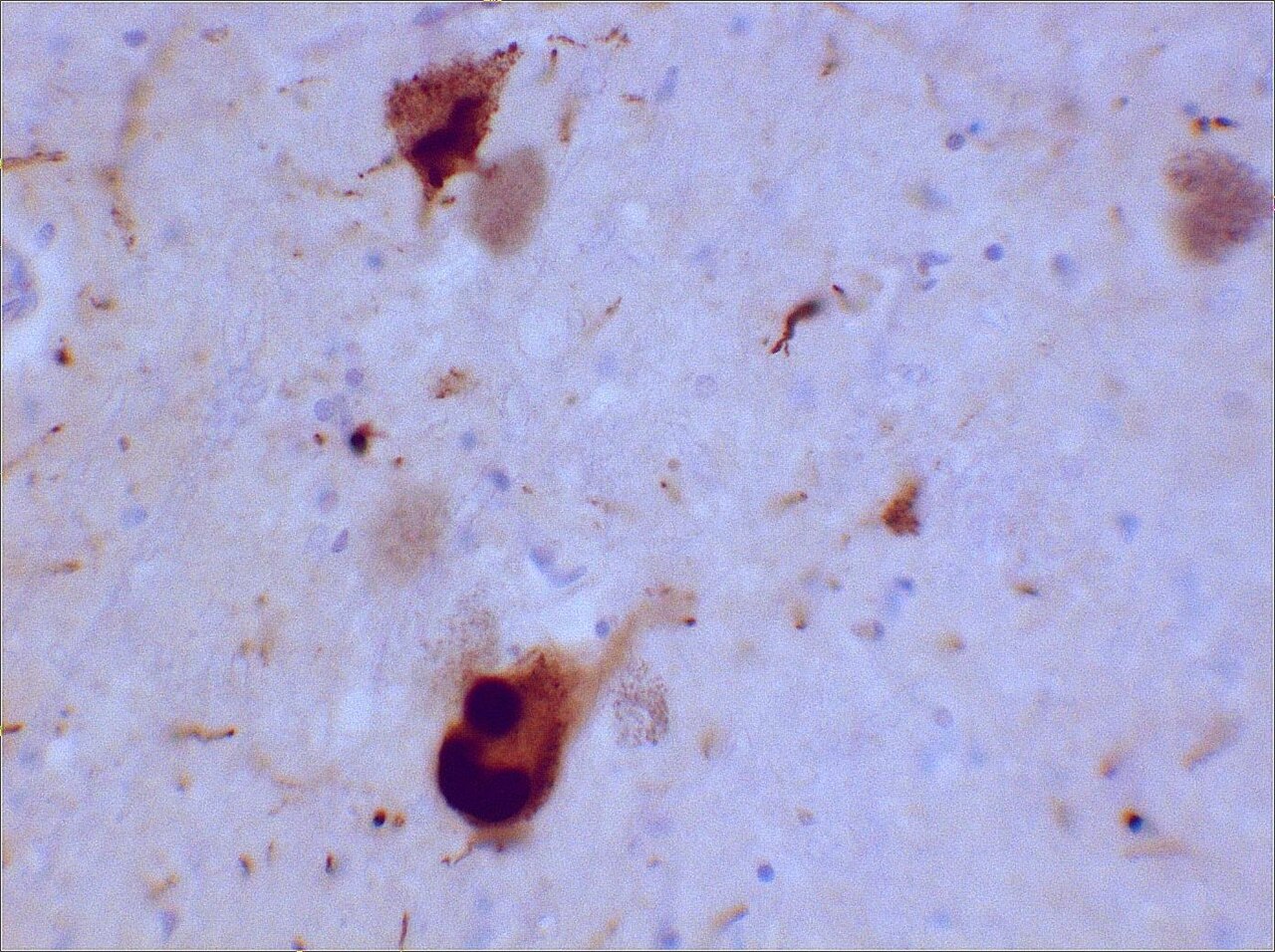
Image: Lewy bodies (alpha-synuclein inclusions) in brain tissue. Suraj Rajan, CC BY-SA 3.0, via Wikimedia Commons.
Comments