
The limiting factor in treating a bloodstream infection in most of the world is not the absence of a good test; it is the absence of a laboratory that can run one. The standard workflow takes two to seven days and needs a mass spectrometer or a trained microbiologist working through biochemical tubes. The fast molecular panels that well-funded hospitals use come with proprietary cartridges and six-figure instruments. In some regions, fewer than 1% of clinical laboratories can test for antibiotic resistance at all, which leaves clinicians prescribing broad-spectrum drugs by syndrome and accelerating resistance in exactly the places already worst affected.
A team at the Broad Institute and Massachusetts General Hospital has built a candidate answer that runs on a heat block and a basic fluorometer. Their assay, BADLOCK, uses CRISPR-Cas13a to name nine Gram-negative bacterial species and four resistance genes directly from a blood culture that has already turned positive, in a single-tube reaction with off-the-shelf reagents. Across 2224 individual reactions it made the right call 97.6% of the time. That number deserves scrutiny, and the authors supply the means to scrutinise it themselves.
Why it matters: Resistant bacterial infections were linked to an estimated 1.27 million deaths in 2019, a figure projected to pass eight million associated deaths a year by 2050. Knowing which organism is in a patient's blood, and whether it carries a carbapenemase, changes the antibiotic that same afternoon rather than three days later.
The study, by Roach et al. at the Broad Institute of MIT and Harvard, with collaborators at Massachusetts General Hospital and Brigham and Women's Hospital, appears in Science Advances. It is retrospective throughout: frozen aliquots of 194 consecutive positive blood cultures, 23 banked carbapenem-resistant isolates, and mock urine samples spiked with known bacteria.
How it works, and why the design is cheap
Two layers of specificity stack on top of each other. An isothermal amplification step called recombinase polymerase amplification copies a target region at a constant temperature, removing the need for a thermal cycler. Within that amplified stretch, a Cas13a complex recognises a 28-base-pair RNA target; when it binds, it starts indiscriminately chopping nearby RNA, including synthetic reporter molecules that fluoresce once cut. Signal therefore depends on a sequence match twice over.
The engineering is in the compromises. Combining amplification and detection in one tube required rebuilding the buffer, which ended up running the amplification mix at two-thirds the manufacturer's concentration. Undiluted blood culture gave weak signal, so samples are diluted tenfold. Setup is under ten minutes of hands-on time, the consumables are ordinary pipette tips and plates, and all the enzymes tolerate freeze-drying, so in principle no cold chain is needed. One omission is conspicuous in a paper whose title claims inexpensiveness: it cites a modelling estimate that rapid tests on positive cultures are cost-neutral in lower-income countries at up to about $109, and says its reagent costs fall substantially below that, without ever stating a figure.
The arithmetic of the headline number
Every sample is run against the whole panel, each target in its own well. A sample with one organism therefore generates one true positive and eight straightforward true negatives. Counting at the level of the well, 1746 reactions across the blood-culture cohort were called correctly 97.7% of the time. Counting at the level of the patient, 80.9% of samples matched the clinical laboratory exactly, and another 7.2% caught at least one organism while getting something else wrong.
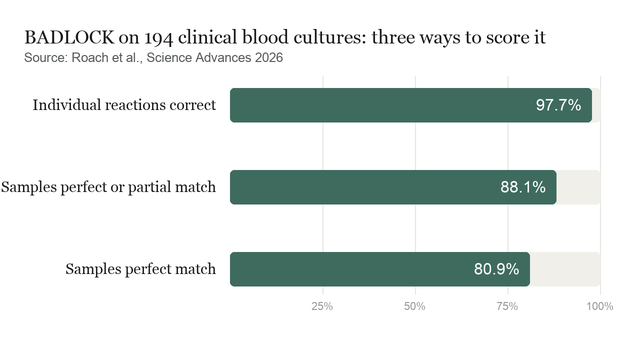
Per-target performance varied more than either summary suggests. Positive percent agreement, the analogue of sensitivity, ranged from 60% to 100% across species, while negative percent agreement stayed between 97.7 and 100%. The weakest link is the most consequential one. Because the amplification reagents are manufactured in a laboratory strain of E. coli, any conserved E. coli target produces false positives, so the team had to aim at a gene carried by only 80 to 90% of pathogenic strains. Detection landed at 84.6%, and E. coli is the commonest cause of Gram-negative bloodstream infection in this cohort and generally. The authors predicted that shortfall in advance and confirmed by PCR that the gene was genuinely absent in 11 of their 12 misses, which is the honest way to report a designed-in weakness.
What the study can't say yet
No patient was treated differently because of this assay, and no one ran it in a low-resource laboratory. The cohort is frozen specimens from one American hospital, and the freeze-thaw effect was not formally tested. Gram-positive organisms, a comparable share of global infection burden, are outside the panel entirely.
Two scoring decisions deserve naming. Discordant results were retested as an internal quality step, and 64% of discrepancies either resolved on a single repeat or traced to the missing E. coli gene. Nine false positives that retested negative were attributed to probable cross-contamination from batched processing. Repeat testing is reasonable laboratory practice, but a test deployed where this one is aimed will often get one run, not two. Separately, the positivity thresholds were re-optimised by a post hoc analysis within this same cohort, which cannot be used to estimate how the tuned thresholds would perform on new samples; the authors say they will apply them in advance next time.
The resistance-gene work is thinner than the species work. Only 46 clinical samples were tested, just one of them carbapenem-resistant, and the carbapenemase results rest largely on banked isolates selected for carrying those genes. The urinary tract infection result, the one culture-free application, used laboratory strains spiked into pooled urine rather than patient samples. On the broader point the authors are plain: This distinction between overall assay concordance and reaction-level accuracy is important in modular diagnostic platforms like BADLOCK, where multiple targets are evaluated independently within a single assay and variability across targets and sample matrices can affect composite results, they write.
Quick questions
Does it replace blood culture? No. It starts from a culture that has already flagged positive. The authors argue direct-from-blood detection remains both technically brutal, at one to ten bacterial cells in 10 millilitres, and economically awkward, since fewer than 10% of blood cultures ever turn positive.
What makes this different from existing rapid panels? Not the targets, which largely overlap with two commercial systems, but the infrastructure. No proprietary cartridge, no microfluidics, no thermal cycler.
What is the one-line takeaway? A CRISPR assay matched a hospital microbiology laboratory on most positive blood cultures using almost no equipment, with the caveat that its most impressive accuracy figure counts wells rather than patients.
Roach et al. "A rapid, inexpensive diagnostic for bacterial pathogen and resistance detection in resource-limited settings." Science Advances, 2026. doi.org/10.1126/sciadv.aeb6630
PubMed PMID: 42826192.
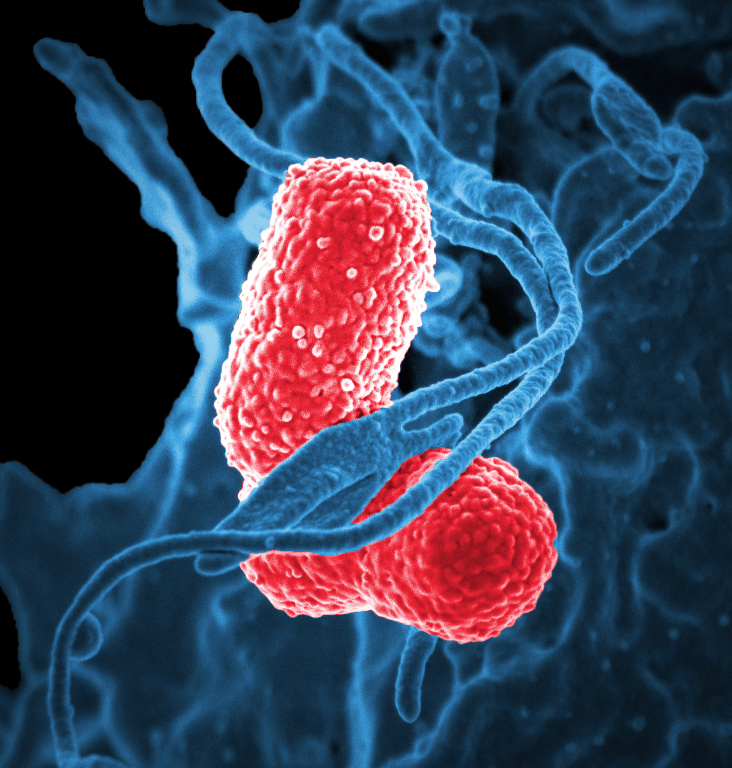
Image: multidrug-resistant Klebsiella pneumoniae and a neutrophil. David Dorward, National Institute of Allergy and Infectious Diseases, public domain, via Wikimedia Commons.
Comments