
The hard question for a blood test that screens for many cancers at once is not whether it can find cancer. It can. The question is whether finding it changes what happens to the people screened. A 142,250-person randomized trial has now reported on the first question, having already answered the second disappointingly.
The NHS-Galleri trial randomized 142,250 people in England, aged 50 to 77, either to usual care or to usual care plus an annual Galleri blood test for three years. Its primary endpoint, a reduction in the number of stage III and IV cancers diagnosed in the screened arm, was not met; that result was reported separately. This paper reports what the test itself did: it flagged about 1 in 100 people, found 937 cancers, and missed most of the cancers in the people it screened.
Why it matters: Multi-cancer blood tests are being weighed for population screening, and these numbers come from exactly that setting: a national health service, a randomized design, three annual rounds.
The analysis was led by Neal et al., with authors at the University of Exeter, Queen Mary University of London, King's College London, the Francis Crick Institute and NHS England, and it was published in Nature Medicine. Several authors are employees of GRAIL Bio UK, the company behind the test.
What the test got right
Positive results came back for 722 of 70,325 people in round one (1.03%), 518 of 64,498 in round two (0.80%) and 561 of 62,323 in round three (0.90%). Positives entered ordinary NHS diagnostic pathways, chosen using the test's prediction of where in the body the "cancer signal origin" lies.
Two numbers stand out. Specificity, the share of people without cancer correctly told they were negative, ranged from 99.50% to 99.60% across rounds, so false alarms were rare. Among positives, the predicted origin was correct 91.1% to 93.6% of the time. That matters: a result of "cancer, somewhere" would send people on a long, invasive search, while one that names an organ mostly sends them to the right specialist.
Positive predictive value, the share of positive results that turned out to be cancer, was 58.0% in round one, 50.4% in round two and 45.8% in round three.
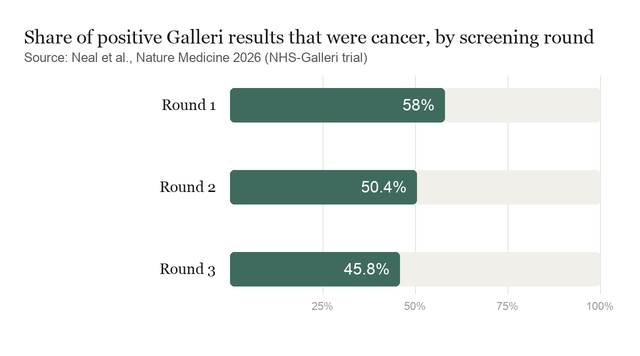
That decline does not mean the test got worse. The cancer detection rate fell from 0.60% in round one to 0.40% and 0.41% in the next two rounds, which is the usual pattern in screening: the first round finds cancers that have built up over years, and later rounds find only the ones that arose since. When there are fewer true cancers to find and the false-positive rate stays roughly flat, a larger share of positives are false. From the abstract's own counts, false positives were about 303, 257 and 304, roughly 0.4% to 0.5% of those tested each round.
What the test missed
Episode sensitivity, the share of cancers present in screened people that the test actually flagged, ranged from 26.7% to 37.2% across rounds for all cancers. In other words, in every round most cancers in the screened arm were not picked up by the blood test. For a prespecified group of 12 cancer types, sensitivity was higher, 47.6% to 63.4%, but still missed a large share even of the types the test is best at.
The negative predictive values make the same point from the other side. They look reassuring at 98.98%, 98.90% and 98.86%, but a high NPV is easy to get when cancer is rare. Doing the subtraction on the abstract's figures, about 708 people who tested negative in round one were counted as having cancer, compared with 419 cancers found among those who tested positive. More cancers were found in the negative group than in the positive group. A negative result is not an all-clear.
A companion paper in the same issue, the single-arm PATHFINDER 2 study of 32,007 performance-analyzable participants in North America, reported similar figures: specificity of 99.64%, positive predictive value of 60.3%, and episode sensitivity of 39.3% for all cancers and 69.8% for the 12-cancer subgroup. PATHFINDER 2 also lists GRAIL employees among its authors and had no control arm, and its authors conclude that randomized trials are needed to judge clinical usefulness.
How a test can find cancers yet not reduce late-stage disease
This is the tension at the centre of the trial. The test found 937 cancers, but the trial's primary endpoint, fewer stage III and IV diagnoses in the screened arm than in the control arm, was not met. Several explanations are possible. The cancers the test finds could be ones that would have been caught at a similar stage anyway. It could be catching aggressive cancers too late to shift their stage. Or its sensitivity for early, small tumours, which shed the least DNA into the blood, may be too low to move the late-stage count. The abstract gives no stage breakdown, so it cannot say which explanation is right.
What the study can't say yet
First, these results are descriptive. The authors state plainly, These analyses were descriptive; there was no hypothesis testing. The sensitivity and PPV figures are estimates without a formal comparison, and the abstract gives ranges across rounds rather than confidence intervals for NHS-Galleri. Second, performance is not the same as benefit. A test can be accurate and still fail to change outcomes, and on the trial's own chosen outcome it did not. Third, the analysis covers only evaluable participants in the intervention arm, and the number tested fell from 70,325 in round one to 62,323 by round three, so later rounds describe a somewhat smaller and possibly different group. Finally, company employees are among the authors of both studies. That does not make the numbers wrong, but independent analyses of the full data would add weight.
Quick questions
If I test negative, am I cancer-free? No. In this trial the test missed between about 63% and 73% of cancers in each round, so a negative result should not replace recommended screening or a visit to a doctor about symptoms.
If I test positive, do I have cancer? About half the time. Between 45.8% and 58.0% of positive results were confirmed cancers, depending on the round.
What's the one-line takeaway? The Galleri test rarely raises false alarms and usually points to the right organ, but it misses most cancers and, in this randomized trial, did not reduce late-stage diagnoses.
Neal RD, Dolly S, Johnson P, et al. "Performance of a multi-cancer early detection test in the randomized controlled NHS-Galleri trial." Nature Medicine, 2026. doi.org/10.1038/s41591-026-04652-8
PubMed PMID: 42773209.
Companion study: Nabavizadeh N, et al. "Performance and safety of a multi-cancer early detection test: the PATHFINDER 2 study." Nature Medicine, 2026. doi.org/10.1038/s41591-026-04618-w. PubMed PMID: 42773207.
Image: blood collection tubes. Helenlunt, CC BY-SA 4.0, via Wikimedia Commons.
Comments