Finding the gene behind a rare condition is rarely the hard part any more; the hard part is the direction of the effect. A gene can cause disease because a variant destroys the protein, or because it makes the protein work too hard, and the two demand opposite treatments. Get the direction wrong and a therapy aimed at the right gene makes the patient worse.
A report in the American Journal of Human Genetics describes a case where the same gene does both. BMPR2 has been known for years through its broken versions: loss-of-function variants cause pulmonary arterial hypertension, a serious disease of the lung circulation. The new work identifies six people carrying one specific, recurrent misspelling of that gene who instead have neurodevelopmental conditions, including autism spectrum disorder and global developmental delay. In flies, that variant does not disable the protein. It leaves it switched on.
Why it matters: Families whose child carries a variant in a well-known disease gene are usually told what that gene does. If one particular variant works in the opposite direction, the label alone is misleading, and the drugs that would help point the other way too.
The study, by Mok et al. at Baylor College of Medicine, with colleagues at Boston Children's Hospital, Columbia and several clinical genetics centres, combines patient genetics with laboratory work in Drosophila melanogaster.
The genetic evidence, and what makes it credible
Six unrelated individuals shared the identical change, c.1126G>A, which swaps a single amino acid, glutamate to lysine, at position 376 of the protein. Two features make this more than coincidence. First, recurrence: the same position in six separate people is unlikely by chance, since most harmless variation is scattered. Second, trio analysis, in which both parents are sequenced alongside the child, showed the variant arose new in at least five of the six, rather than being inherited from an unaffected parent.
That is the standard evidence for a dominant, disease-causing variant, and it is the reason the fly work follows rather than leads. Genetics identifies the suspect; it does not explain what the suspect does.
Why a fly answers the mechanism question
BMP signalling is an ancient system, conserved from insects to humans, which is what makes a fly informative here. The receptor sits on the cell surface waiting for a signalling molecule to arrive, then passes the message on by chemically modifying a partner receptor.
Expressed in flies, the variant behaved as a gain-of-function allele, and the details are the useful part. It acted in a ligand-independent manner, meaning it signalled without waiting for the molecule that normally switches it on, a receptor stuck in the on position rather than one that responds too strongly. It still required the type-1 BMP receptor, so it works through the normal pathway rather than creating a new one. And BMPR2-specific inhibitors suppressed the excess signalling, which is the cleanest confirmation that too much signal is the problem: block the pathway and the effect goes away.
When the team expressed the variant in fly neurons or glial cells, it produced neurodevelopmental defects, which connects the biochemistry to the kind of outcome the patients have.
What the study can't say yet
Six individuals is a small series, and they were found through clinical sequencing, so the description of the condition comes from people whose difficulties were severe enough to reach a genetics clinic. That says nothing about the range of outcomes among everyone who carries this variant, and nothing about how common it is.
The mechanism is established in an insect. Flies have BMP signalling and neurons, but not a human cortex, and defects in fly neurodevelopment are not autism. The authors keep to this boundary in their own conclusion, writing that ectopic activation of BMP signaling in multiple cell types is likely to contribute to the neurodevelopmental phenotypes observed in the probands. Likely to contribute is not the same as causes, and the paper does not claim otherwise.
The inhibitor result is a mechanistic control, not a treatment. It shows the excess signalling can be suppressed in a fly, months to years away from any claim about children. Nor does the abstract say whether these individuals also show signs of the vascular disease the gene is better known for, which would matter for their long-term care.
Quick questions
How can one gene cause two unrelated conditions? Because the variants do opposite things. Variants that destroy BMPR2 reduce signalling and are linked to pulmonary arterial hypertension; this one leaves the receptor active without its normal trigger, increasing signalling.
Why does the same variant keep appearing in unrelated people? Some positions in a gene are mutation-prone, and only a few changes produce this specific effect. A change arising independently in several people, and new in each, is strong evidence that it is the cause rather than a bystander.
What's the one-line takeaway? A recurring new mutation in BMPR2, a gene known for the disease its broken versions cause, was found in six people with neurodevelopmental conditions, and in flies it leaves the receptor signalling without its trigger, which is the opposite defect.
Mok JW, Welch CL, Dostalik HA, et al. "A rare recurring gain-of-function variant in BMPR2 causes neurodevelopmental phenotypes in humans and flies." American Journal of Human Genetics, 2026. doi.org/10.1016/j.ajhg.2026.08.019
PubMed PMID: 42767215.
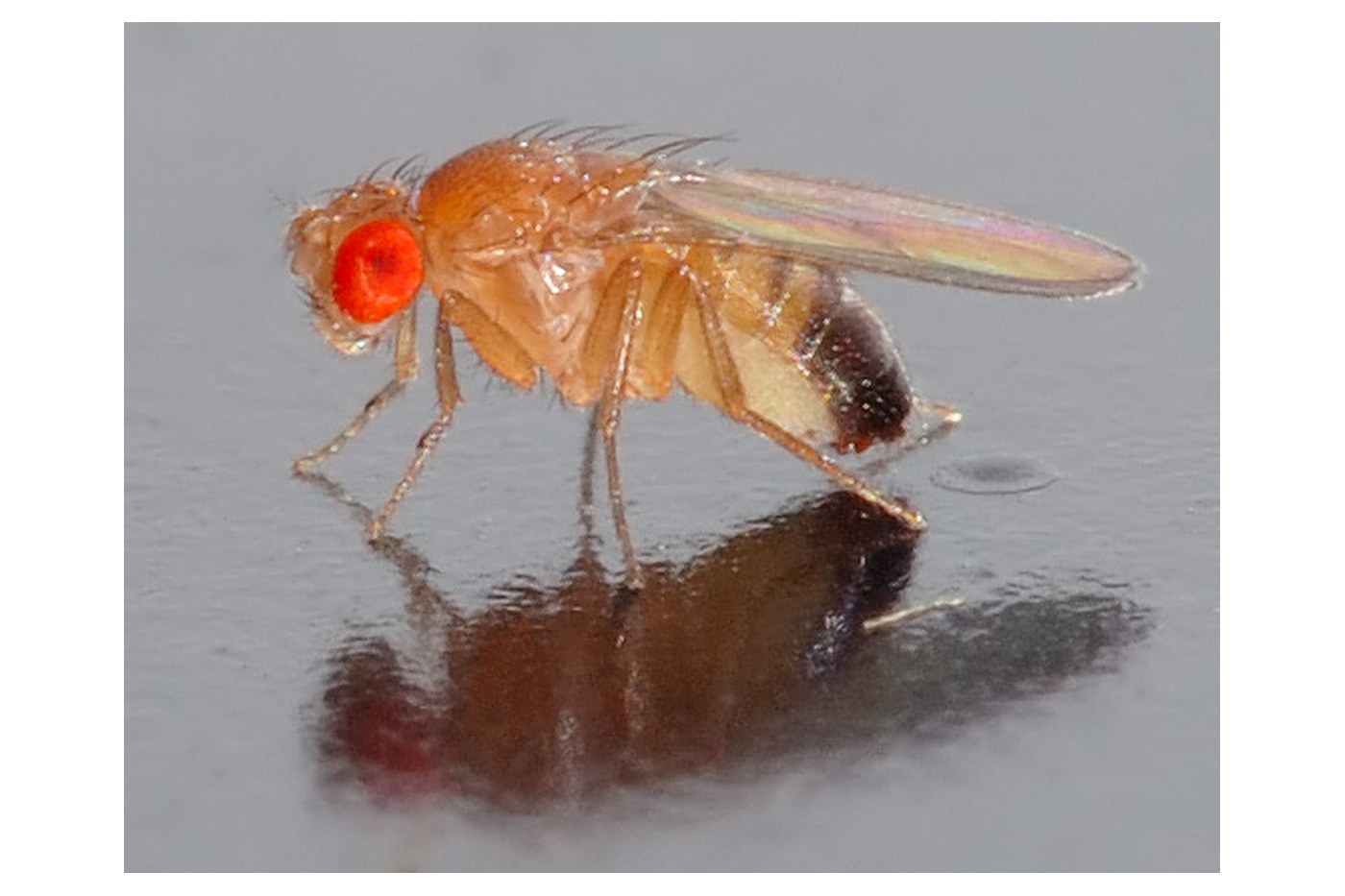
Image: Drosophila melanogaster. André Karwath (aka), CC BY-SA 2.5, via Wikimedia Commons.
Comments