
Retinoblastoma has been genetically understood for over forty years. Roughly 40 percent of cases carry an inherited variant in a single well-characterized gene, carriers usually develop tumours in both eyes before age three, and early ophthalmic surveillance catches those tumours while they are small enough to treat locally. Despite all of that, most children with the bilateral form still arrive at diagnosis with advanced disease that costs them an eye, their vision, or both.
A group at Dana-Farber and Boston Children's asked what would have happened if those children had been sequenced at birth. Michigan has kept newborn dried blood spots since 1987 and runs a statewide cancer registry, so the two can be linked. They identified 1,948 children born between 1987 and 2020 who developed a solid or brain tumour by age eight, retrieved their infant blood spots, and sequenced 11 cancer predisposition genes.
Why it matters: Roughly 1 in 27,000 newborns in this cohort went on to develop an early-onset cancer while carrying a detectable predisposing variant. That is a higher rate than several conditions newborn screening already covers, including severe combined immunodeficiency at about 1 in 59,000.
What the sequencing found
Pathogenic or likely-pathogenic variants turned up in 132 children, 6.8 percent of the cohort, concentrated in RB1 with 69 cases and TP53 with 24. The technical result matters for feasibility: usable DNA came from 1,943 of 1,948 archived spots, a 99.7 percent success rate on spots collected as far back as 1987, punched from a card.
The specificity is the more striking number. In 130 of the 132 carriers, the tumour that developed was one already established as associated with that particular gene. All six children who developed medullary thyroid carcinoma carried a RET variant. Every child with a WT1 variant developed a renal tumour, and no child without one did. This is not a panel producing scattered hits that happen to co-occur with cancer.
For retinoblastoma specifically, germline variants appeared in 41 of 51 known bilateral cases, 80 percent, against 23 percent of the unilateral or unrecorded ones. Carriers were also diagnosed far earlier across the whole cohort, at a median of 14 months against 32 months for non-carriers, which is consistent with predisposition producing tumours sooner rather than merely more often.
Set against the conditions newborn screening already covers, the arithmetic is not obviously unfavourable. Pompe disease runs at roughly 1 in 18,000 births, severe combined immunodeficiency around 1 in 59,000, maple syrup urine disease near 1 in 200,000, and all three are screened as a matter of routine. At 1 in 27,000 this sits comfortably inside that range on frequency alone. Frequency is only half the case, though: screening is justified when early detection changes the outcome, and for retinoblastoma the evidence that it does is unusually strong, since surveillance catches subclinical tumours treatable without removing the eye.
The design decides what the number means
This is a phenotype-first study, and that shapes everything. The children sequenced had all already developed cancer. So 6.8 percent is the proportion of childhood solid tumours attributable to these 11 genes, which is a genuine and useful figure. It is not the positive predictive value of a screening test, because that requires knowing how many newborns carry these variants and never develop anything.
The authors are explicit that the ideal comparison, a large cohort of newborns confirmed cancer-free with identical sequencing and interpretation, could not be assembled. They substitute published newborn genomic studies covering 38,448 infants, which found only two such variants, and population databases where these variants are very rare. That is reasonable evidence the variants are uncommon. It is not the same as measuring how often carriage occurs without disease.
They also raise the ethical ledger themselves, listing psychological distress for families, the burden of surveillance in young children, and the possibility of overdiagnosis or unnecessary interventions arising from indeterminate findings. As Diller and colleagues note in Nature Communications, those costs fall on every family flagged, including the ones whose child was never going to be ill.
What the study can't say yet
Penetrance is the missing quantity, and without it the balance of benefit and harm cannot be calculated. Nothing here establishes what fraction of carriers develop cancer, so nothing here establishes how many families would be enrolled in years of surveillance for a tumour that never arrives.
The cohort is also one state's births, and the authors caution against extrapolating to populations with different ancestry or founder variants. Registry data were thin enough that they could not tell which families already knew about their syndrome from family history, meaning some proportion of these children were arguably identifiable without sequencing at all. Leukaemia predisposition genes and recessive syndromes were excluded by design, so the count is a floor rather than a total. And the second-cancer difference between carriers and non-carriers did not reach significance.
Quick questions
Would this catch every predisposed child? No. Eleven genes covering autosomal dominant solid-tumour syndromes were sequenced, with leukaemia and recessive conditions deliberately left out, so the real number of genetically at-risk newborns is higher.
Why do decades-old blood spots still work? Because DNA on dried filter paper is stable, and modern targeted sequencing needs very little of it. A single 3.2 millimetre punch was enough in 99.7 percent of cases.
What's the one-line takeaway? Sequencing 11 genes in archived newborn blood spots would have flagged 6.8 percent of children who later developed early cancers, including 80 percent of those with bilateral retinoblastoma, though the design cannot say how many healthy carriers would be flagged alongside them.
Diller et al. "Population-based genomic detection of childhood cancer predisposition using newborn dried blood spots." Nature Communications, 2026;17(1). doi.org/10.1038/s41467-026-76296-8
PubMed PMID: 42586985.
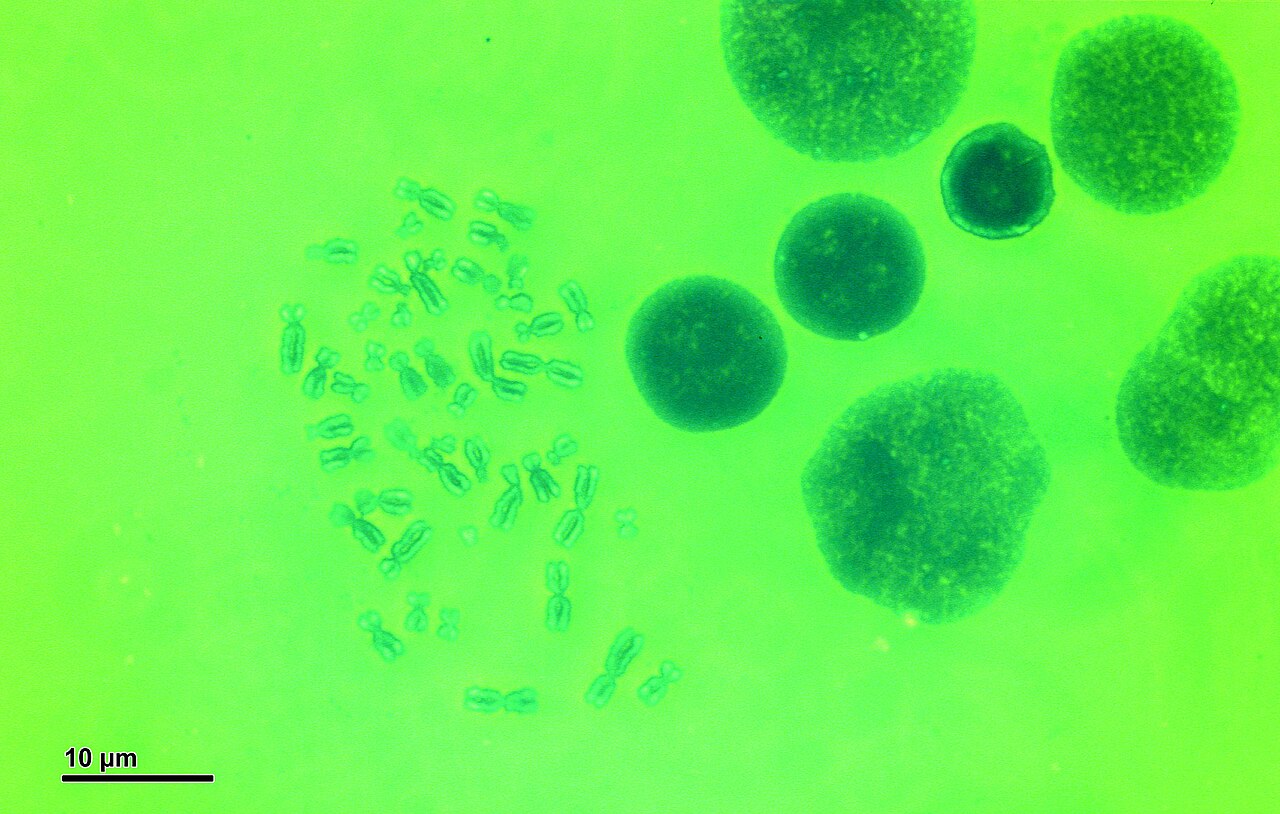
Image: Human karyotype, Josef Reischig, CC BY-SA 3.0, via Wikimedia Commons.
Comments