

Duchenne muscular dystrophy follows a schedule that families learn to read years in advance. He walks late. He gets up off the floor by climbing his own legs. Running gives way to walking, walking to a wheelchair, and eventually the muscles that matter most, the ones that move the ribs and the ones that squeeze the heart, begin to fail too. The cause is a single gene. The protein it should make, dystrophin, works as a shock absorber inside muscle fibers, and without it every contraction does a little damage that never fully heals.
A new study reports something that has been promised in this field for a long time and rarely delivered: one dose that keeps working. In monkeys carrying the same kind of mutation boys carry, a single administration restored dystrophin and improved movement for at least a year and a half. In the first three patients ever to receive it, that single dose was safe, did what it was designed to do at the molecular level, and came with measurable gains in how well they moved and breathed.
Why it matters: Duchenne is fatal, and most attempts to correct it have run into the same wall: the body notices the fix and attacks it. This approach hands instructions to an editing enzyme that every cell already carries, rather than shipping in a foreign editor for the immune system to find.
The work, led by Guo et al. across Kunming University of Science and Technology, Peking University, and Shanghai Children's Medical Center, is built on a platform the group calls LEAPER 2.0, short for leveraging endogenous ADAR for programmable editing of RNA. The name is a mouthful; the idea underneath it is elegant.
Skipping over the broken part
Most Duchenne mutations delete a chunk of the gene, and whether that chunk is fatal turns on a question of arithmetic: does what remains still read in frame? Genes are read in three-letter words, so a deletion that leaves the count wrong throws every word after it out of alignment. The cell reads the instructions, hits nonsense partway through, and gives up. The old insight is that if you could persuade the cell to skip the mangled section too, the count would come out right again, the frame would snap back into register, and the cell would build a shortened dystrophin that is imperfect but functional.
The delivery is where this study departs from the familiar path. Instead of sending in a molecular scissor, the team sends in a circular ADAR-recruiting RNA, or circ-arRNA. ADAR is an RNA-editing enzyme our cells already make and use. The circular RNA parks itself on the signals a cell uses to decide which chunks of a gene to keep and which to leave out, and it tips that decision: the mangled stretch gets left on the cutting-room floor, the frame snaps back, and dystrophin gets built again. The authors are careful to note that this runs through both ADAR-dependent and ADAR-independent mechanisms. The borrowed enzyme is not the whole story, and they say so themselves.
Two details make the design worth pausing on. The RNA is circular, which makes it more durable inside a cell than a loose linear strand. And because the therapy edits RNA rather than DNA, it never rewrites the genome itself. That is a genuine trade: no permanent edit to inherit or regret, but also nothing permanent to rely on.
A year and a half in monkeys, a first look in boys
The strongest durability evidence comes from monkeys, and it is worth being precise about that. In monkeys carrying mutations in the stretch of the gene where most human cases cluster, a single dose restored dystrophin and kept motor function improving for at least a year and a half, with no anti-dystrophin immune response, the specific backlash that has undercut other attempts to reintroduce a protein a body has never seen.
The human data are far earlier and far smaller. In a first-in-human study, a single dose of the circ-arRNA, delivered by an adeno-associated virus (a hollowed-out virus used as a shipping container for genetic cargo), produced what the authors describe as safe, dose-dependent exon skipping in three patients, accompanied by measurable gains in motor and cardiopulmonary function. Dose-dependent matters here: more drug produced more skipping, which is the signature of a treatment actually doing what the mechanism predicts rather than a lucky wobble in the data.
What the study can't say yet
Three patients is three patients. A first-in-human study that size has no control group and no randomization to lean on, and no way to separate the drug's effect from physiotherapy, growth, or hope. Studies like this are built to answer whether something is safe enough to keep testing, not whether it works, and this one should be read that way. It is also worth noting that the paper reports the gains as "accompanied by" the dose rather than caused by it, which is the language of association, chosen deliberately.
The word "reversal" in the paper's own title is doing more work than three treated boys can support. And the headline durability figure, a year and a half, belongs to the monkeys. Nobody yet knows how long the benefit lasts in a person, which is an especially live question for an RNA therapy that does not permanently alter the genome. AAV delivery generally makes redosing difficult, since the immune system learns to recognize the carrier, and the study does not resolve what happens when the effect eventually fades. The cleanest read is this: a promising mechanism with real primate durability, and a human story that has barely started.
Quick questions
Is this CRISPR? No. CRISPR edits DNA, usually with a bacterial protein delivered into the cell. This edits RNA using ADAR, an enzyme your cells already make, and leaves the genome untouched.
Does it cure Duchenne? No, and the study does not claim to have shown that. It restores a shortened form of dystrophin, and in three patients it improved some measures of movement and breathing over a short window. Cure is a much higher bar that needs far more patients and far more time.
What's the takeaway? A real candidate worth watching, not a finished answer. The mechanism has genuine durability behind it in monkeys; the human story is three boys old.
Guo et al. "Long-term reversal of Duchenne muscular dystrophy via circular arRNA-guided exon skipping in monkeys and humans." Cell, 2026. doi.org/10.1016/j.cell.2026.05.030
PubMed PMID: 42269605.
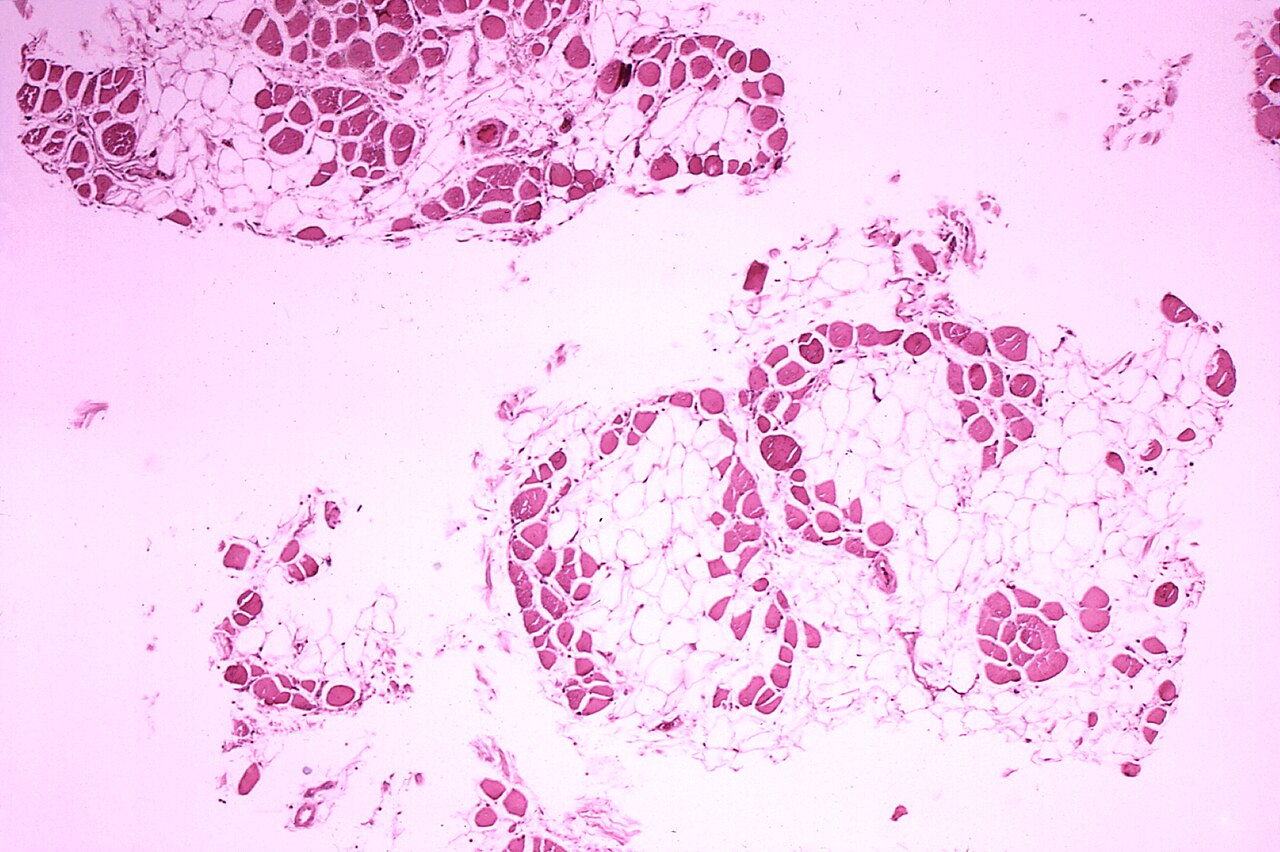
Image: Histopathology of gastrocnemius muscle in Duchenne muscular dystrophy. Dr. Edwin P. Ewing, Jr., CDC Public Health Image Library, public domain, via Wikimedia Commons.
Comments