


Over the past two years, a handful of children born deaf have gained hearing after a single shot of gene therapy into the inner ear. It is one of the most concrete wins the field has had. But the treatment came with a frustrating ceiling: you usually got one attempt. A trial out of Fudan University, published in Nature Medicine on June 26, shows a way past that ceiling, restoring hearing in a child's second ear after the immune system had already turned against the therapy.
The antibody problem
The condition here is a recessive form of congenital deafness traced to a gene called OTOF. It makes otoferlin, a protein the ear's sensory hair cells rely on to pass their signal to the auditory nerve. The hair cells are present and intact. They just cannot talk. Gene therapy fixes that by loading a working copy of the gene into a harmless virus and injecting it into the ear.
That first injection teaches the immune system to recognize the virus. Inject the same virus again and the antibodies it raised can mop it up before it reaches anything. So children were treated in one ear and left deaf in the other, without the stereo hearing that lets a person tell where a sound came from or follow one voice in a noisy room.
Treating the other ear anyway
Yilai Shu and colleagues started in mice. Dosing the opposite ear worked even when antibody levels were at their peak, and stirred up little immune trouble. They then amended an ongoing trial to add four children, roughly two to three and a half years old, who already carried antibodies from an earlier treatment. Each got a second dose in the untreated ear and was followed for six months to a year.
None of the four hit the trial's safety stop. Hearing in the new ear improved in every one. Thresholds that had sat worse than 95 decibels, deep in profound-deafness territory, came down to 43, 63, 80 and 53 decibels. Side effects stayed mild. One child had a moderate dip in a type of white blood cell; nothing worse turned up.
How far it goes
Four children and under a year of data is a start, not a verdict. The study does not prove the antibody barrier is beaten for good, and it cannot say how long the second ear keeps working. It also applies only to this otoferlin form of deafness, where the hair cells survive. The far more common kinds of hearing loss, where those cells are damaged or gone, are a different problem it does not touch. What it settles is narrower and still real: a repeat dose can work at all. That is the door the field has been trying to pry open.
Fan, X. et al. “Re-administration of AAV-mediated gene therapy for OTOF-related deafness: a single-arm trial.” Nature Medicine, 2026. doi.org/10.1038/s41591-026-04505-4
PubMed PMID: 42362868. Trial registration ChiCTR2200063181.
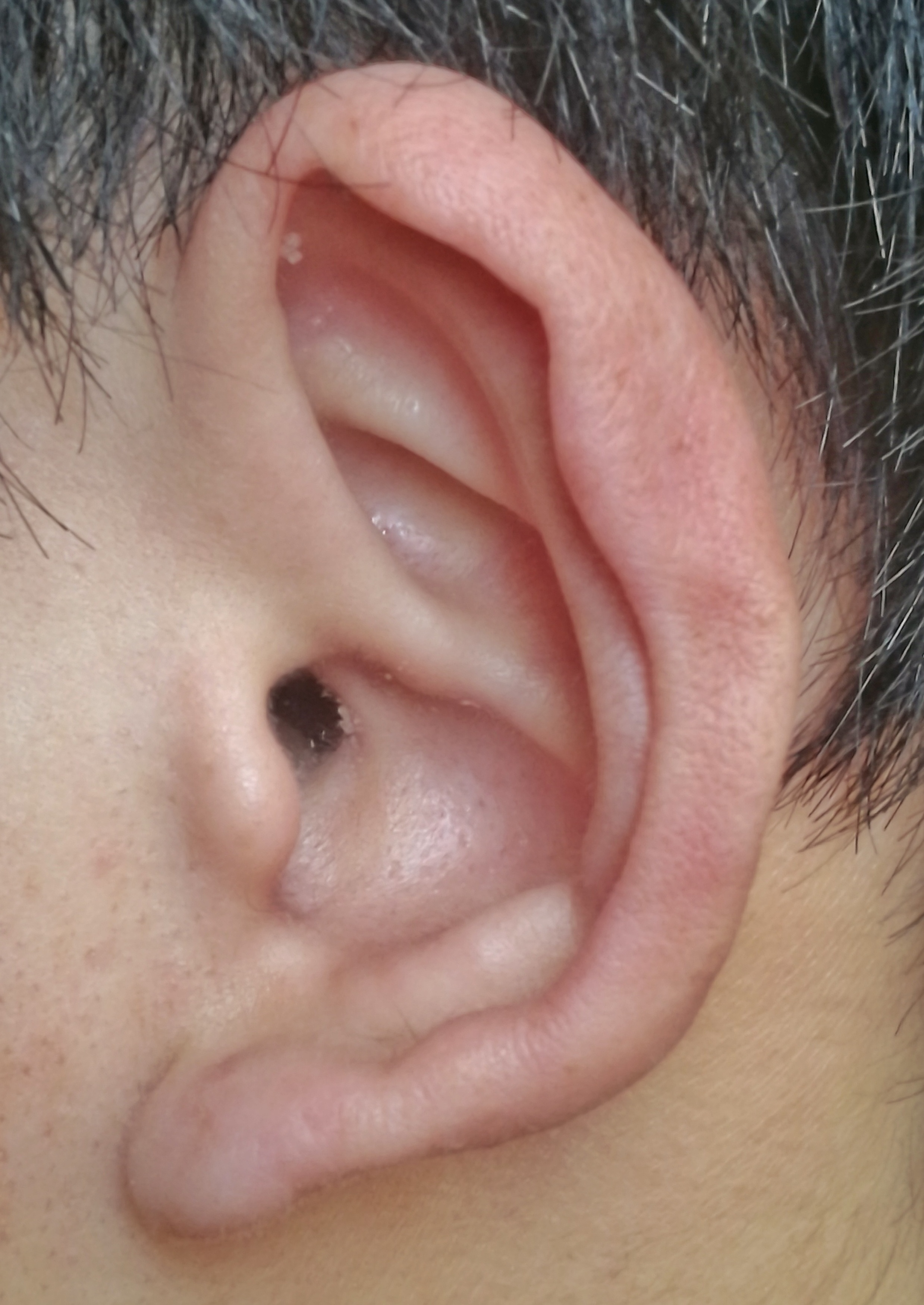
Photograph: “Close up of man's ear” by BIT0865, CC BY-SA 4.0, via Wikimedia Commons.
Comments