Observational studies of vaccine effectiveness have a structural problem that randomized trials do not. Nobody assigns the vaccine at random. People choose it, or are offered it, or are quietly passed over, and the factors governing that are the same factors governing whether they were going to end up in hospital anyway. The comparison is between two groups that differ in more than their vaccination status, and the size of that difference is usually unknown.
A team across Linkoping University and three Swedish regional health authorities has measured it. Following 245,696 people aged 65 and over through the 2024-2025 season, they estimated the JN.1-adapted vaccine at 75 percent effective against COVID-19 hospitalization. Then they checked the same comparison against an outcome the vaccine could not possibly influence, and found the vaccinated group had less than half the all-cause mortality of the unvaccinated.
Why it matters: No vaccine halves your chance of dying of anything. When a study says it does, the number is measuring who received the vaccine rather than what the vaccine did, and every other estimate from the same comparison inherits some of that distortion.
The negative control, and why it works
The technique is elegant in its simplicity. Choose an outcome the exposure cannot plausibly cause, run the identical analysis on it, and whatever signal appears is bias, because there is nothing else it can be. Short-term all-cause mortality suits the role here: a COVID vaccine has no mechanism for protecting against cancer, falls or heart failure within six months.
The result was a hazard ratio of 0.43, meaning vaccinated individuals died of all causes at well under half the rate of the unvaccinated. That gap is entirely selection. It was largest in the first 90 days and narrowed later, consistent with the frailest people dying early and leaving a healthier unvaccinated group behind. Critically, removing everyone hospitalized with COVID-19 barely moved it, which rules out the explanation that COVID deaths alone were responsible.
The most telling number is a subgroup. Among people who had taken the previous year's updated vaccine, the mortality gap was enormous, a hazard ratio of 0.27. Among those who had not, it was 0.90 and not statistically significant. Prior vaccination is a marker for being the sort of person who turns up, and comparing repeat vaccinees with everyone else compounds that selection year on year.
How much of the effectiveness estimate this eats
Less than the setup suggests, and the authors are careful here. They simulated a scenario stripping out the main routes by which the bias operates, excluding those with end-stage frailty, assuming the sickest unvaccinated had been vaccinated, and dropping the comorbidity correction. Effectiveness fell from 75 percent to 69 percent. A six-point overstatement is real and it is not the collapse the mortality figure might imply.
Two further checks point the same way. The vaccine's effectiveness held steady across the season rather than decaying as a purely artefactual signal would. And the E-value, which asks how strong an unmeasured confounder would have to be to erase the result entirely, came out with a lower limit of 7.2, an implausibly powerful hidden variable. As Lyth and colleagues state in Nature Communications, we do not propose that our findings invalidate the early reports on the effectiveness of the 2024 BNT162b2 vaccine in preventing COVID-19 hospitalization. Even the subgroup that had skipped the previous year's dose, the least healthy by this measure, showed 65 percent effectiveness.
The finding underneath the methodology
The more consequential result is about who was missed. Vaccination was lower among people with metastatic cancer and among those with hemiplegia or paraplegia, and lower again among people born outside Sweden, in a country where no elderly subgroup was excluded from the recommendation. And because removing COVID hospitalizations did not close the mortality gap, the same people were evidently also underusing emergency care.
That describes a group of frail elderly falling out of both preventive and acute medicine at once, invisible to a health database that records diagnoses but not physiological reserve. They are the reason the bias exists, and they are the people the vaccine would most benefit.
What the study can't say yet
Frailty was never measured, only inferred from its consequences, and the authors say plainly that their adjustments for age, sex, birth country, immunosuppression and comorbidity were insufficient to capture baseline health. Without a frailty instrument, the size of the correction is a modelled estimate rather than an observation.
This is also one region of one country with universal healthcare, high uptake at 68 percent, and a single vaccine product. Selection effects depend on how access works, so the magnitude here should not be transplanted to systems where cost or coverage determines who gets vaccinated. And 519 hospitalizations, while adequate overall, thin out considerably once the population is split into subgroups, which is visible in the wide confidence interval on the 65 percent figure.
Quick questions
Does this mean COVID vaccines work less well than reported? Modestly, in this population. The corrected estimate was 69 percent rather than 75 percent, and the authors explicitly decline to say their work invalidates earlier effectiveness reports.
Why use all-cause mortality as the check? Because a vaccine cannot alter it within six months. Any difference that shows up is therefore a measure of how much the two groups differed to begin with.
What's the one-line takeaway? Vaccinated Swedish elderly had less than half the all-cause mortality of the unvaccinated, which no vaccine can cause, and correcting for that selection lowered measured effectiveness from 75 to 69 percent.
Lyth et al. "Healthy vaccinee effect in the evaluation of updated COVID-19 vaccines in elderly populations." Nature Communications, 2026;17(1). doi.org/10.1038/s41467-026-76312-x
PubMed PMID: 42570961.
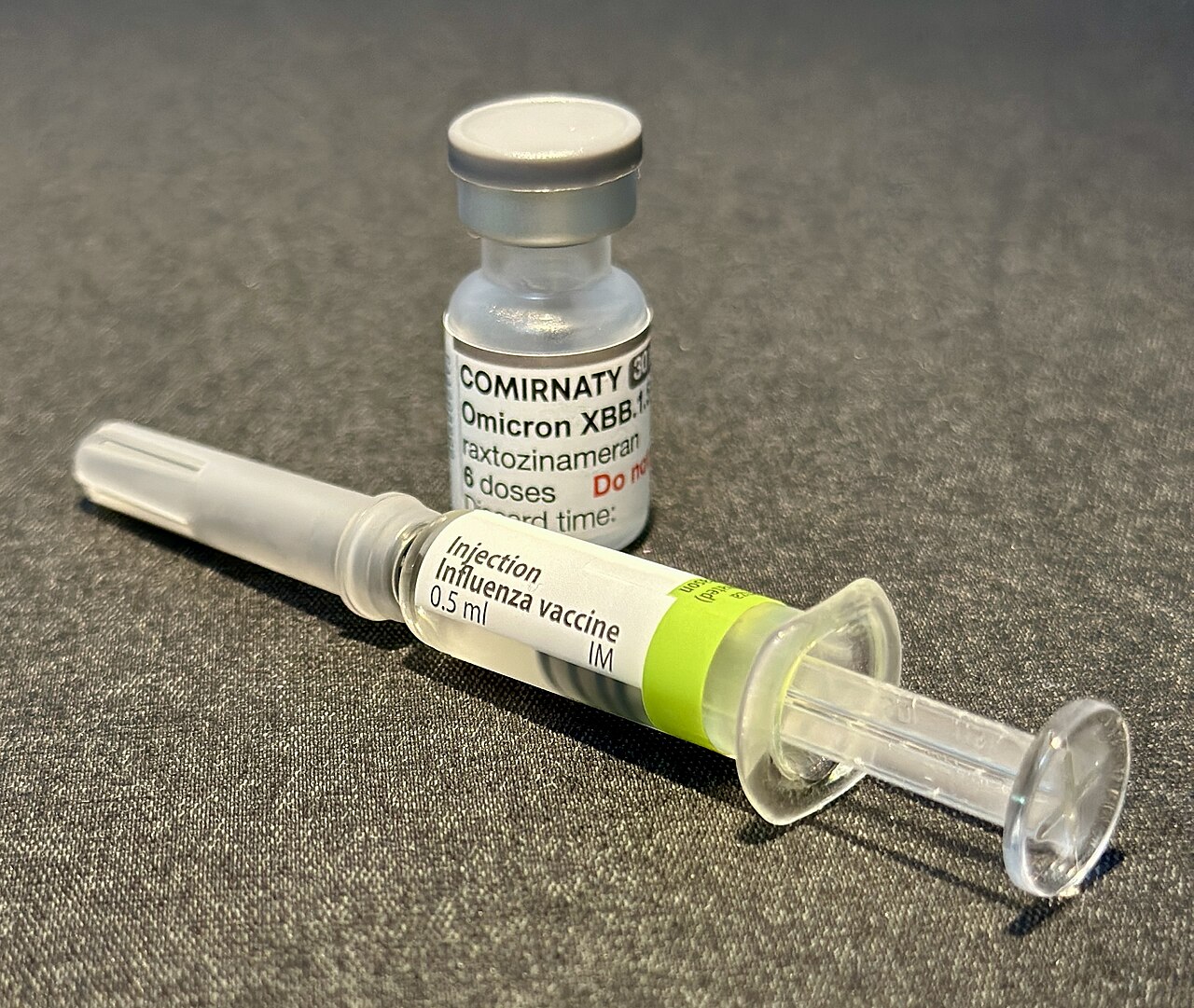
Image: Omicron-adapted Comirnaty vial with influenza vaccine, Whispyhistory, CC BY-SA 4.0, via Wikimedia Commons.
Comments