The fish started turning up in 2012. Biologists working a lake that straddles the border between Vermont and Quebec kept pulling brown bullhead catfish out of the water with dark, raised lesions across their skin. Melanomas, in numbers nobody expected from a wild population. The first explanations to reach for were the ordinary ones: something in the water, a pollutant settled into the sediment, an industrial legacy doing slow damage to the fish living above it. A lake is close to a closed system, and a contaminant would neatly explain why the animals in this particular one were sick.
The other explanation was stranger, and it is the one the genetics support. A team led by researchers at the University of Vermont, working with the state's Fish and Wildlife Department and the U.S. Geological Survey, sequenced both the tumours and the fish carrying them. The melanomas turned out not to be each fish's own cancer at all. The tumour genomes were more closely related to one another than to the animals they were growing inside. What had been coming up in the nets was a single cancer lineage that has been moving from fish to fish.
Why it matters: Cancer normally dies with its host, which is the one limit the disease reliably obeys. A transmissible cancer has escaped that limit and become something closer to an organism in its own right, passing between bodies and outliving every individual it kills. Only three others are known in the whole animal kingdom.
How you prove a cancer is contagious
The logic of the test is simple, even if the sequencing behind it is not. Take a tumour and take healthy tissue from the same fish, then read both genomes. In a conventional cancer, the tumour is descended from that animal's own cells, so its DNA is a corrupted copy of the host's, carrying the host's inheritance plus whatever mutations drove the cell to divide without stopping. The tumour should look like its host, only damaged.
That is not what the sequencing showed. The tumours matched each other. Both the nuclear genomes and the separate, much smaller mitochondrial genomes clustered together across different fish, rather than tracking the animals they came from. The team counted hundreds of thousands of genetic variants shared between tumours from different individuals and absent from those individuals' own tissue, a level of sharing the authors note vastly exceeds anything seen in ordinary cancers.
The only arrangement that produces that pattern is physical transfer of the cancer cells themselves. This is what the researchers set out to test, describing it as a rare phenomenon in which cancer cells themselves spread between individuals, behaving more like parasites than conventional tumours. The cells are not signalling to each other or triggering the same mutation independently in fish after fish. They are the same cells, physically relocating, dividing in one host and then establishing themselves in the next.
The fourth of its kind
Transmissible cancers are among the rarest phenomena in biology, and until now biologists knew of three lineages in animals. The oldest and best studied is a venereal tumour in dogs, a cell line that has been passing between animals for thousands of years. The most notorious is the facial tumour disease that has driven Tasmanian devils toward collapse, spread when the animals bite each other. The third occupies several species of bivalves, where a leukaemia-like disease moves between clams and mussels through seawater. As Curd and colleagues report in Nature, the bullhead melanoma is the fourth.
What makes the finding land is how ordinary the setting is. The devils are an isolated island population under enormous ecological stress, and the bivalve cancers move through open water between filter feeders. These are catfish in a North American lake that people fish, and the disease was noticed because fisheries staff kept seeing something wrong with the animals they were handling.
What the study can't say yet
Almost everything about how this works remains open, and the authors are direct about it. They do not know where the lineage came from, or when the original fish lived whose cancer is still dividing in its descendants' neighbours. They do not know how it moves between animals. Bullheads are bottom dwellers that crowd together and make contact, but contact alone is not a mechanism, and nothing in this work identifies one. Guessing at a transmission route would be inventing detail the data does not contain.
The population consequences are also unresolved. A high rate of melanoma in a lake is not the same as a threat to the species, and the study does not attempt to measure whether these fish are dying at rates that matter for the population. The Tasmanian devil precedent makes that question urgent rather than answered. And this is one lake: whether the lineage exists elsewhere, in other waters or other bullhead populations, is untested.
Quick questions
Could this happen in humans? Not in any practical sense. Transmissible cancers require cells to survive transfer between bodies and evade the new host's immune system, which is why only four are known across all of animal life. This paper makes no claim about human health.
Is the cancer itself alive, separately from the fish? In a meaningful sense, yes. The lineage is a population of cells reproducing and dispersing across hosts, which is why the authors reach for the language of parasites rather than tumours.
What's the one-line takeaway? Melanomas in catfish from one Vermont and Quebec lake are not each fish's own cancer but a single transmissible lineage moving between them, the fourth such cancer ever documented in animals.
Curd et al. "Brown bullhead catfish melanoma represents a novel transmissible cancer." Nature, 2026. doi.org/10.1038/s41586-026-10828-6
PubMed PMID: 42486978.
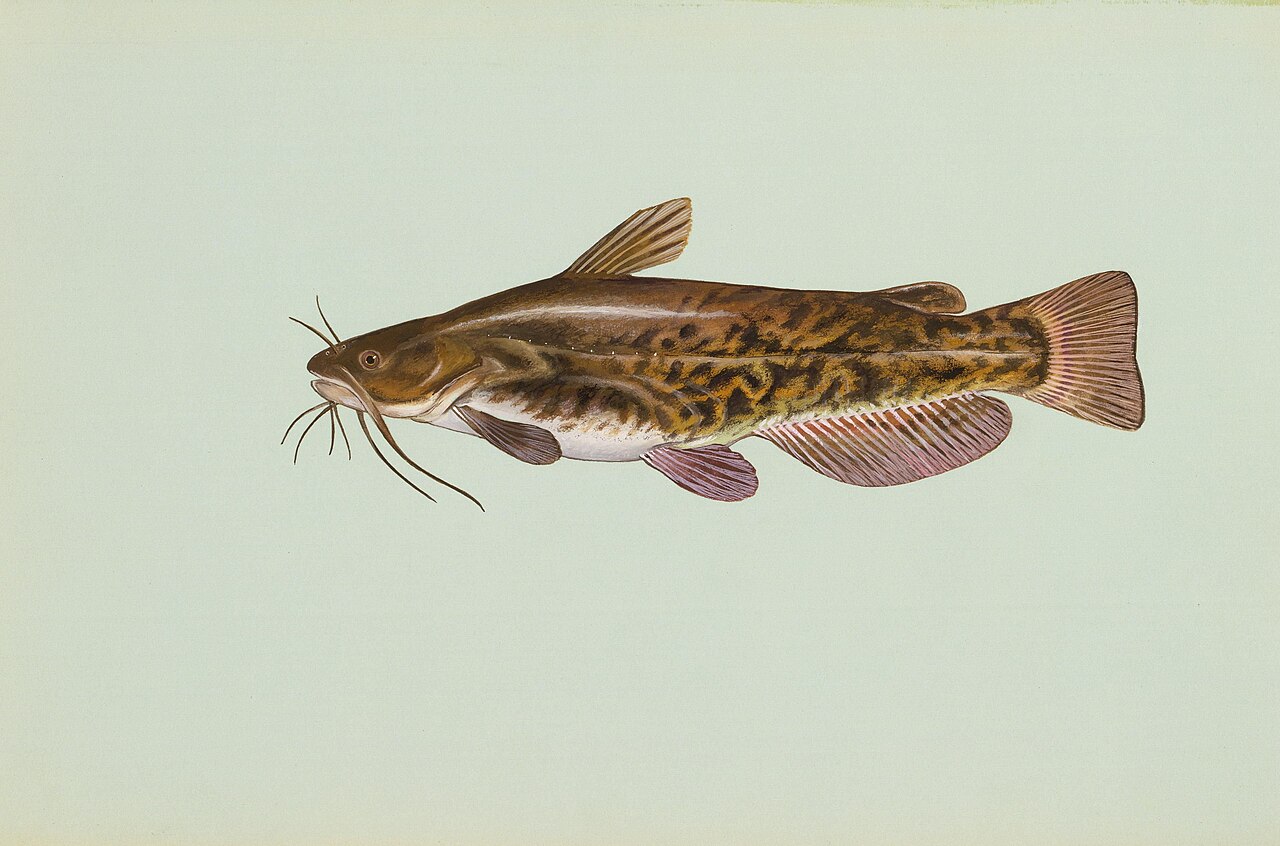
Image: Brown bullhead (Ameiurus nebulosus), illustration by Duane Raver, U.S. Fish and Wildlife Service, public domain, via Wikimedia Commons.
Comments