

Most animal models of disease begin with a switch thrown everywhere at once. A gene is deleted across a whole tissue, or an oncogene is activated throughout an organ, and what follows is studied as though it were the disease. Real chronic illness rarely starts that way. A lung tumour begins in a few cells in one place, surrounded by healthy tissue that is part of the story. The gap between those two situations is a real limitation on what mouse models can teach.
Light is the obvious way to add location to the equation, because a beam can be pointed. The problem is that tissue is opaque, so optogenetics has worked best on the brain, where fibres are already routinely implanted, and poorly on organs buried in the torso. A group at the University of Illinois Chicago, working with bioelectronics engineers at Northwestern University, has addressed both halves of the problem at once: a redesigned light-activated enzyme, and a wireless implant small enough to sit on a mouse lung and illuminate a patch of it on command.
Why it matters: Being able to choose where and when a disease starts inside an internal organ, rather than inducing it everywhere, makes it possible to study the earliest events in a lesion alongside the normal tissue next to it. That boundary is where much of the interesting biology of early cancer sits.
The study, by Bansal et al. at the University of Illinois Chicago and Northwestern University, appears in Science Advances. All of the work is in mice.
Two engineering problems, solved separately
The enzyme half concerns leakiness. Cre recombinase makes permanent genetic edits, so a light-controlled version that works even slightly in darkness will quietly rewrite cells you never illuminated, and the authors found exactly that problem in an existing design. Their version, E-LightR-Cre, showed no detectable activity in the dark while responding strongly to blue light, which is the property that makes a spatial experiment trustworthy rather than merely tidy.
The hardware half is a flexible printed circuit: a 50-micrometre polyimide film carrying a 10-millimetre receiving coil for wireless power, a serpentine connector that lets the device bend and move with the breathing lung, and at the end of it a light-emitting diode measuring roughly 270 by 220 micrometres. There is no battery and no tether. The authors report that These implants did not affect mouse health, mobility, or lung architecture while providing stable wireless power delivery, and that the size of the activated patch can be dialled by changing light intensity and duration.
Put together, the system did what it was built for. After delivering the light-activated enzyme into the airway and illuminating the left lobe, they switched on a mutant form of the KRas oncogene in that area alone. Eight weeks later the illuminated region carried neoplastic growths, ranging from atypical adenomatous hyperplasia up to in-situ adenocarcinoma.
What the study can't say yet
The tumours are early-stage by their own description. Atypical hyperplasia and carcinoma in situ are premalignant and non-invasive; nothing here reports a lesion that spread. For a tool aimed at modelling chronic disease, eight weeks and a premalignant endpoint is a starting point rather than a demonstration of the full course.
A physical question is left open, and the authors flag it themselves. An illuminated diode in contact with living tissue produces heat as well as light, and heat alone changes cell behaviour. They note that Future studies in tissue phantoms or ex vivo lung preparations could provide direct thermal validation, which is a candid way of saying that the thermal load on the lung was modelled and inferred rather than measured directly.
There is also a result that complicates the clean picture of a precisely bounded effect. Looking at transcription, the team found that We observed significant differential expression of several genes in the nonilluminated cells that did not undergo recombination. Cells that were never switched on nonetheless behaved differently, so the perturbation is not confined to the cells whose DNA changed, whether through diffusible signals, surgery, the implant itself or scattered light.
Finally the delivery step is imprecise in a way that limits reproducibility. The authors acknowledge that Organ-targeted adenoviral delivery of the optogenetic protein achieves relatively homogeneous expression but cannot ensure uniform distribution across all target cells, potentially causing variability in timing and activation strength across experiments. The light can be aimed precisely; which cells were listening is less controlled.
Quick questions
Is this a treatment for anything? No. It is the opposite of a treatment: a method for inducing disease in a chosen location so that its earliest stages can be studied. Any clinical relevance is downstream of better models.
Why does dark-state leakiness matter so much? Because the enzyme's edits are permanent. A conventional light-switched protein that drifts on in darkness is merely noisy; a recombinase that does so has already rewritten the genome of cells meant to serve as controls.
What is the one-line takeaway? A battery-free implant and a non-leaky light-activated recombinase let researchers switch on a lung oncogene in one chosen patch of a living mouse and grow premalignant lesions there, with the heating from the device not yet directly measured and some gene-expression changes appearing in cells that were never illuminated.
Bansal et al. "Local control of Cre-regulated genetic modeling in vivo using wireless implantable optoelectronics." Science Advances, 2026. doi.org/10.1126/sciadv.aed1014
PubMed PMID: 42873865. Full text: PMC13665946.
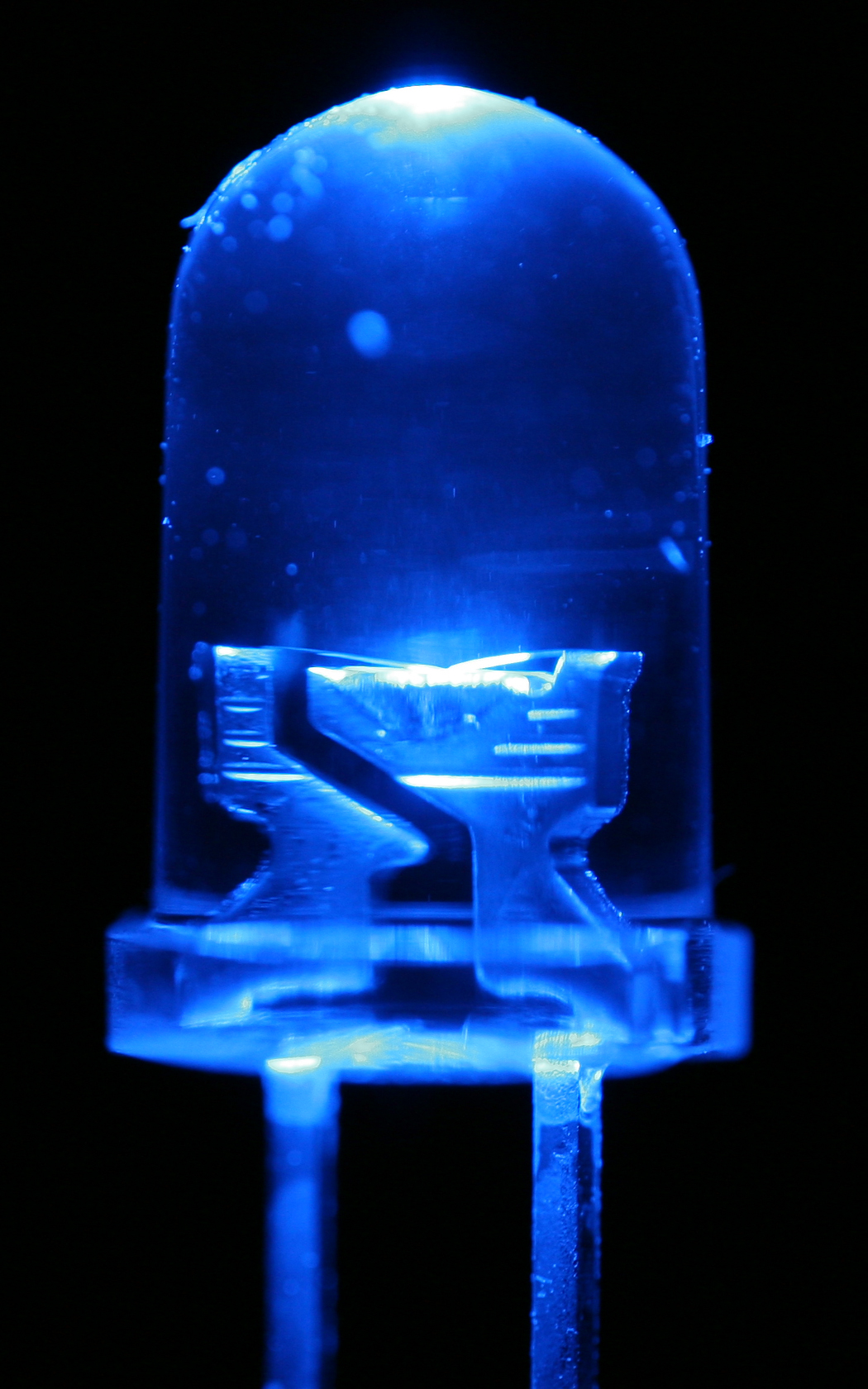
Image: blue LED macro. outlaw_wolf, CC BY-SA 2.0, via Wikimedia Commons.
Comments