A biological synapse does something a sensor usually cannot: it responds to a chemical signal by moving in either direction. The same terminal can depolarize a neuron or hyperpolarize it depending on which transmitter arrives, so the readout is not merely present or absent but positive or negative. A group at the China University of Geosciences has built an artificial version of that behaviour into a membrane, and applied it to detecting prostate cancer markers.
The device is a graphene oxide membrane with fluidic channels roughly angstroms across, functionalized with capture DNA on its outer surface. When a target binds, it induces a bidirectional space charge polarization that sets up a local concentration gradient at the surface, and cations then flow into or out of the membrane depending on the target. Conductance rises or falls. One sensor gives a signed answer rather than a magnitude.
Why it matters: Most biosensors report one direction of change, so distinguishing several markers means several devices or several assays. A membrane whose conductance can swing either way encodes more information per measurement, which is a genuine advance in sensor physics whatever happens clinically.
The physics is the contribution
Worth separating what is demonstrated from what is claimed. The bidirectional switching is supported by experiment and theory together, and the mechanism is specific: binding on the outer surface reorganizes charge such that the local ion gradient reverses sign, and the number density of charge carriers inside the membrane follows. That is a real analogy to excitatory and inhibitory postsynaptic behaviour rather than a loose metaphor, and it works in a membrane whose channels are near the scale of hydrated ions.
Applied to clinical material, the system reads three prostate cancer markers: prostate-specific antigen from serum, and the RNA markers PCA3 and miRNA-198 from blood. Each yields an index, and the three indices feed a small neural network with a single hidden layer, deliberately kept low in capacity to limit overfitting. That restraint is to the authors' credit and is exactly the right instinct for a dataset this size.
Why three markers instead of one
The choice of targets reflects a real clinical problem rather than convenience. Prostate-specific antigen is the established blood test and is notoriously unspecific: it rises with cancer, but also with benign enlargement, infection and even recent cycling, which is why PSA screening generates so many unnecessary biopsies. PCA3 is a long non-coding RNA expressed almost exclusively in prostate tissue and strongly overexpressed in tumours, and miRNA-198 is a small regulatory RNA whose levels shift with disease. Combining a protein marker with two RNA markers is a reasonable attempt to buy specificity that no one of them has alone.
The device suits that combination because it reads them in different directions. A protein and a nucleic acid arriving at the same functionalized surface produce opposite conductance changes, so the signed output distinguishes what is binding rather than only how much. That is the argument for building a synapse-like sensor rather than three conventional ones, and on the physics it holds up.
What 100% accuracy is measuring
The headline is perfect performance, and the number needs unpacking rather than repeating. In total 115 specimens were used. Seventy-five formed the training cohort that set the model parameters. Thirty formed a validation cohort used to choose the classification threshold from the ROC curve by Youden's index. That leaves, as the methods put it, a 10-sample double-blind test cohort reserved exclusively for final performance evaluation.
So the retrospective figure of 100 percent across 105 specimens is accuracy on the data used to fit the model and tune its threshold. A flexible classifier reproducing labels it was trained on is expected, not evidence. The number that speaks to generalization is the prospective one, and that rests on ten samples.
Ten out of ten is a good result and it is a small number. Binomial arithmetic puts the lower bound of the 95 percent confidence interval on 10 correct out of 10 at roughly 69 percent, meaning the data are compatible with a test that is right about seven times in ten. As Zhao and colleagues report in Nature Communications, the system identified patients correctly in every prospective case, which is the honest description. Perfect accuracy on ten patients and a validated diagnostic are different objects.
What the study can't say yet
Beyond cohort size, nothing here establishes performance where diagnostics actually fail. Prostate cancer screening's central difficulty is not separating obvious cancer from obvious health but distinguishing indolent disease that should be left alone from aggressive disease that should not, and separating both from benign prostatic hyperplasia, which also raises PSA. A classifier trained to split cancer from non-cancer does not address that, and the specimens are not characterized in a way that would show whether the hard cases were present at all.
The measurements also depend on tightly controlled conditions. Readings are taken in dilute unbuffered potassium chloride at around pH 6, chosen because PSA carries a net positive charge there, with serum diluted to limit matrix effects and RNA separately extracted and purified. That is a laboratory workflow with several sample-preparation steps, not a bedside test, and robustness across the variability of unselected clinical samples is untested.
Quick questions
Is this better than a PSA test? Unknown. It reads PSA plus two RNA markers and combines them, but no head-to-head comparison against standard PSA testing in the same patients is reported.
Why does the direction of the signal matter? Because a sensor that can respond both upward and downward can distinguish targets a single-direction sensor would report identically, packing more information into one device.
What's the one-line takeaway? A membrane with angstrom-scale channels that switches conductance in either direction on binding is a real advance in sensing, and its perfect diagnostic accuracy was measured on ten prospective patients.
Zhao et al. "Angstrom-fluidic chemical synapses for accurate cancer diagnosis." Nature Communications, 2026;17(1). doi.org/10.1038/s41467-026-76214-y
PubMed PMID: 42567863.
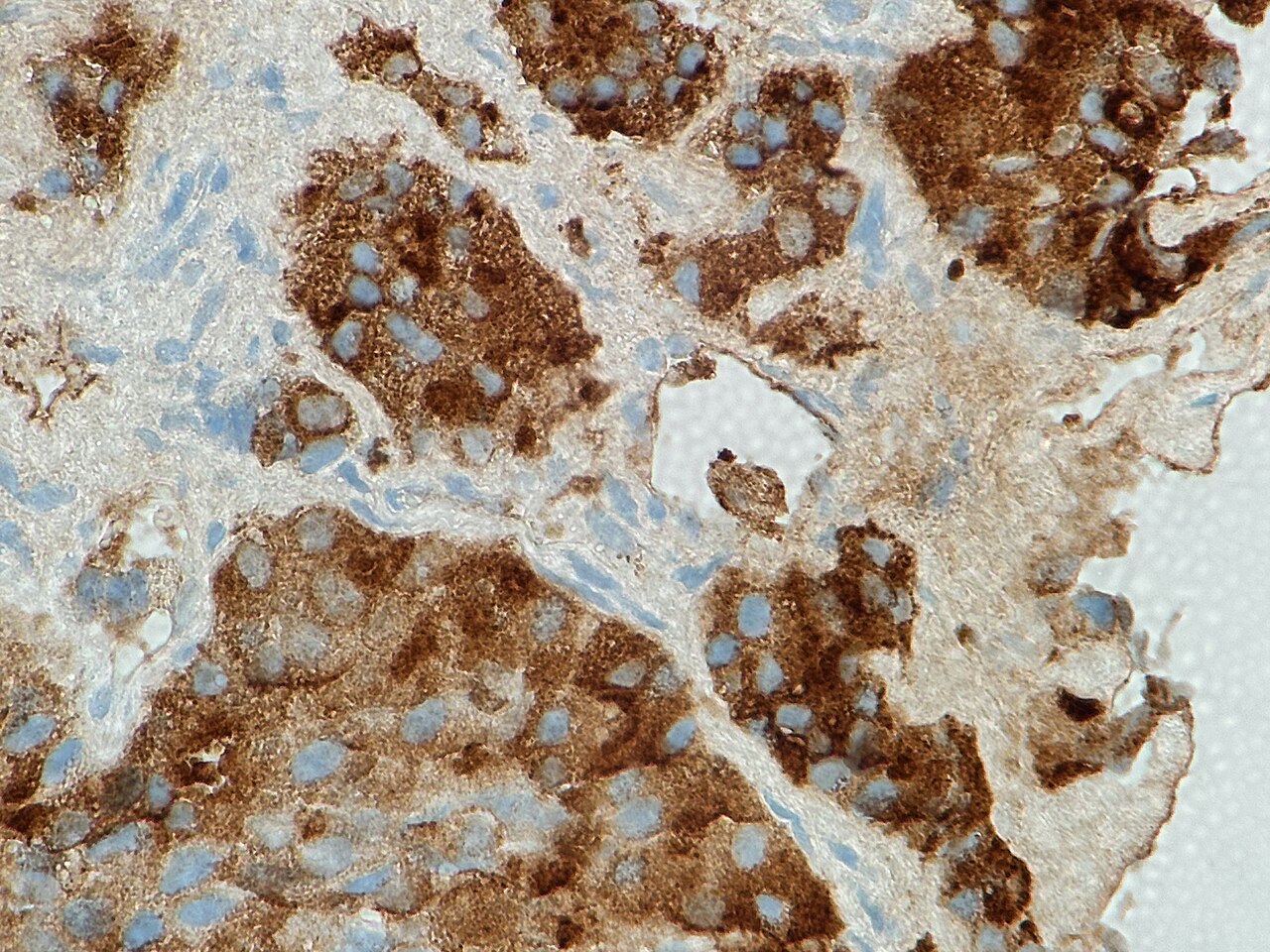
Image: PSA immunohistochemistry of metastatic prostate cancer, Mikael Haggstrom, CC0, via Wikimedia Commons.
Comments