

Some people are born lucky in a very specific way. A small number of us carry a broken copy of a gene called PCSK9, and because of that quirk they spend their whole lives with low cholesterol and, on average, fewer heart attacks. They did nothing to earn it. The genetic dice simply landed well.
A phase 1 trial published in the New England Journal of Medicine set out to hand that same luck to people who were not born with it, using a single intravenous infusion that rewrites one letter of DNA inside the liver. The therapy is called VERVE-102, and the work was led by Vafai et al. at Verve Therapeutics, now a subsidiary of Eli Lilly, in Boston.
Why it matters: High LDL cholesterol is one of the most treatable drivers of heart attacks, but today's therapies only work for as long as a person keeps taking them. A one-time infusion that durably lowers LDL could turn lifelong treatment into a single dose — if larger, longer trials confirm it is safe and actually prevents heart attacks.
Borrowing a mutation instead of inheriting it
PCSK9 is a protein made in the liver that acts like a saboteur of your cholesterol cleanup crew. It grabs the receptors that pull low-density lipoprotein, or LDL, out of the bloodstream and drags them off to be destroyed. Fewer receptors means more LDL cholesterol left circulating, and LDL is the fraction that builds up in artery walls. People with a naturally disabled PCSK9 gene keep more of those receptors, clear more cholesterol, and tend to have healthier arteries.
VERVE-102 tries to copy that accident on purpose. It uses base editing, a refined descendant of CRISPR that does not cut the DNA strand in two. Instead it chemically converts a single genetic letter, in this case flipping one base so the PCSK9 gene can no longer make a working protein. The edit is delivered as a set of instructions: a messenger RNA that tells liver cells how to build the editing protein, plus a guide RNA that points it to the exact spot in the PCSK9 gene. Both are wrapped in a fatty bubble, a lipid nanoparticle, studded with a sugar tag called N-acetylgalactosamine that liver cells recognize and pull inside. The cargo does its work and then breaks down, but the edit it leaves behind is written into the DNA itself.
What one dose did
The study enrolled 35 adults who either had heterozygous familial hypercholesterolemia, an inherited condition that keeps cholesterol dangerously high, or early coronary artery disease. Each received one infusion at one of six doses, ranging from 0.3 to 1.0 milligrams of total RNA per kilogram of body weight. Everyone was followed for at least 28 days, and 15 participants were tracked for a year or more.
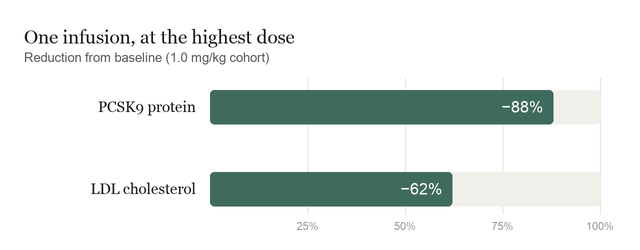
The effect scaled with the dose. At the lowest dose, blood levels of the PCSK9 protein fell by about 51 percent. At the highest, they dropped by 88 percent, meaning the liver had largely stopped making the saboteur protein. LDL cholesterol followed the same curve, falling 9 percent at the low end and 62 percent at the top dose. In practical terms the highest dose cut LDL by 78 milligrams per deciliter, a large move for a single treatment. And the reductions did not fade. Across the follow-up period, including the participants watched for over a year, the numbers stayed down — the authors report that “Reductions appeared to be durable throughout follow-up” — which is what you would expect from a change made to the gene rather than a drug that has to be taken again and again.
On safety, the early signals were reassuring rather than alarming. No dose-limiting toxic effects showed up. Some participants had mild-to-moderate reactions during the infusion and temporary bumps in a liver enzyme, alanine aminotransferase, that settled on their own. One person with acid reflux developed aspiration pneumonitis, an inflammation of the lungs.
What the study can't say yet
This is a first-in-human, open-label trial with 35 people and no comparison group, designed to test safety and to see whether the biology moves in the right direction. It was not built to prove that anyone avoided a heart attack. Lower LDL cholesterol is one of the most reliable predictors of cardiovascular risk, but a drop in a blood number is a stand-in for the outcome that actually matters, and confirming that will take far larger, longer, randomized studies.
A year of durability is encouraging, yet a permanent edit demands a much longer horizon of watching. Because base editing changes the DNA for good, there is no dialing it back if a problem surfaces later, so questions about off-target edits and effects that emerge over many years remain open. The trial also enrolled a select group, people with inherited high cholesterol or early heart disease, so it says little about how the therapy would behave in the broader population. And these are results reported by the company that makes the therapy.
Still, the core observation is hard to wave away. One infusion, a single rewritten letter in the liver, and a stubborn risk factor stayed lowered for a year. Whether that translates into fewer heart attacks is the next, much harder question, and it is finally one that can be asked.
Quick questions
Can I get VERVE-102 from my doctor now? No. This was a first-in-human phase 1 safety study in just 35 people; the therapy would need much larger, longer, randomized trials before it could be approved for use.
Does the big LDL drop mean fewer heart attacks? Not proven yet. LDL fell sharply and lower LDL reliably predicts lower cardiovascular risk, but this trial was not designed to show that it actually prevents heart attacks.
Can the DNA edit be undone if something goes wrong? No. Base editing rewrites the gene permanently, which is exactly why long-term safety monitoring matters so much.
The one-line takeaway? A single infusion durably lowered a major cholesterol risk factor for at least a year — genuinely promising, but proof that it prevents heart attacks is still to come.
Vafai et al. "In Vivo Base Editing of PCSK9 with VERVE-102 for Hypercholesterolemia." New England Journal of Medicine, 2026. doi.org/10.1056/NEJMoa2601283
PubMed PMID: 42187087.
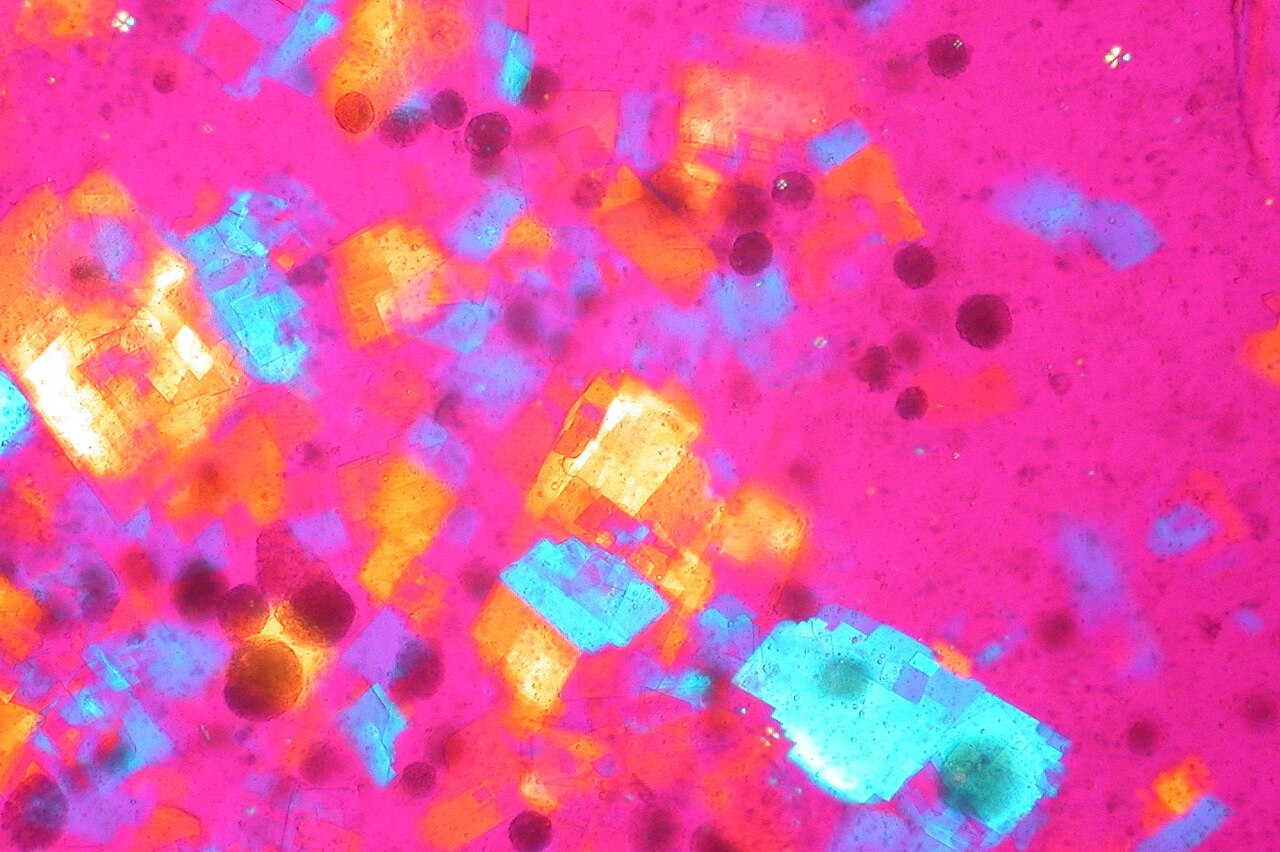
Image: Cholesterol crystals under polarized light. Ed Uthman, MD, CC BY 3.0, via Wikimedia Commons.
Comments