
Somewhere in most hospitals that do genetic testing, there is a freezer that cannot be allowed to fail. It hums at minus 80 degrees Celsius, backed up by alarms and generators, and it holds the one thing a genetic diagnosis depends on: intact DNA. Let a sample warm up, or let it thaw and refreeze a few times, and the long strands start to shear into shorter pieces. For the newest kind of sequencing, that damage matters. The cold chain is the quiet reason genomic medicine tends to stay inside wealthy, well-wired institutions and struggles to travel anywhere else.
A team at Stanford has been testing a way to skip the freezer entirely. In a paper published June 15 in Genome Biology, researchers led by Alexis Ferrasse (Ferrasse et al.), working in Euan Ashley's group at Stanford and its Center for Undiagnosed Diseases, describe wrapping DNA inside a shell of silica, the same basic material as glass and sand. They call it ensilication. The encased DNA sat at ambient temperature for 30 days, was later freed from its glass, and then read about as cleanly as DNA that had been kept frozen the whole time.
Why it matters: A diagnosis for a rare genetic disorder currently depends on a cold chain that most of the world cannot afford, keeping advanced sequencing locked inside well-resourced hospitals. If DNA can be sealed in glass and shipped at room temperature without losing diagnostic quality, the same answers that end a family's long search could reach clinics that never had a minus-80 freezer.
Why the freezer is so hard to leave behind
The reason this is worth caring about comes down to what today's best sequencing reads. Older methods chopped DNA into tiny fragments and stitched the pieces back together with software. Newer "long-read" sequencing threads much longer molecules through a pore and reads them in one continuous pass. That extra length lets it see through repetitive, garbled stretches of the genome that short reads simply can't resolve. It also reads chemical tags sitting on top of the DNA, called methylation, that switch genes on and off without changing the letters underneath.
Both of those advantages are fragile. Break the DNA into shorter chunks and the long reads get shorter too. Handle it carelessly and the methylation marks can smear. So the field leaned on deep cold to hold everything still. Ensilication is a bet that you can freeze the molecule in place chemically, inside solid glass, instead of freezing the whole tube.
The Stanford group put that bet through a fairly demanding set of checks. They ran it against three well-characterized reference genomes, the widely used "Genome in a Bottle" standards, comparing ensilicated samples head to head with frozen ones. The ambient glass-stored DNA and the minus-80 DNA showed no significant difference in read length, with molecules running roughly 8,000 to 11,000 bases before they ended. Variant calling, the step where you actually spot the mutations, held up. So did the genome-wide methylation. When they checked individual methylation calls against an independent gold-standard method, the per-read accuracy between the two storage conditions differed by less than half a percent. The authors report that “ensilication introduces no detectable bias” in those single-read methylation calls.
Two patients, and the reason this isn't just a chemistry trick
The part that lifts this out of the realm of clever preservation is what happened with real samples. The researchers applied the method to DNA from two people with rare genetic disorders. In one, the ambient-preserved DNA resolved a spontaneous, or de novo, mutation sitting in the GTF2I region, a stretch of the genome that is duplicated in places and notoriously hard to read accurately. In the other, it picked up a methylation pattern consistent with a condition tied to the gene KDM2A. These are exactly the kinds of findings that give a family an answer after a long diagnostic odyssey, and the glass-stored DNA delivered them.
The samples also turned out to be sturdier in ordinary ways. Ensilicated DNA put up with repeated handling better than frozen DNA, and it held its length under what the authors call accelerated weathering, a lab stand-in for the heat and time a sample might face on a long trip. The picture they sketch is a vial of DNA you could mail across a country with poor refrigeration, store on a shelf, and still sequence to diagnostic quality at the other end.
What the study can't say yet
This is a proof of concept, and it reads like one. Thirty days at room temperature is a real result, but it is not a year, and clinical samples sometimes wait far longer than a month. The clinical evidence rests on two patients, which is enough to show the method can recover known, meaningful findings but not enough to measure how often it might miss something in routine use. The reference-genome comparisons are rigorous, yet they were run in a single lab with one sequencing setup, so how the approach behaves across different machines, sample types, and everyday clinical messiness is still open.
There's also a commercial thread worth naming plainly. Two of the authors are affiliated with Cache DNA, a company built around this kind of ambient DNA storage, and the silica encapsulation is the product. That doesn't undo the measurements, which stand on their own, but it's the sort of context a careful reader should hold alongside the results. Independent labs will need to reproduce the work before anyone leans on it.
What the paper does establish is narrow and concrete. You can lock high-quality DNA inside glass, leave it warm for a month, and still read both its sequence and its methylation about as well as if you'd kept it frozen the entire time. If that holds up in more hands and over longer stretches, the freezer stops being a gatekeeper. The technology that finds the answer for a child with an undiagnosed disease could then reach the places that never had a minus-80 freezer to begin with.
Quick questions
Does room-temperature storage make the DNA read worse? Not in this study. Across three reference genomes, glass-stored DNA held at ambient temperature for 30 days matched frozen DNA on read length, variant calling, and methylation, with per-read methylation accuracy differing by less than 0.4 percent.
Is this ready to use in the clinic now? No. It is a proof of concept tested for 30 days, with clinical evidence from just two patients and results from a single lab. Longer storage times and independent replication are still needed.
One-line takeaway? Sealing DNA in glass let it survive a month at room temperature and still sequence to diagnostic quality, hinting that genomic diagnosis could one day travel without a freezer.
Ferrasse A et al. "Ensilication preserves high-molecular weight native DNA for clinical long-read sequencing." Genome Biology, 2026. doi.org/10.1186/s13059-026-04137-4
PubMed PMID: 42298673.
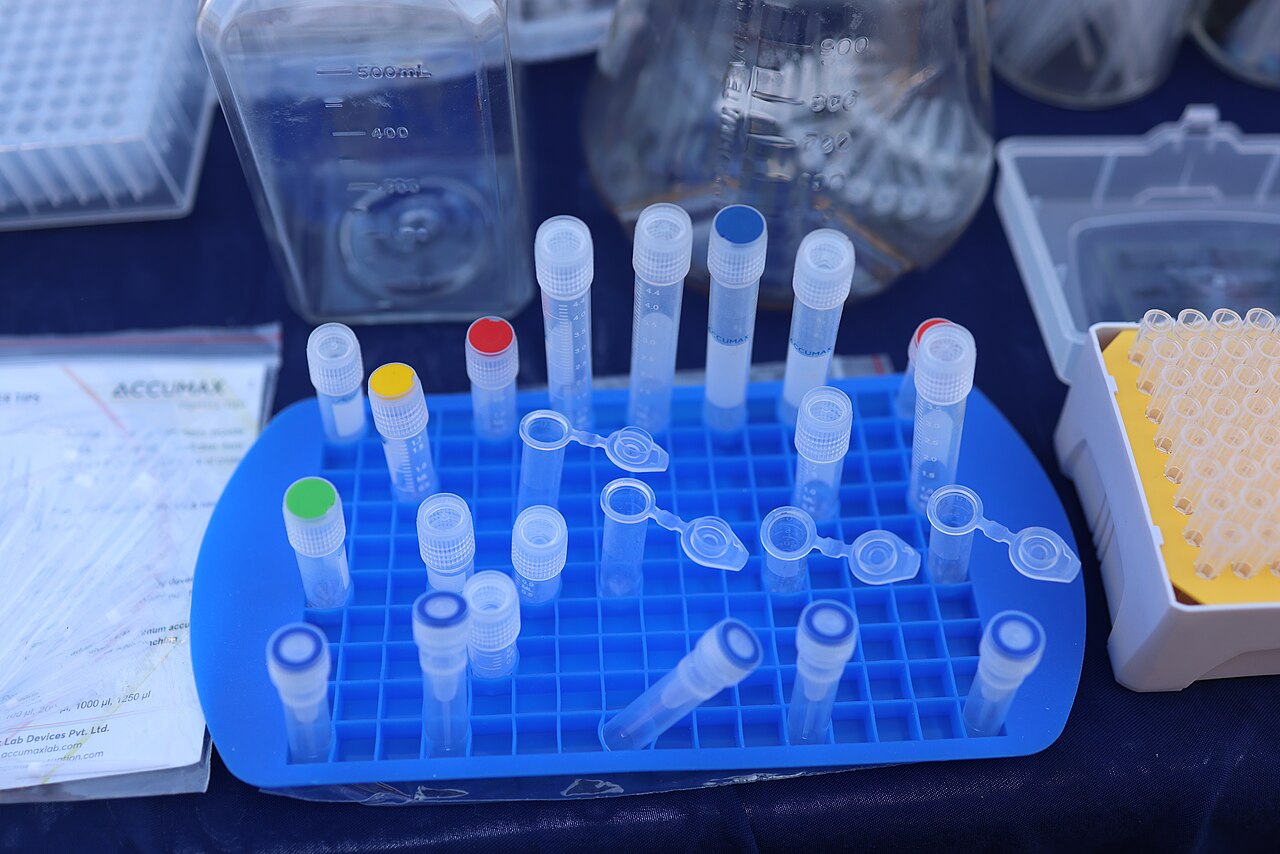
Photograph: Gannu03, CC BY-SA 4.0, via Wikimedia Commons.
Comments