
A honey bee colony behaves less like a crowd of insects and more like a single body with tens of thousands of moving parts. Food is shared mouth to mouth, work is divided by age and caste, and a threat to one bee becomes a problem the whole colony solves together. That collective behavior has a hidden benefit that has been hard to measure. When a pesticide arrives on a forager's load of nectar, the colony can blunt its impact before it reaches the members it cannot afford to lose. A new study set out to watch exactly how that defense works, and to catch the moment it fails.
Writing in Current Biology, researchers at the University of California, Davis and the U.S. Department of Agriculture fed a small laboratory colony a pesticide carrying a faint radioactive label, then followed that label wherever it went. Their instrument, biological accelerator mass spectrometry, can detect vanishingly small amounts of a traced molecule, which let them map the chemical's path through workers, wax, honey, the queen, and finally her eggs. What they found was a colony operating as a detoxification network, and a last line of defense that had not been documented before.
The hive as a filter
The colony's first move was to dilute. Worker bees, who process incoming food and pass it around, stripped roughly 95 percent of the pesticide out of the diet early on, parking much of it in the wax of the honeycomb rather than letting it circulate. The comb became a kind of chemical landfill. But the filter was not permanent. By day 10 the share of pesticide kept out of the diet had slipped from 95 to 86 percent, a sign that the colony's capacity to sequester the chemical was finite and filling up.
The queen sat apart from all of this. Fed and groomed by attendants, she carried markedly less pesticide in her body than the workers around her, the kind of protection a colony would be expected to lavish on the one individual it cannot replace. For a while, the social insulation held.
Where the last of it goes
Then the researchers watched that insulation give way. Over time, the pesticide the queen could not avoid began to collect in her ovaries, and from there it passed into the eggs she was laying. This is the result the authors flag as new. A reproductive queen, unable to shed a chemical burden any other way, offloads it into the next generation. It is a bleak form of self-preservation: the queen stays functional, and the cost moves downward into eggs that cannot refuse it.
The queen's presence also reshaped the colony's chemistry as a whole. In hives with a laying queen, workers ended up more exposed and more pesticide built up in the wax than in colonies without one. The same social structure that shields the queen redistributes the risk onto everyone else. The authors describe a system in which a chemical's fate is decided less by its own properties than by the colony's behavior and the division of labor among castes.
What the study can't say yet
This was a small colony under controlled laboratory conditions, fed a single model pesticide with a radioactive tag chosen to be trackable rather than to match a specific product a bee would meet in a field. Real colonies are larger, face mixtures of chemicals at doses that rise and fall with the seasons, and forage across landscapes a lab cannot reproduce. Whether the same filter-then-offload pattern holds at field scale, and for the pesticides bees actually encounter, remains to be shown.
The study also traced where the pesticide went, not what it did once it arrived. Finding the chemical in eggs is not the same as measuring harm to the brood that hatches from them, and the paper does not claim to close that gap. It is a map of chemical movement. The biological consequences of that movement, for the eggs and for the colony's long-term health, are the obvious next question rather than something this work answers.
Why it matters anyway
Honey bees pollinate about a third of the crops people eat, and the long, uneven decline of managed and wild pollinators has been one of the more stubborn worries in agriculture. Much of the research on pesticides and bees has focused on the individual insect, testing how a dose affects a single forager's memory or lifespan. This work reframes the question at the level of the society. A colony is not a passive victim of a contaminated flower. It actively moves, stores, and redistributes what it takes in, and those behaviors decide who is exposed and who is spared.
That reframing cuts both ways. It reveals a resilience that individual-bee studies miss, a colony able to absorb a chemical hit that would overwhelm a lone insect. It also shows that the resilience has an exit valve, and the valve empties into the eggs. Making sense of pollinator decline may depend on watching not just what a pesticide does to a bee, but what a colony does with it.
Encerrado-Manriquez AM et al. "Queen bees offload pesticide burden to eggs when social buffering is overwhelmed." Current Biology, 2026. doi.org/10.1016/j.cub.2026.06.022
PubMed PMID: 42392068.
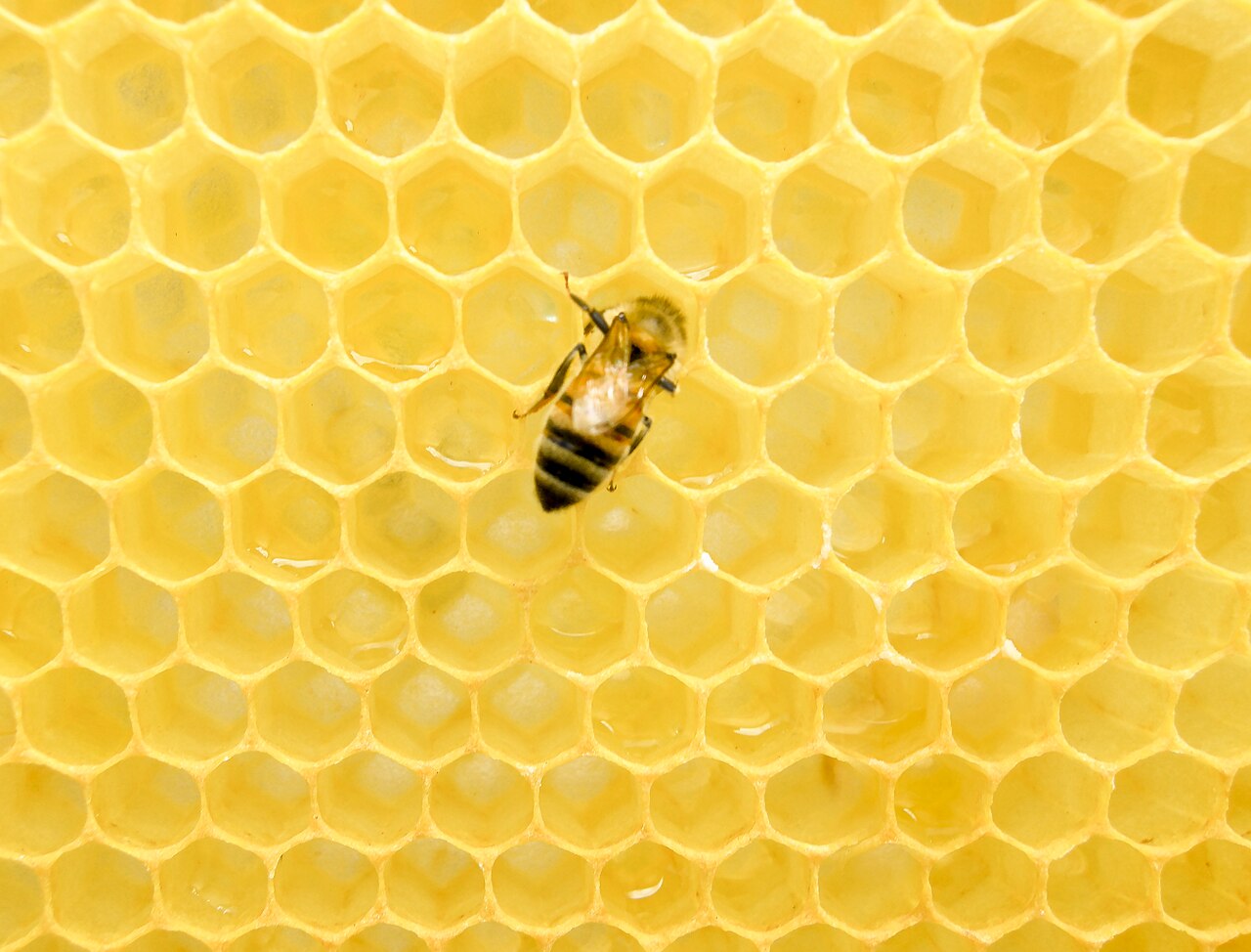
Photograph: Matthew T Rader, CC BY-SA 4.0, via Wikimedia Commons.
Comments