
Neurons and muscle get the attention in bioelectricity because their voltage changes are large and obvious. Every other cell also holds a membrane potential, and there is good evidence it matters for proliferation, differentiation and development. The problem has been measurement. The interesting fluctuations in a non-excitable cell are fractions of a millivolt, and the available indicators could not resolve them, so the question of what those cells do electrically over time was largely unaskable.
A group at Friedrich Schiller University Jena built an indicator sensitive enough and then used it on a straightforward question: what changes when cells are electrically connected to their neighbours rather than sitting alone. The answer is that connection quiets them. Voltage in coupled cells is markedly less volatile, and the variance falls in proportion to one over the number of cells in the network.
Why it matters: That scaling is the signature of averaging. It means electrical stability in a tissue is not something each cell achieves and then shares, but something that exists only in the group, and it appears without any signalling pathway being involved.
The instrument, and its honest limits
The indicator was made by rational engineering rather than directed evolution, which usually means screening hundreds to thousands of mutants. Combining what is known about fluorescent protein optimization with a systematic analysis of how mutations in the voltage-sensing domain shape the optical response got there without the brute-force screen.
The performance figure worth quoting is the comparison with the alternative technology. Chemical dyes based on photoinduced electron transfer are the main competitor and can be calibrated for absolute voltage. The best cited gives a 1.63-fold change in fluorescence across 100 millivolts; this indicator gives 4.6-fold, which is what buys resolution below a single millivolt.
The paper also states plainly what it gave up. As Rühl and colleagues note in Nature Communications, A limitation of rEstus2s is that it exhibits reduced excitation at 400 nm relative to rEstus and therefore cannot be calibrated by dual-excitation ratiometry. So the new tool measures change more sensitively while its predecessor remains the one to use for absolute voltage, and they say so rather than presenting a straight upgrade.
What coupling does
Gap junctions are protein channels joining the interiors of adjacent cells, letting ions pass directly between them. Two cells joined this way are, electrically, closer to one larger cell. If each cell's voltage wanders because of the random opening and closing of its own ion channels, then joining many together should average those independent fluctuations out, and the variance should shrink as one over the number of cells.
That is what was measured, which makes the effect passive. Nothing is sensing instability and correcting it. Stability is a consequence of being wired together, in the same way that a larger sample has a smaller standard error, and the authors name the phenomenon bioelectric contact inhibition.
The cancer-relevant test sharpens it. Calcium-activated channels associated with tumours, including ANO1 and KCa3.1, make isolated cells electrically volatile. In coupled networks that volatility was suppressed. Disrupting the gap junctions abolished the suppression and the volatility returned, which is the manipulation that turns a correlation into something causal.
Why the cancer link is suggestive
Loss of gap junction coupling is a well-documented early feature of many tumours, and it has usually been discussed in terms of cells escaping growth-regulatory signals passed between neighbours. This offers a different and more physical consequence: a cell that disconnects also loses the averaging that kept its membrane potential steady, and if it additionally overexpresses the channels that generate volatility, the two changes compound. Whether that instability contributes to anything, or is merely a readout of disconnection, is not established here.
What the study can't say yet
Cultured cells are not tissue. Real epithelium sits on a basement membrane in three dimensions with heterogeneous coupling, and the clean inverse relationship between network size and variance is a property of a monolayer in a dish, where the number of connected cells can be counted. Whether it holds where coupling is patchy is untested.
The functional consequence is also absent. Every result concerns electrical behaviour, and none demonstrates that a cell with a volatile membrane potential proliferates differently, migrates differently, or behaves more like a tumour cell. The framework is proposed as a unifying one for how multicellular systems maintain electrical homeostasis, which is a hypothesis this data supports rather than a demonstrated function. And because the indicator cannot be calibrated for absolute voltage, the measurements describe fluctuation rather than where a given cell actually sits.
Quick questions
Why does connecting cells reduce voltage noise? Because their independent random fluctuations partially cancel when the interiors are electrically continuous. It is averaging, not regulation.
Do non-excitable cells really use voltage? They maintain a resting potential, and it is linked to proliferation and development. What they do with it on short timescales has been hard to study because the changes are too small to see.
What's the one-line takeaway? A more sensitive voltage indicator shows that gap junction coupling passively stabilizes membrane potential, with variance falling as one over network size, and that cutting the connections restores the volatility driven by cancer-associated ion channels.
Rühl et al. "Sub-millivolt voltage imaging reveals gap junction-mediated bioelectric contact inhibition." Nature Communications, 2026;17(1). doi.org/10.1038/s41467-026-76758-z
PubMed PMID: 42603816.
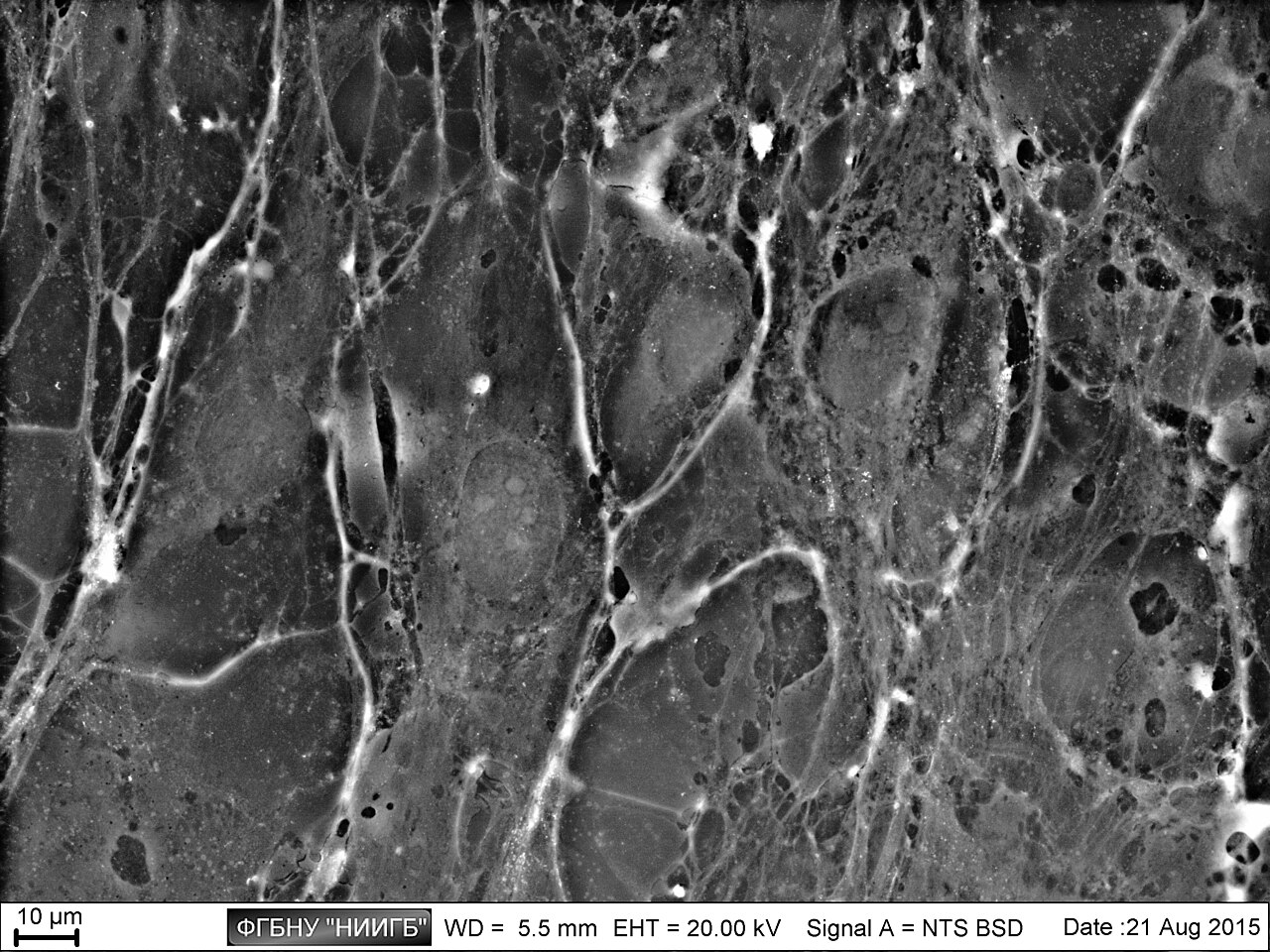
Image: Limbal epithelial cell monolayer, Ivan A. Novikov, CC BY-SA 4.0, via Wikimedia Commons.
Comments