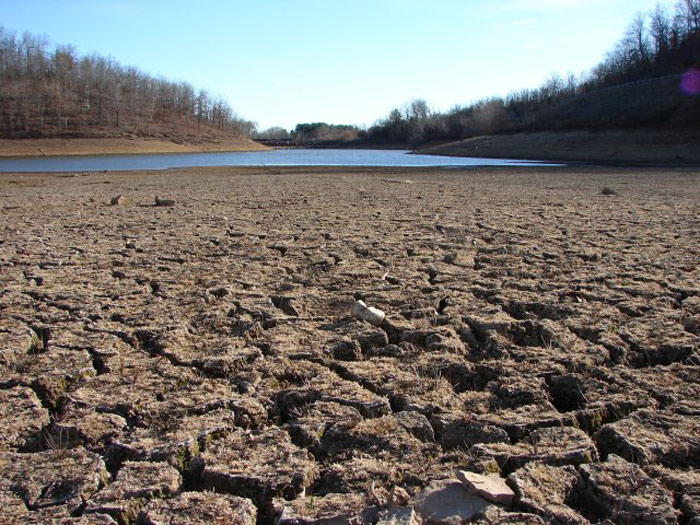
When people picture a drought, they usually picture rain that never came. But a lot of the damage happens on the other side of the ledger, in water that leaves the ground and the leaves faster than it used to. Warm air is thirsty air. Heat it up and it pulls moisture out of soil, rivers, and the pores of plants with more force, whether or not the rain shows up. A team led by researchers at Oxford and Southampton spent that logic across 122 years of global data, and the picture that came back is unsettling in its consistency.
The study, published in Nature in June 2025, built an ensemble of high-resolution drought datasets covering 1901 to 2022. Across that span, drought severity has climbed worldwide. The dry places are getting drier, which is roughly what you would expect. The surprise is that many wet places are drying too. And the driver the team keeps pointing at is not a shortfall in precipitation. It is the growing thirst of the atmosphere itself.
The measure that captures a thirstier sky
The technical name for that thirst is atmospheric evaporative demand, usually shortened to AED. It is a way of asking how much water the air would take from the surface if water were freely available. It rises with temperature, with sunshine, with wind, and with dry air. As the planet has warmed, AED has gone up, and the researchers were able to separate its fingerprint from ordinary rainfall swings.
The number they land on is large. Increased evaporative demand has raised global drought severity by an average of 40 percent. That is not a story about one bad year or one unlucky region. It is a background trend that has been quietly loading the dice for decades, making each dry spell bite harder than the same rainfall deficit would have a century ago.
The recent acceleration stands out even against that long climb. In the five years from 2018 to 2022, the land area in drought expanded by an average of 74 percent compared with the 1981 to 2017 baseline, and evaporative demand accounted for 58 percent of that expansion. The year 2022 broke records. Moderate to extreme drought touched 30 percent of the global land surface, and the thirsty atmosphere explained 42 percent of that reach.
Why wet regions are not safe
The finding that humid areas are drying deserves a second look, because it cuts against the tidy summary that climate change makes wet places wetter and dry places drier. That summary is about rainfall. Drought is about the balance between what falls and what evaporates. A region can keep getting decent rain and still slide toward drought if the air above it is pulling water away faster than before.
That reframing matters for anyone planning around water. Reservoir operators, farmers, and forest managers who track only precipitation are watching half the equation. A wet spring followed by a hot, dry summer can leave soils parched even in a year with normal rainfall totals, because the demand side ran hot the whole time. The study makes the case that evaporative demand belongs in the forecast alongside the rain gauge.
What the study can't say yet
This is an analysis of trends and attribution, not a controlled experiment, and the authors are careful about what that allows. Global drought records carry real uncertainty, which is exactly why the team built an ensemble of datasets rather than trusting a single one. The 40 percent figure is an average across that ensemble, and it comes with spread. Different methods of estimating evaporative demand can nudge the number up or down.
Attribution also has limits. The work ties worsening drought to rising evaporative demand and links that rise to warming, but it stops short of assigning every regional event to greenhouse gases versus natural variability. Local drought is a tangle of ocean cycles, land use, and water management, and a global synthesis smooths over much of that texture. The study says where the thirsty atmosphere is doing heavy lifting; it does not promise the same share in every valley.
The forward-looking claim is a projection, not an observation. The authors expect evaporative demand to keep climbing under future warming, which would keep pushing drought severity up. That is a reasonable extrapolation of a robust past trend, but it depends on emissions and on how vegetation responds to more carbon dioxide, a feedback that remains genuinely uncertain.
Still, the through-line is hard to shrug off. For a century, the share of drought severity that traces back to a warming, thirstier atmosphere has been growing, and it has grown fastest in the last few years on record. It means the map of where water is scarce is being redrawn not only by where the rain falls, but by how hard the sky pulls it back.
Gebrechorkos et al. "Warming accelerates global drought severity." Nature, 2025. doi.org/10.1038/s41586-025-09047-2
PubMed PMID: 40468063.
Photograph: National Oceanic and Atmospheric Administration, Public domain, via Wikimedia Commons.
Comments