
Every summer that the ocean runs a fever, some corals turn ghostly white and some do not. Reef biologists have spent years chasing the reasons why. The convenient answer has always been the algae: corals live in partnership with tiny photosynthetic cells called symbionts, and swapping a heat-sensitive strain for a hardier one can buy a colony a few degrees of grace. But that never explained the whole picture. Two neighboring colonies, same species, same symbionts, same patch of reef, would sometimes react to a heatwave in completely opposite ways.
A team working in Kane'ohe Bay on the island of O'ahu went looking for what else might be going on. Instead of sequencing genes, they read the chemistry. They took corals whose behavior in past bleaching events was already known, bred them, and then traced the molecular contents of their offspring from sperm and egg all the way to settled juveniles. What they found suggests that a coral's chemistry, and some of its resistance to heat, does not start fresh with each generation.
Reading a coral by its chemistry
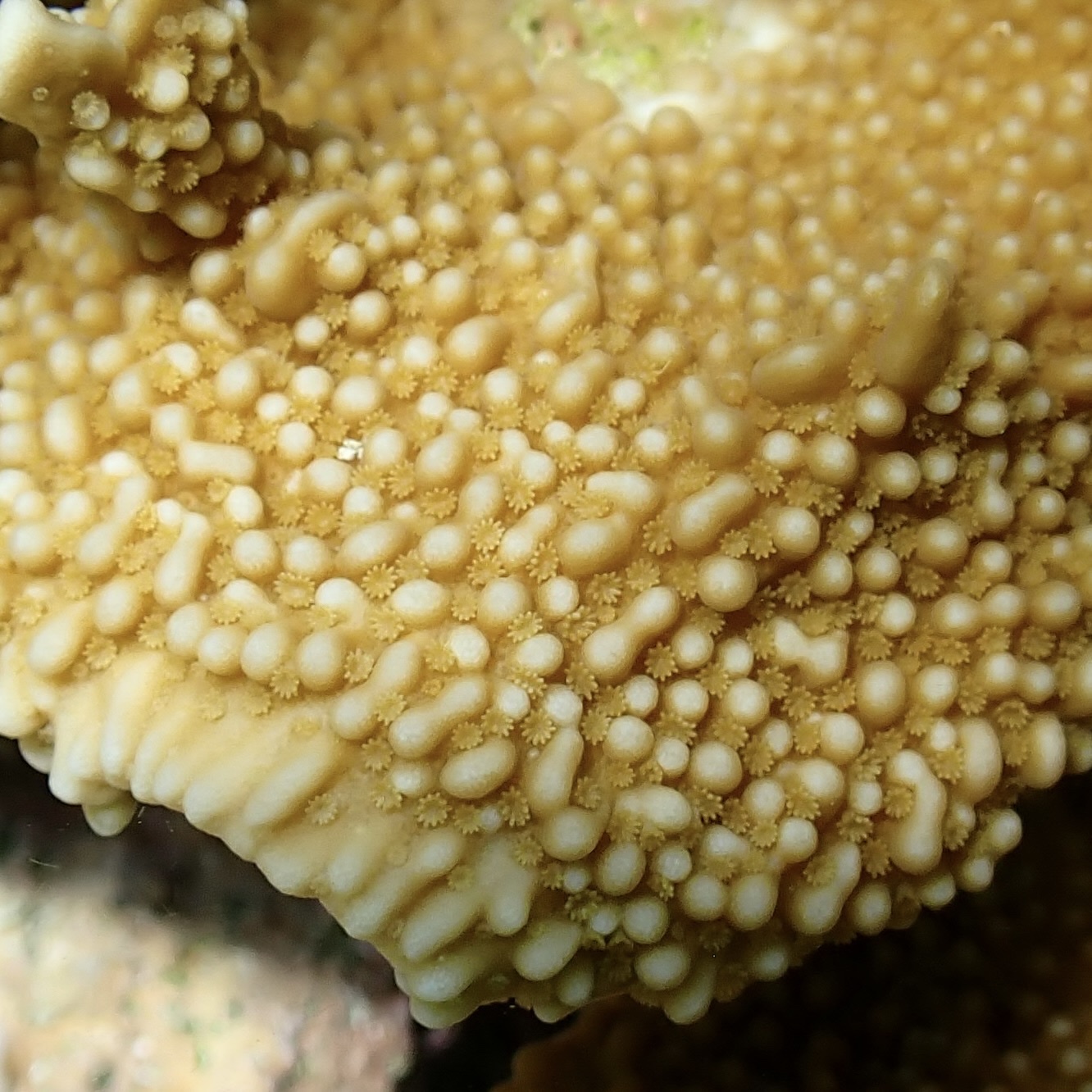
The species is Montipora capitata, the rice coral, a common reef-builder in Hawai'i. The researchers used metabolomics, which is the practice of measuring the small molecules a living thing produces rather than the genes that encode them. Think of it as sampling the finished dishes coming out of a kitchen instead of reading the recipes. Metabolites capture what an organism is actually doing in the moment, shaped by both its genes and its environment.
They compared the chemical profiles of corals with a documented history of resisting bleaching against those with a history of succumbing to it. The two groups looked different at the molecular level. More striking, that difference showed up in their children. Sperm, eggs, embryos, larvae, and young corals all carried a signature that tracked with the parents' bleaching behavior. The chemistry was inherited, in a loose sense of the word, even though the offspring had never once faced a heatwave themselves.
A lipid that keeps turning up
One class of molecules stood out. These are betaine lipids called DGCC, and their saturation state, a measure of how their fatty tails are built, has been tied before to heat tolerance in the algal symbionts corals depend on. Here the same lipid signal reappeared as one of the strongest markers of inherited resistance.
The most surprising part came from a mismatch. Some offspring carried a symbiont strain, Cladocopium, that is generally the more heat-sensitive of the available partners. On paper those juveniles should have been vulnerable. Yet if their parents had come through a recent bleaching event intact, their DGCC lipids showed the hardier, more saturated profile anyway. The parental history seemed to override what the symbiont alone would predict. The authors traced the inherited chemistry to both the coral host and its algae, spanning several molecular families, which points to more than one route by which a phenotype can be handed down.
What the study can't say yet
This is a chemical fingerprint, not a guarantee of survival. The work shows that offspring of resistant parents inherit a metabolome associated with tolerance. It does not prove those young corals would actually withstand a bleaching event, because the researchers did not raise them to adulthood and cook them in a heatwave to find out. Correlation with resistance is not the same as resistance.
The mechanism also stays open. A lipid signature can be passed along through several routes, from molecules packed into an egg to shifts in how genes are switched on, and this study does not pin down which one is at work or how long the effect lasts. One generation of chemical priming might fade quickly, or it might compound. Nobody knows yet. The study also centers on a single species in one bay, so how far it generalizes to other corals and other reefs is untested.
Still, the payoff matters for anyone trying to keep reefs alive. Coral restoration increasingly leans on breeding tougher stock and replanting it, and that strategy assumes the toughness will carry forward. This work offers early evidence that at least part of it can, through chemistry rather than DNA sequence alone. If a coral that survives one bad summer can give its young a measurable head start, then the survivors of today's marine heatwaves may be worth more to a warming ocean than their numbers suggest.
Roach et al. "Intergenerational metabolomic signatures of bleaching resistance in corals." Nature Communications, 2025. doi.org/10.1038/s41467-025-61102-8
PubMed PMID: 40593676.
Photograph: Thomas Irvine, CC BY 4.0, via Wikimedia Commons.
Comments