
CAR-T therapy has a logistics problem hiding behind its cancer-fighting reputation. The most successful versions are built from a patient's own T cells, shipped to a factory, engineered to recognize the tumor, then shipped back and infused. That round trip takes weeks, costs a fortune, and fails outright when a patient is too sick to donate healthy cells. The obvious fix is to use one healthy donor to make cells for many patients. The obvious problem is that the recipient's immune system treats those donor cells as foreign and destroys them before they can do their job.
A group at Peking University and the Chinese PLA General Hospital went after that problem from an unusual angle. Instead of stripping away the marker proteins that flag donor cells as foreign, they changed the sugar molecules coating the cell surface. In a paper published in Cell on August 21, they report that deleting a single gene reshuffles those sugars enough to make donor T cells much harder for the host to attack, and they tested the idea in nine patients with lymphoma.
One deleted enzyme, a new sugar coat
The gene is called SPPL3. It codes for an enzyme that trims other enzymes involved in building the sugar chains, called glycans, that decorate the outside of cells. When the researchers used CRISPR to knock SPPL3 out of primary human T cells, the glycan pattern shifted. That shift physically got in the way of the molecular handshakes that immune cells rely on to recognize and kill each other. In lab tests, the edited cells drew far less fire from natural killer cells and from the recipient's T cells, the two forces that normally clear mismatched donor cells.
What makes the approach appealing is that it did not blunt the therapy itself. The anti-CD19 CAR molecule, the part that hunts down B-cell cancers, kept working normally on the edited cells. So the team got immune evasion without paying for it in lost potency, at least in the dish.
What happened in the patients
The clinical part of the study was a phase I trial in nine people with relapsed or refractory B-cell non-Hodgkin lymphoma, cancers that had come back or never responded to standard treatment. These patients received allogeneic CAR-T cells that were both SPPL3-null and stripped of their T-cell receptor, a standard edit meant to stop donor cells from attacking the recipient's tissues. The trial met its main safety goal. Three of the nine developed grade 3 or higher cytokine release syndrome, the immune overreaction that is a known risk of CAR-T therapy and is usually manageable in specialized centers.
Then the researchers noticed something in their own data that pushed them in a different direction. Cells missing the T-cell receptor did not stick around as long. The receptor, it turned out, was helping the CAR-T cells persist. So the team tried a bolder version, keeping the T-cell receptor intact and relying on the sugar shield alone to prevent rejection. They gave these T-cell-receptor-sufficient cells to three more patients with lymphoma or leukemia under compassionate use rules. None of the three showed clinical signs of graft-versus-host disease, the dangerous condition where donor cells turn on the patient's body. That was the outcome the receptor deletion was supposed to prevent, and here it did not happen even without it.
What the study can't say yet
These are small numbers. Nine patients in the main trial and three more in a compassionate-use group cannot tell you how often a therapy works or how long the benefit lasts. A phase I trial is designed to check safety, not to prove the cancer stays away, and this one does exactly that and no more. The absence of graft-versus-host disease in three people is encouraging, but three people is not enough to call the sugar shield a reliable replacement for deleting the T-cell receptor.
There are also open questions the glycan trick raises on its own. Changing the sugars on a cell surface is a blunt instrument, and the long-term consequences for how these cells behave, traffic through the body, and eventually die off are not settled here. Independent groups will need to reproduce the immune-evasion effect, and larger trials will have to show that persistence translates into durable remissions rather than a temporary reprieve.
Still, the logic is worth sitting with. Most efforts to build universal, off-the-shelf CAR-T cells focus on removing what the immune system recognizes. This one adds a layer that hides the cell instead, and the early hint that keeping the T-cell receptor might help the cells last longer runs against the field's usual instinct to delete it. If that holds up, the recipe for a truly off-the-shelf cancer cell therapy may look different from what most companies are currently building.
Wu et al. "Glycan shielding enables TCR-sufficient allogeneic CAR-T therapy." Cell, 2025. doi.org/10.1016/j.cell.2025.07.046
PubMed PMID: 40845838.
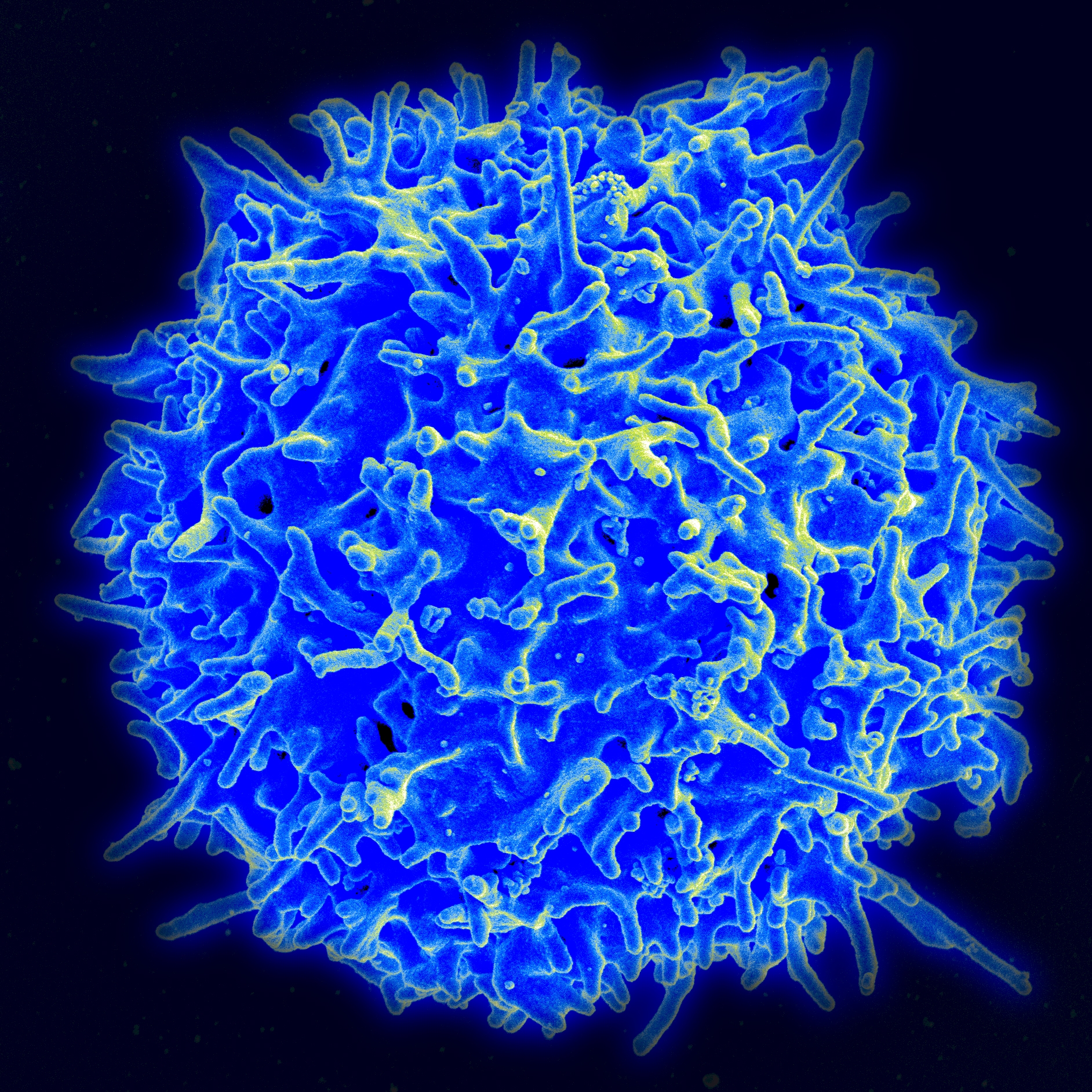
Photograph: NIAID/NIH, Public domain, via Wikimedia Commons.
Comments