Beneath the hard-baked soil of East Africa, a naked mole-rat colony runs on a rule that would look intolerable almost anywhere else in the animal world. The tunnels hold a crowd of pink, hairless, nearly blind rodents who dig, forage, haul pups around, and fling themselves at snakes. Exactly one of them breeds. The queen is the only female who will ever be pregnant, and the rest of the females in the colony, healthy adults with functioning ovaries, stay infertile for as long as she holds the throne. Biologists have known about this arrangement for decades. What nobody could say was how she enforces it.
A new study points at an answer with a distinctly unroyal name: isopropyl myristate, a heavy, greasy, barely volatile ester that sits on queens and is nearly absent from the non-breeding animals around her. It is not an exotic molecule. The same compound turns up in drugstore moisturizers, where it is valued for being slick and slow to evaporate. In a mole-rat colony, it appears to function as something closer to a standing order. Other animals smell it, and smelling it shifts their reproductive hormones. And when the compound kept arriving in a colony that no longer had a queen, the succession that normally follows a queen's death never came.
Why it matters: Eusociality, where one female breeds and everyone else works, is the organizing principle of ant and bee societies but is almost unheard of among mammals. Pinning a specific chemical to the mammalian version suggests evolution reached for the same kind of tool twice, in bodies as different as an insect's and a rodent's.
The work, led by Khallaf et al. at the Max Delbrück Center for Molecular Medicine in Berlin, with colleagues at the University of Pretoria, began with an obvious question that had never been answered cleanly: what is on a queen that is not on anyone else? Isopropyl myristate was the standout. It is enriched in queens and nearly absent from non-breeding animals, a difference sharp enough to make it a plausible signal rather than background noise.
A smell that lands in the nose and in the brain
A chemical is only a signal if somebody reads it. The team showed that isopropyl myristate is detected by both peripheral and central olfactory neurons, meaning it registers at the nose and again deeper in the brain's smell circuitry. It also carries social weight. The compound elicits avoidance in high-ranking animals, the ones with the most to gain from a vacancy at the top.
Then comes the part that reaches into the body. Exposure alters levels of prolactin and progesterone in non-breeders, two hormones central to reproduction, in the direction that suppresses it. That is the outline of a complete pathway: a molecule on the queen, a nose that reads it, and an endocrine system that answers by standing down.
Take away the queen, keep her smell
The most persuasive experiment is also the simplest to describe. When a naked mole-rat queen dies, her colony does not stay calm. Aggression flares, females compete, and a new queen eventually rises. It is one of the reliable dramas of mole-rat life.
So the chemical was kept flowing in a colony that no longer had a queen. Daily addition of isopropyl myristate to a queenless colony prevented queen succession. The animals behaved as though the throne were still occupied. When the compound was withdrawn, the delayed drama arrived on cue: aggression and reproductive competition broke out. The colony was not responding to the queen herself. It was responding to something she leaves behind.
An insect's trick, running in a mammal
The finding gets stranger when the researchers look sideways at the mole-rat family tree. Isopropyl myristate was also detected in breeding females of several Fukomys mole-rat species, cousins with their own, milder versions of a breeding hierarchy. But it reaches higher levels in naked mole-rats, paralleling their extreme reproductive skew. More of the chemical tracks with a more absolute monopoly on breeding.
That is what makes the authors reach for a comparison across the animal kingdom. Their findings, they write, reveal a chemical cue that can mediate reproductive suppression in a mammal, linking insect and mammalian eusociality. Ant and bee colonies famously run on queen pheromones. A mole-rat is not an insect by any stretch, but the logic of its society may rest on a similar chemical foundation.
What the study can't say yet
The authors are careful with their verbs, and it is worth reading them just as closely. They write that the odour can regulate the reproductive hierarchy, not that it is the only thing that does. Naked mole-rat queens also shove, chase, and bully; this work adds a chemical channel to that picture without proving it is the master switch.
The hormonal evidence is also a step removed from the outcome that matters most. The study reports shifts in prolactin and progesterone in non-breeders rather than direct measures of fertility, so the last link in the chain is inferred rather than watched. The avoidance response, too, is reported in high-ranking animals, and the paper does not say how the rest of the colony reacts. And the comparison with Fukomys species is a correlation across species, which suggests a pattern but cannot prove that the chemical caused their differing degrees of reproductive skew.
One more thing worth saying plainly, because the temptation runs the other way: none of this is about people. This is a study of a burrowing African rodent with an unusually strict society, and nothing in it speaks to human behaviour or human smell.
Quick questions
Is the queen basically drugging her colony? Not quite. She is not dosing anyone. She carries a compound that other animals smell, and smelling it shifts their hormones toward not breeding. It works through their own senses, not by force.
Why is isopropyl myristate in my moisturizer? The same properties that make it a decent lotion base make it a usable signal: oily, stable, and slow to evaporate, so it stays put on a body in a warm tunnel instead of drifting off. That is a coincidence rather than a connection. The cosmetics industry and the mole-rat arrived at the same molecule for unrelated reasons.
What's the takeaway? A single greasy molecule on a mole-rat queen can suppress breeding in the females around her, and removing the queen while keeping the molecule keeps her colony in line, hinting that mammals and insects found similar chemical answers to the same social problem.
Khallaf et al. "A queen odour mediates reproductive suppression in a eusocial mammal." Nature, 2026. doi.org/10.1038/s41586-026-10772-5
PubMed PMID: 42457958.
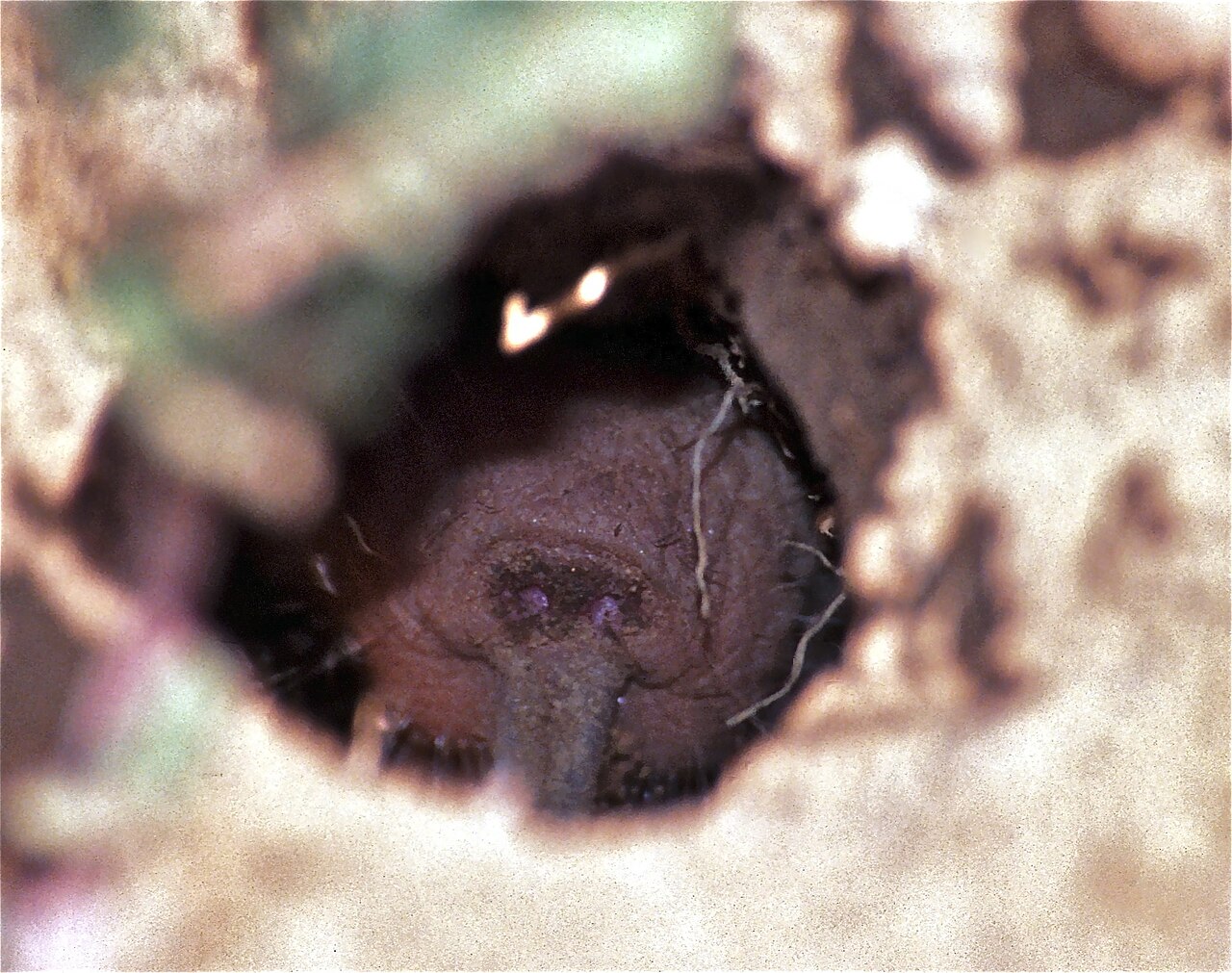
Image: Naked mole-rat (Heterocephalus glaber), Samburu National Reserve, Kenya. Bernard DUPONT, CC BY-SA 2.0, via Wikimedia Commons.
Comments