

On a raw morning in the boreal fringe of Alaska, a female tree swallow drops into a wooden nest box before the last snow has melted from the spruce shadows. She is running a calculation her ancestors never had to make: lay too early and a cold snap can wipe out the brood; lay too late and the brief northern burst of flying insects will already be fading when her chicks are hungriest. A thousand miles south, another tree swallow faces the same trade-off with weeks of slack to spare. Same bird, same instinct, wildly different margins for error.
A sweeping new analysis finds that tree swallows everywhere respond to warming in almost exactly the same way, advancing their egg-laying by about one day for every degree Celsius of local warming. Yet their fates are diverging sharply. Northern populations have shifted their breeding earliest of all, and are still declining fastest. The problem is not that some birds are less sensitive to a warming climate. It is that some have far less room to move.
Why it matters: Aerial insectivores like swallows are among the fastest-declining birds in North America, and this work shows that a shared, seemingly healthy response to warming can still leave whole regions of a species in trouble. Knowing where the squeeze falls hardest tells conservationists which populations to watch before they wink out.
The study, led by Taff et al. at Cornell University's Lab of Ornithology, drew on an extraordinary pool of data: 1,555 population-years gathered from 123 tree swallow populations spread across the continent, stitched together from dozens of long-running nest-box networks. That scale let the team separate two things that usually stay tangled together: how strongly a population reacts to temperature, and whether it can actually act on that reaction in time.
One day per degree, from Georgia to the Yukon
The headline surprise is the uniformity. Whether a swallow nests in the mild American South or the compressed summers of northern Canada, warmer springs pull its laying date forward at nearly the same rate, roughly a day earlier per degree of warming. Biologists sometimes assume that struggling populations must be the ones failing to keep up, dulled somehow in their sensitivity to the seasons. Here, that assumption breaks. The birds are all reading the same thermometer and responding in step.
What changes across the map is not the response but the runway. Northern swallows live inside a tighter calendar, hemmed in by late-melting snow at one end and a short, sharp pulse of insect abundance at the other. They are also feeling the strongest recent warming, since high latitudes are heating faster than the global average. So even though northern birds have advanced their laying dates the most, they still face intense selection to breed earlier still, especially in warm years, as though the season keeps sliding out from under them.
Why the far north falls behind
The result reframes what it means to be vulnerable to climate change. A population can be perfectly responsive and still lose ground, simply because of when and where it lives. In the words of the authors, vulnerability to climate change can arise not just from different sensitivity to warming, but from when and where populations can respond effectively. It is the difference between a runner who is slow and a runner who is fast but started closest to the cliff edge.
That distinction matters for triage. If declines came from blunted sensitivity, the fix might be about the birds themselves. Instead, the pressure is structural, baked into geography and the pace of regional warming. The populations that most need attention are the ones with the least slack in their annual schedule, and those happen to be the same ones warming fastest and thinning out fastest in breeding abundance.
What the study can't say yet
The analysis is powerful at describing the pattern, but it stops short of nailing the exact mechanism killing northern nests. It does not prove that mistimed breeding, rather than some parallel stressor like collapsing insect supplies, pesticide exposure, or conditions on distant wintering grounds, is what drives the steeper northern declines. Correlations between warming, timing, and abundance are consistent with a timing squeeze, but the study cannot fully rule out other forces moving together. Nor can findings from one adaptable, cavity-nesting songbird be assumed to hold for every migratory species. And because the data end where they end, the work cannot say how much further north populations can bend their schedules before they simply run out of calendar.
Quick questions
Do the northern birds just care less about warming? No. They respond to temperature just as strongly as southern birds, about one day earlier per degree. Their trouble is a lack of time and space to keep pace, not a lack of sensitivity.
Why single out tree swallows? They readily use nest boxes, so researchers have decades of detailed records across the continent, making them one of the best natural experiments for tracking how a widespread species meets a warming climate.
What's the takeaway? A shared, healthy-looking response to climate change can still hide uneven danger, and for tree swallows the sharpest edge is in the fast-warming north, where the calendar has the least give.
Taff et al. "Divergent population trajectories despite similar response to temperature in a widespread aerial insectivore." Proc Natl Acad Sci U S A, 2026. doi.org/10.1073/pnas.2601817123
PubMed PMID: 42412926.
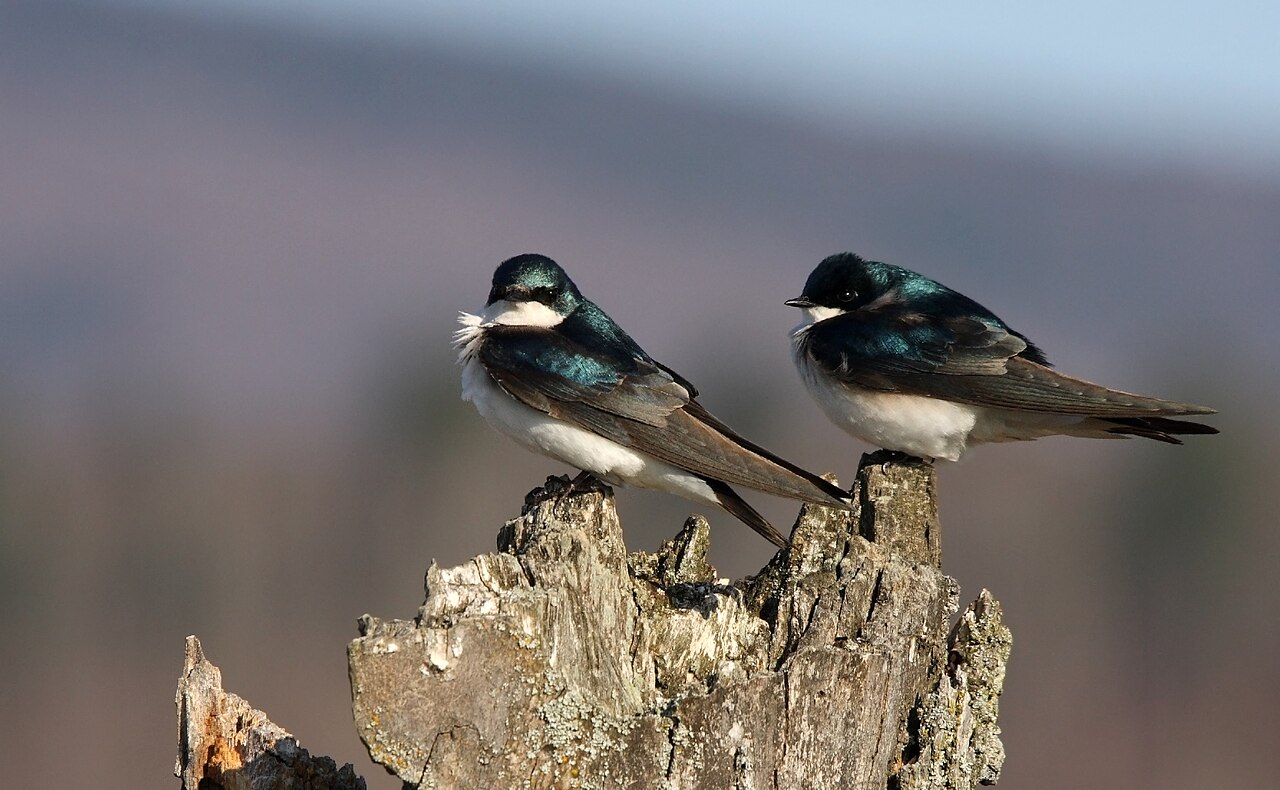
Image: Tree swallow (Tachycineta bicolor), Quebec. Cephas, CC BY-SA 3.0, via Wikimedia Commons.
Comments