
Every year stroke leaves around five million people with a lasting disability, and for many the hardest part is getting an arm or hand to cooperate again. A trial in Nature Medicine, published June 26, tried an unusual fix: immersive virtual reality run in lockstep with light electrical stimulation of the sensory nerves in the skin. Against standard rehab, it produced close to twice the gain in arm function.
Lining up sight and touch
The system, called MultiSensy, comes from labs at ETH Zurich and the Medical University of Vienna. Its logic is to rebuild the brain's map of a neglected limb by feeding two senses the same story at the same instant: a convincing virtual view of the hand moving, and a matched pulse of stimulation on the skin. When sight and touch agree, the brain is readier to attend to a body part it had begun writing off.
The numbers
Thirty-four people took part, all in the chronic stage of stroke, more than three months out, when most natural recovery has stalled. Across a pilot and a 33-day randomized run, MultiSensy beat conventional therapy on the two standard arm scales: 13.2 points gained against 7.5 on one, 8.3 against 2.4 on the other. People also got better at sensing where their own arm was, and at fine touch. Sensors logged movement the whole time, the kind of data that could let a therapist follow along from a distance.
Early days
This is a feasibility study, 34 patients over about a month, not the trial that settles things. The gains live on research scales for now. Whether they show up in real tasks like doing up a button or lifting a mug, and whether they last, will take bigger and longer studies. The authors say so themselves, and frame the work as a first step toward rehabilitation intense enough to matter but light enough to eventually run at home.
Aurucci, G. V. et al. “Immersive virtual reality with synchronous neurostimulation for upper-limb recovery after stroke: a randomized feasibility trial.” Nature Medicine, 2026. doi.org/10.1038/s41591-026-04486-4
PubMed PMID: 42362865. Trial registration NCT06400823.
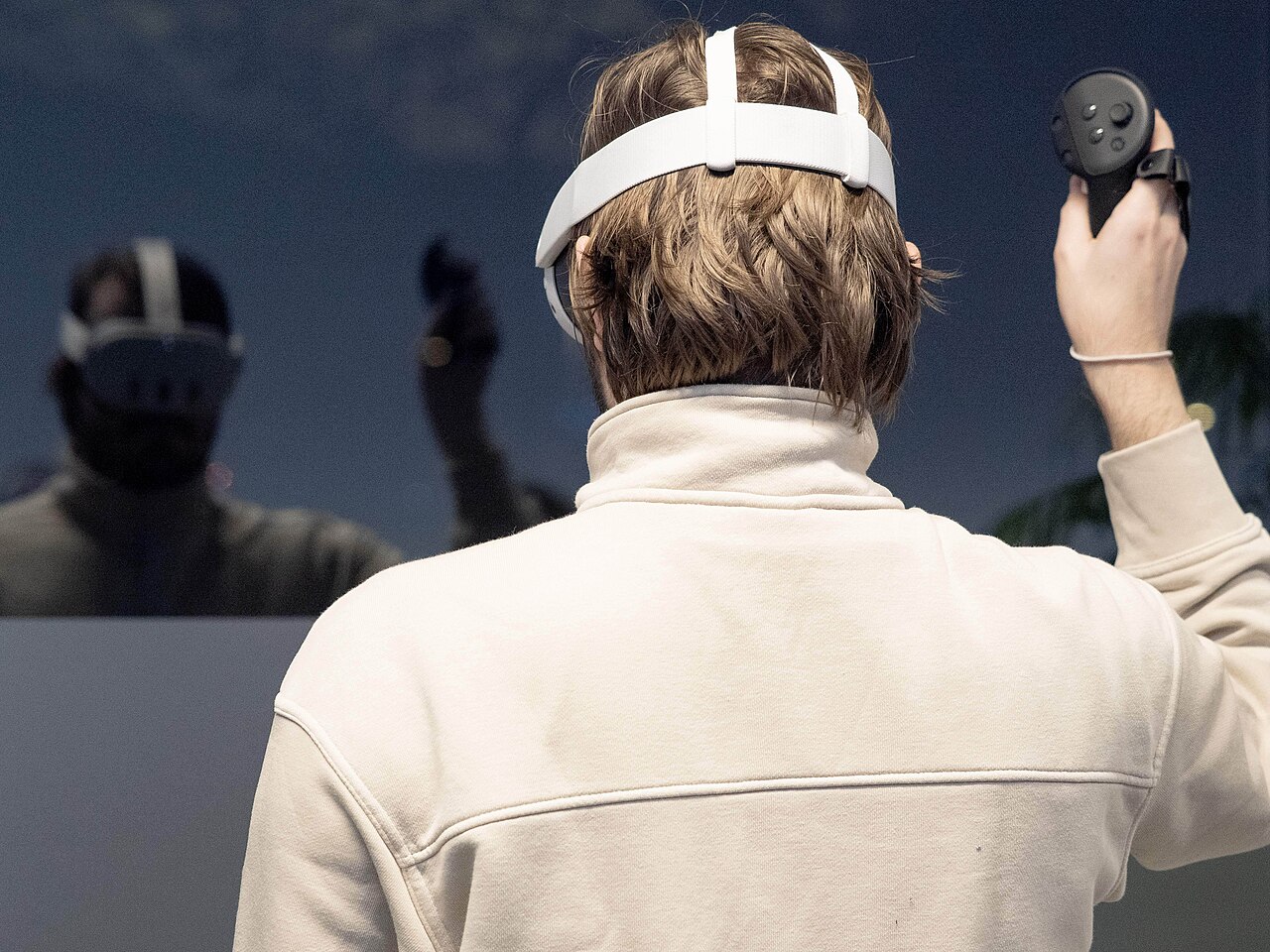
Photograph: “Person playing virtual reality” by InclusiveGameLab, CC BY-SA 4.0, via Wikimedia Commons.
Comments