Somewhere below your ribs, a nerve the width of a shoelace is listening. The vagus nerve threads up from the gut, past the heart and lungs, into the base of the brain, carrying a constant murmur of news about what is happening inside you. This inward sense, called interoception, rarely reaches conscious awareness. But the brain leans on it, and one region that pays close attention is the hippocampus, the seahorse-shaped structure where new memories are first written down.
A study published in Nature in March 2026 (Cox et al.) argues that as this internal murmur fades with age, memory fades with it. Working in mice, a team led by Timothy O. Cox at the Perelman School of Medicine at the University of Pennsylvania traced a specific chain of events that runs from aging gut bacteria all the way to the firing of hippocampal neurons, and then showed that interrupting the chain at several points could sharpen memory in old animals.
Why it matters: Age-related memory loss is usually treated as something that happens inside the brain. This work locates part of it in the gut, and points to specific, physical places along the gut-to-brain line where a fading signal might be restored — a new set of handles for one of aging’s most feared changes.
A cable that carries the gut's news
The researchers began by building a high-resolution map of how the mouse microbiome changes across a full lifespan, and pairing it with measures of how well the animals could form memories. What emerged was not a story of the microbiome simply wearing out, but of a particular signal going quiet. In older mice, the electrical activity of vagal afferent neurons, the sensory fibers that carry gut information toward the brain, was blunted. With that input weakened, the hippocampus was activated less strongly during learning, and the animals struggled to encode new memories.
In other words, the problem was not only inside the brain. It was a communication breakdown along the line connecting the gut to the brain, an example of what the authors call interoceptive dysfunction. The brain was not being properly told what the body knew.
A bloom of bacteria that jams the line
Then the team asked what was silencing the nerve. The trail led to a shift in the gut community with age: an accumulation of bacteria that produce medium-chain fatty acids, among them a species called Parabacteroides goldsteinii. These fatty acids are not directly toxic to the nerve. Instead they act as a signal, latching onto a receptor called GPR84 on myeloid cells, a class of immune cell. That triggers a low, persistent inflammation in the tissue around the gut.
It is this peripheral inflammation, driven through GPR84, that appears to muffle the vagal neurons. The result is a cascade with a clear order to it: age-shifted bacteria, then a fatty-acid signal, then immune activation, then a dampened nerve, then a quieter hippocampus, then weaker memory. Each link is a place where the chain might be broken.
Three ways to turn the volume back up
The most striking part of the work is that the researchers tested that idea directly, and from three different angles. First, they went after the bacteria themselves, using bacteriophages, viruses that infect specific microbes, to target Parabacteroides. Second, they blocked the receptor, using a GPR84 inhibitor to interrupt the inflammatory signal even while the bacteria remained. Third, they went straight to the nerve, restoring vagal activity to rebuild the interoceptive signal the brain was missing.
Each of these interventions enhanced memory in aged mice. That the same benefit could be reached by pulling three different levers, one microbial, one immune, one neural, is what gives the pathway its weight. It suggests the researchers are describing a genuine mechanism rather than a single lucky manipulation. The authors propose a name for the general strategy: interoceptomimetics, treatments that mimic or revive the gut-to-brain signal, and suggest such treatments “may counteract age-associated cognitive decline.”
What the study can't say yet
The caveats are real and the authors are candid about them. This is a study in mice, and the tidy causal chain they map, from a named bacterium through a specific receptor to hippocampal firing, was worked out in a controlled animal system. Human aging is far messier. The paper itself notes that cognitive decline in people is extremely heterogeneous, and it does not show that Parabacteroides goldsteinii or GPR84 signaling drives memory loss in humans.
Nor do the interventions translate directly to the clinic. Phage therapy targeting a gut species, a GPR84-blocking drug, and vagal stimulation are tools for probing a mechanism in the lab, not approved treatments for age-related memory loss. Whether any of them is safe or effective in people, and whether the modest memory gains seen in mice would matter for a human trying to remember a name or a route, remains untested. The work also focuses on one node, the vagal-hippocampal link, in a brain that ages along many axes at once.
What the study does offer is a change of vantage point. It locates part of the machinery of forgetting not in the brain alone but in a conversation between the gut and the brain, and it identifies specific, physical places along that line where the signal can be restored. For a problem as diffuse as aging memory, having concrete handles to pull is a meaningful place to start.
Quick questions
Does this mean my gut bacteria are making me forgetful? Not in people — this was shown in mice. It identifies a mechanism, a gut-bacteria to vagus-nerve to hippocampus chain, that weakens memory in aged animals, not a proven cause of human forgetfulness.
Could a probiotic or supplement fix it? No. The interventions that worked — bacteriophages, a GPR84-blocking drug, and vagus-nerve stimulation — are laboratory tools, not approved or over-the-counter treatments.
What is the one-line takeaway? In old mice, a bloom of certain gut bacteria muffles the vagus nerve’s signal to the memory center, and restoring that signal three different ways each improved memory.
Cox et al. "Intestinal interoceptive dysfunction drives age-associated cognitive decline." Nature, 2026. doi.org/10.1038/s41586-026-10191-6
PubMed PMID: 41813891.
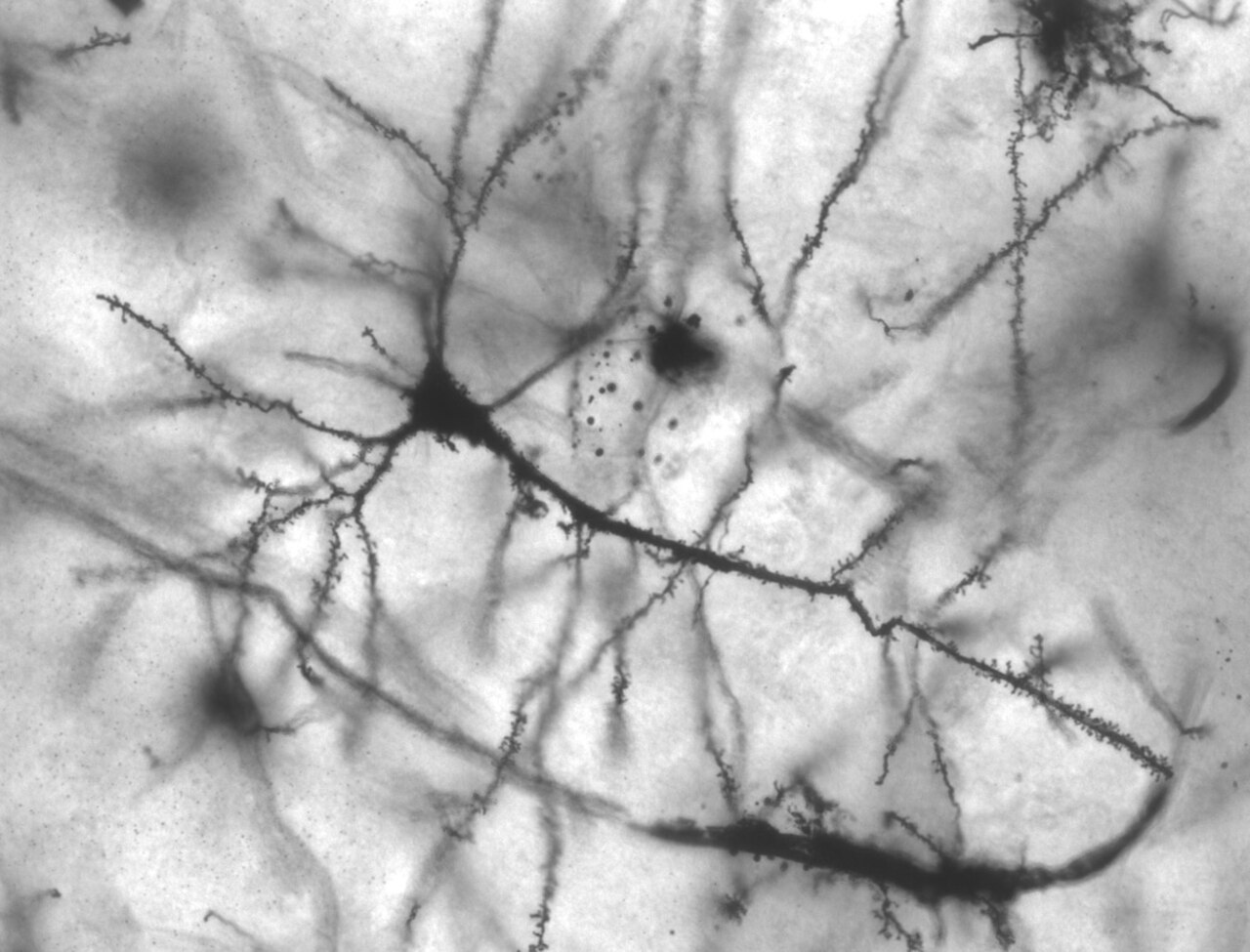
Image: Golgi-stained pyramidal neuron in the hippocampus. MethoxyRoxy, CC BY-SA 2.5, via Wikimedia Commons.
Comments