

Chemotherapy does not only kill cells. Some survive in a state called senescence: alive, no longer dividing, and chemically active in ways that ordinary cells are not. Whether that is good or bad for the patient has been an open question, since a cell that stops dividing is no longer a growing tumour but is also not gone.
A group at the San Raffaele Institute in Milan, with collaborators across Europe, treated leukemia samples from newly diagnosed patients with chemotherapy outside the body and sorted them by what happened next. Some entered senescence in numbers; others barely did. The two groups then behaved very differently toward the immune system.
Why it matters: Acute myeloid leukemia has resisted the immunotherapies that transformed several solid cancers. If chemotherapy itself makes some leukemias visible to T cells, that is a route in, and a way to tell in advance which patients have it.
What senescence does to a leukemia cell
In the samples that became senescent, the cells began behaving somewhat like professional immune-presenting cells. Interferon signalling rose, and so did display of HLA molecules of both classes, the surface proteins that hold up fragments of a cell's contents for T cells to inspect. More leukemia-associated and senescence-associated fragments were on show.
The functional consequence followed. Patients' own T cells responded more strongly to their own leukemia, in culture and in mice carrying patient-derived grafts, and the leukemia was cleared more effectively. Both CD8 T cells, which kill directly, and CD4 T cells, whose role in leukemia control is less studied, were activated.
Crucially, senescence also restored responsiveness to checkpoint blockade, the class of immunotherapy that has largely disappointed in this disease. Samples that did not become senescent stayed unresponsive.
The same signature, read two ways
This is where the paper gets careful, because the markers involved already have a reputation, and it is the opposite one. High interferon-stimulated gene expression and high HLA class II at diagnosis are associated with poor prognosis and resistance to treatment, and are read as signs of a chronically inflamed, exhausted immune environment that the leukemia has learned to live in.
Here the same features predict the opposite. As Gilioli and colleagues write in Nature Communications, our findings reveal a fundamentally distinct nature of immune activation in response to chemotherapy. Chronic activation before treatment signals evasion; activation appearing after treatment signals a response the immune system can act on. The measurement is the same and the meaning depends on when it is taken.
Why some samples cannot do it
The difference turned out to be epigenetic rather than genetic. Samples that failed to become senescent carried more of a repressive histone mark, and more of the enzyme that places it, across immune-related regions of the genome including the interferon genes and several HLA loci. Those regions were switched off rather than absent.
Notably, none of these patients had mutations in the gene encoding that enzyme, so the repression is a regulatory state rather than a broken gene, which is the kind of thing that can in principle be reversed.
Treating non-senescent cells with a drug that inhibits the enzyme did reverse it, reactivating senescence-related genes and HLA expression and allowing T cells to respond. The authors keep the claim hedged, saying this repression may limit immunogenicity in that subgroup rather than asserting it does.
The pattern was not confined to one kind of leukemia either. The link between becoming senescent and raising HLA display held up in a separate set of samples treated in the lab, and in data from patients who had received chemotherapy in the clinic, across leukemias carrying different genetic abnormalities. That argues it is a general early response to treatment rather than a quirk of one subtype.
What the study can't say yet
Nearly all of this happens outside a patient. Chemotherapy was applied to samples in culture, and the immune experiments used the patient's own cells in a dish or mice given human grafts. Mouse models with human tissue lack a full human immune system, so the T cell responses observed are informative about capability rather than about what a treated patient's immune system would do.
The proposed use as a biomarker, sorting patients by senescence response to predict who benefits from checkpoint blockade, has not been tested prospectively. It is a hypothesis generated by this data, and would need a trial designed around it.
The split into two groups also comes from ex vivo response rather than from anything measurable at diagnosis. Turning it into a clinical test would require knowing in advance which patients will become senescent, which this work does not provide.
And the epigenetic drug was used to demonstrate mechanism. Whether adding it to leukemia treatment would help, and at what cost given that the enzyme it blocks does many other things, is a separate question.
Quick questions
What is cellular senescence? A state in which a cell permanently stops dividing but stays alive and metabolically active, often secreting signals that affect neighbours and the immune system.
Why would chemotherapy make cancer more visible to T cells? Because the stress response it triggers raises the display of protein fragments on the cell surface. More on display means more for T cells to recognise.
What's the one-line takeaway? Chemotherapy pushes some leukemias into a senescent state that makes them visible to the patient's own T cells and responsive to checkpoint blockade, and the ones that cannot do this are held back by a reversible epigenetic block rather than a mutation.
Gilioli et al. "Therapy induced senescence promotes immunogenicity in acute myeloid Leukemia through reduced EZH2 activity." Nature Communications, 2026;17(1). doi.org/10.1038/s41467-026-76853-1
PubMed PMID: 42697881.
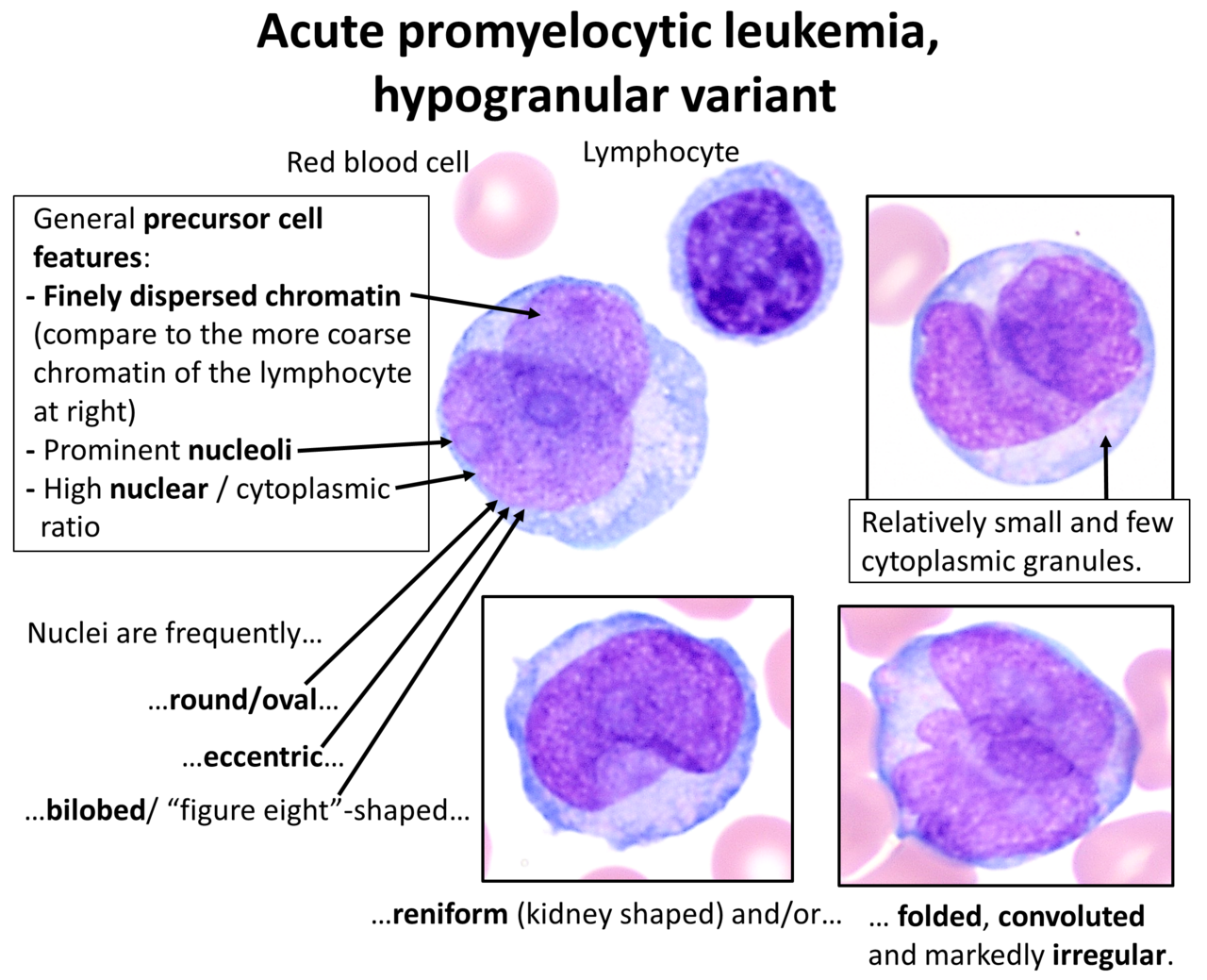
Image: Peripheral blood smear in acute promyelocytic leukemia, Mikael Häggström, CC0, via Wikimedia Commons.
Comments