


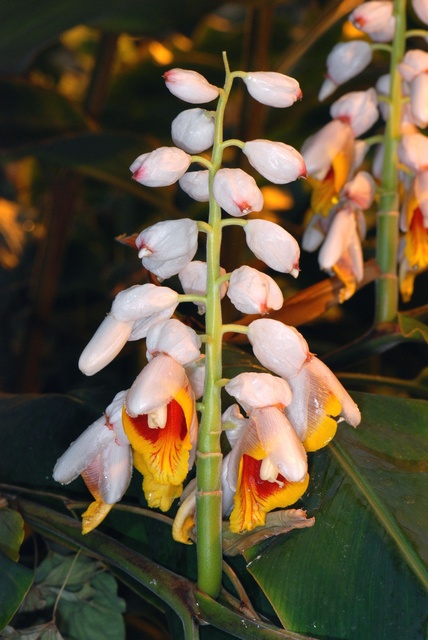
Walk past a stand of wild ginger in the morning and you might catch the plants in the middle of a careful bit of choreography. Some flowers hold their pollen-bearing stamens ready and bend their styles up out of the way. Others do the reverse, dropping the style down to catch pollen while their stamens stay shut. By afternoon the two groups switch roles. The result is a population that pollinates across morphs rather than within a single bloom, and it happens on a schedule tight enough to look almost mechanical.
A study published in Nature Plants pins much of this behavior on a single gene. Working with the ginger Alpinia mutica, researchers led by Jian-Li Zhao and colleagues found that a Mendelian locus with one dominant allele decides which timing program a plant follows, and that a gene next to it, which they named SMPED1, sets the actual clock for when anthers open and styles move.
Two schedules, one population
Most flowering plants that separate their male and female phases in time stick to one pattern. They are either protandrous, releasing pollen before the stigma becomes receptive, or protogynous, the other way around. That makes the trait hard to study, because you cannot easily compare the two states side by side in the same species.
Alpinia mutica is unusual. Both floral types grow within the same population. The plants also perform what the authors describe as synchronized rhythmic movement: styles rise and fall, and stamens release pollen, in a coordinated daily rhythm between the two morphs. Because a protandrous plant is shedding pollen at the same moment a protogynous neighbor is receptive, the timing itself drives cross-pollination.
To find the genetic basis, the team built haplotype-resolved genome assemblies and used population genomics to locate the region controlling the switch. They identified a large deletion in the protandrous form. Sitting right next to that deletion was SMPED1, which the researchers show governs the timing of both anther dehiscence and style movement. One dominant allele produces protogyny; without it, the plant follows the protandrous schedule.
A gene with a long reach
What makes SMPED1 more than a botanical curiosity is where else it shows up. According to the study, the gene is widespread among angiosperms, the flowering plants, and probably keeps a similar function across them. That suggests the machinery for coordinating the sexes in time is not a one-off invention of this ginger but part of a toolkit many plants carry.
Dichogamy, the general term for staggering male and female function, is one of the main ways plants avoid inbreeding without going to the trouble of full physical or genetic incompatibility systems. Selfing can be costly. It exposes harmful recessive mutations and cuts down the genetic mixing that helps populations adapt. A timing-based solution lets a plant sidestep that while keeping both sexes on the same flower.
What the study does not settle
This is a mechanism paper anchored in one species, and it leaves room for follow-up. The researchers identified SMPED1 through its position next to the deletion and its association with the timing trait; the exact molecular steps by which it moves a style or triggers an anther to open are not spelled out here. The claim that the gene keeps a conserved role across other flowering plants rests on its broad distribution and is described as probable, not demonstrated in those species. And how a plant's internal clock, its hormones, and this gene talk to each other to produce such tight synchrony remains open. What the work does offer is an unusually clean genetic handle on a behavior that most plants keep well hidden.
Zhao, J.-L. et al. "Ginger genome reveals the SMPED1 gene causing sex-phase synchrony and outcrossing in a flowering plant." Nature Plants, 2026. doi.org/10.1038/s41477-025-02125-3
PubMed PMID: 41057617.
Photograph: J C Shou, CC BY 3.0, via Wikimedia Commons.
Comments