Salt in soil does two things to a plant at once. It pulls water out of the roots, which is an osmotic problem, and it floods cells with sodium and chloride ions, which is a chemical one. Plants respond to both, but the responses are not interchangeable, and a long-standing puzzle is how a root distinguishes genuine salt from ordinary drought-like water stress quickly enough to mount the right defence. A clock protein in Arabidopsis turns out to make that distinction in an unusually literal way: it changes physical state.
Researchers at Washington University in St. Louis found that TIME FOR COFFEE, a nuclear component of the plant circadian clock known by the abbreviation TIC, condenses into droplets inside the nucleus within about twenty to thirty minutes of salt exposure. The key control is what does not trigger it. The team compared salt against non-ionic treatments chosen to impose the same water stress without the ions, including mannitol, sorbitol and polyethylene glycol, and the droplets did not form. Cold, heat and two plant hormones did not produce them either.
Why it matters: Salinity is a growing constraint on farmland, and most known salt-tolerance machinery works by pumping ions or adjusting water balance. This is a different kind of mechanism, in which the clock decides what time of day a salt defence gene is allowed to switch on, and a phase change in one protein is what couples the two.
The study, by Tian et al. at Washington University in St. Louis, appears in Science Advances. It combines test-tube experiments on purified protein with imaging, mutants and chromatin measurements in whole seedlings.
A protein that is mostly shapeless
TIC is a large protein, 164.5 kilodaltons, and prediction tools indicate that nearly all of it is intrinsically disordered, with a long stretch at one end flagged as prion-like. Disorder of that kind is the usual signature of a protein that can undergo liquid-liquid phase separation, separating out of solution into droplets the way oil does from water.
It behaves that way in isolation. A purified fragment covering the first 422 residues made its solution visibly cloudy once diluted into a buffer containing only 50 millimolar salt, while the fluorescent tag alone did not. The resulting droplets fused into larger ones, and after being bleached with a laser their fluorescence recovered to a plateau within seventeen minutes, both of which indicate a liquid rather than a solid aggregate.
In living plants, though, a different region mattered. Deleting residues 423 to 660 left a protein that still had the intrinsic capacity to condense but no longer did so in response to salt. The authors read this as two related but separable properties, one being the raw tendency to phase-separate and the other being the salt trigger, and they are careful that the in-vitro result may not explain the in-vivo one, since salt inside a cell also shifts ion balance, signalling and protein interactions rather than just the physical chemistry of the solution.
The clock half of the story
Plants lacking TIC, made both by gene editing and from an existing insertion line, survived salt stress at significantly lower rates. The informative result is what happened when the day length was changed. A tic mutant runs a short internal clock, roughly twenty-one hours, and when those mutants were grown on twenty-one-hour cycles of 10.5 hours light and 10.5 hours dark, their salt-stress growth defect was partially relieved relative to standard twelve-and-twelve or constant light. The explanation offered is the general principle that plants better tolerate stress when the external cycle matches with their endogenous circadian period, and the mutant's clock happens to match a twenty-one-hour day.
Underneath that sits a chromatin mechanism. Two salt-responsive genes, NAC019 and RD29A, cycle through the day and peak at different hours, and salt raises an activating histone mark, H3K9 acetylation, at both in a time-of-day-dependent way. In the mutant, both the mark and the gene activation are blunted. TIC physically associates with HD2-type histone deacetylases, the enzymes that strip that mark, and some of them collect with TIC inside the nucleolus under salt. With the deacetylases pulled away from those genes, acetylation rises and the genes turn on, which is the model the paper proposes: the droplet works as a sink that sequesters a repressor.
What the study can't say yet
The sink is inferred more than measured. The authors state that the extent of HD2 enrichment within TIC condensates in vivo remains to be fully resolved, and the colocalisation they report is partial and restricted to a subset of the enzymes. Showing that two proteins associate, and that one moves off a gene, is not the same as showing that the droplet is what took it there.
The headline about day length rests on supplementary data and is described as partial relief of a defect, not restored tolerance. Nothing here was tested in a crop, in soil, or at field salinity. One domain-deletion line also complicates the tidy version of the story: a protein missing a substantial portion of its C-terminal end still conferred salt tolerance comparable to the full-length version, so not every part of TIC that exists is part of this mechanism.
Quick questions
Does this mean salt-tolerant crops are close? No. This is mechanism in a laboratory model plant. The practical hook is that a clock gene turns out to sit upstream of salt-response genes, which makes timing a variable worth testing in crops, not a trait anyone has engineered.
Why does a droplet do anything useful? Concentrating or removing a protein from the rest of the nucleus changes what it can act on. Here the proposal is removal: a repressive enzyme gets held inside the droplet and stops suppressing the genes the plant needs.
What is the one-line takeaway? A circadian clock protein in Arabidopsis condenses into nuclear droplets specifically in response to salt and not to equivalent water stress, and appears to raise salt-defence gene activity by sequestering the enzymes that would otherwise keep those genes quiet, on evidence that is strong for the trigger and still indirect for the sequestration.
Tian et al. "TIME FOR COFFEE coordinates phase separation and chromatin regulation for salt tolerance." Science Advances, 2026. doi.org/10.1126/sciadv.aei1213
PubMed PMID: 42873852. Full text: PMC13666050.
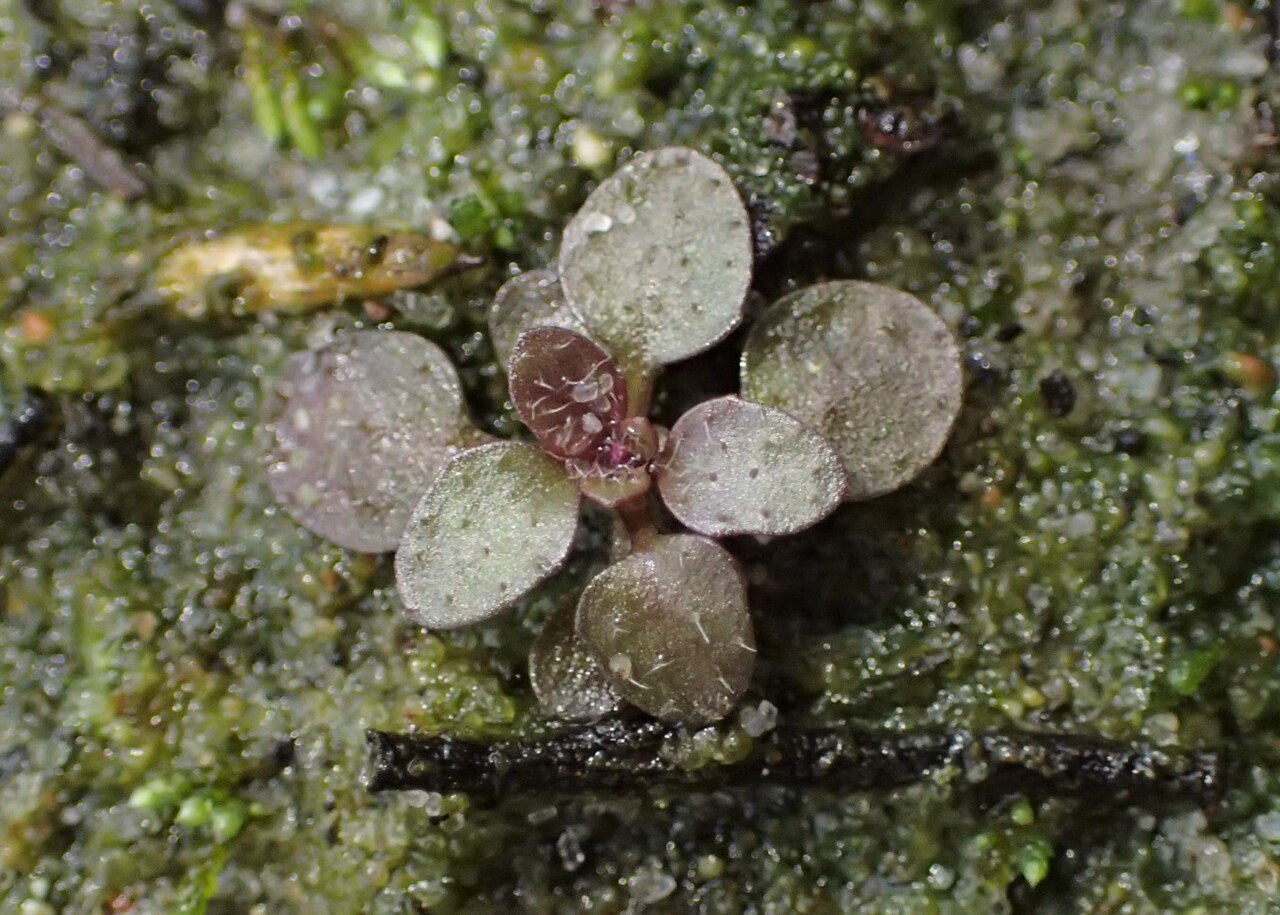
Image: Arabidopsis thaliana. Krzysztof Ziarnek, Kenraiz, CC BY-SA 4.0, via Wikimedia Commons.
Comments