
The constraint on an enzyme is usually not which reaction it can catalyse but which direction it runs. Cinnamyl alcohol dehydrogenase has a textbook job in plants: it takes an aldehyde, adds electrons from the cofactor NADPH, and hands back an alcohol, the monomer from which lignin is built. The reaction is a reduction, and the enzyme has been treated as a one-way valve on the path to woody cell walls for decades.
A group at Anhui Agricultural University has found a version in the tea plant, Camellia sinensis, that does not stay in one direction. In a single reaction mixture, their enzyme turns each of three aldehyde substrates into both the expected alcohol and the corresponding acid, because the NADPH it consumes becomes NADP, and the enzyme will bind that too and run the oxidation. The products are both antifungal, and together they inhibit the fungus causing gray blight, a disease that costs tea growers 10 to 20% of leaf yield, more effectively than either does alone.
Why it matters: Gray blight is managed with benzimidazole and triazole fungicides that some isolates already tolerate. Resistance bred into the plant's own chemistry is the alternative, and this work identifies a single base in a single gene that separates a susceptible cultivar from a resistant one.
The study, by Xu et al. at Anhui Agricultural University, with a collaborator at North Carolina State University, appears in Science Advances. The work runs from mass spectrometry of infected leaves through enzyme kinetics, transient gene knockdown in tea leaves, overexpression in a model plant, a 40-plant breeding cross, and an evolutionary analysis across algae and land plants.
How one enzyme makes two products
Infecting tea leaves and profiling them turned up 2729 metabolites, of which 495 rose and 234 fell; the pathways that fed phenolic compounds were among those enriched. Screening 23 candidate enzymes from the tea genome and testing seven, the team found two that produced two compounds from each substrate rather than one. The mechanism they propose is not exotic. NADPH donates a proton to make the alcohol and is thereby oxidised to NADP, so partway through the reaction the tube contains both cofactors, and the enzyme can use the oxidised form to drive the reverse chemistry on the remaining aldehyde.
That self-limiting structure shows up in the kinetics, and it is the most interesting detail in the paper. Acid production rose with NADPH and then fell again, failing to follow standard Michaelis-Menten behaviour, while alcohol production followed it cleanly. A strongly reducing cell therefore gets mostly lignin monomers, which is why dual-capable enzymes look alcohol-biased inside living plants. The authors note that infection consumes NADPH, which would relax that constraint and tip the same enzyme toward making acids exactly when the plant needs them.
What the compounds do, and how much
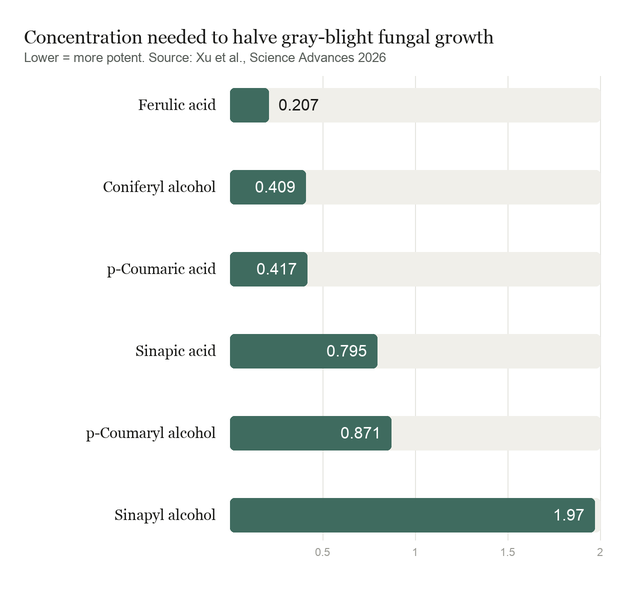
All six compounds were tested against the pathogen individually. Potency varied roughly tenfold across them.
Combining coniferyl alcohol with ferulic acid beat either alone. The precise claim is narrower than the headline word suggests: the fractional inhibitory concentration index came to 0.5, which the authors describe as a weak synergistic antifungal effect. That value sits exactly on the conventional boundary between synergy and simple additivity, so the compounds help each other, but not dramatically. Applied to spores, the pair damaged membranes and reduced lesion size on leaves; a six-compound mixture was the strongest tested against a second tea pathogen.
The breeding result, and the evolutionary one
Two cultivars anchor the genetics: one susceptible, one resistant. Sequencing found a single base difference in the gene's coding region in the susceptible cultivar, swapping a proline for a leucine, and the protein made from that allele showed no catalytic activity at all, not merely a loss of the second product. Crossing the two produced 40 progeny that sorted into 10 resistant, 20 intermediate and 10 susceptible.
The genotypes line up only partly, and the paper reports it plainly. All 10 resistant plants carried two copies of the functional allele, and all 10 susceptible plants were heterozygous. But 15 of the 20 intermediate plants were also heterozygous, so the same genotype spans intermediate and susceptible outcomes, and the marker predicts resistance far better than it predicts disease. Expression of the gene did not differ between resistant and susceptible progeny; the metabolites did.
The evolutionary claim is that a valine at residue 192, absent in the green alga tested and present in land plants, underlies the dual activity. Mutating it away in the tea enzyme abolished the second reaction, and three other substitutions weakened it.
What the study can't say yet
The reciprocal experiment did not work. Installing that valine into a single-activity tea enzyme failed to give it the second reaction, so the residue is necessary in this protein without being sufficient to create the capability. That considerably limits how much the residue can be said to have driven the trait.
No stable transgenic tea plant was made. Resistance gains come from overexpression in a model plant and from transient antisense knockdown in tea leaves, which is a short-term manipulation of a detached-leaf assay rather than a field trial. The breeding population is 40 plants from one cross, enough to show segregation and not enough to estimate effect size. Why heterozygotes, which retain a working copy, are susceptible at all is not explained.
The evolutionary analysis rests on 14 sequences, one alga as the outgroup for the key contrast, and structural models with docking rather than solved structures. On the underlying history the authors stay hypothetical: Single-enzymatic activity CADs may represent evolutionarily conserved enzymes optimized for lignification, whereas dual-enzymatic activity CADs may have evolved through neofunctionalization or subfunctionalization to fulfill lineage-specific or stress-related roles, they write.
Quick questions
Could this change the tea I drink? Not directly. The nearest application is a breeding marker for selecting disease-resistant cultivars; the compounds involved are ordinary plant phenolics already present in tea leaves.
Why would a plant want one enzyme doing two jobs? Because the cofactor balance decides which job gets done. A healthy cell makes building material; an infected cell, short of NADPH, makes defence compounds from the same enzyme and the same substrate.
What is the one-line takeaway? A tea enzyme long assumed to run in one direction runs in both, yielding two antifungal compounds that work better together, and a single base change that disables it tracks with susceptibility to a major tea disease.
Xu et al. "Functional diversification of CsCAD14 orchestrates synergistic phenylpropanoid biosynthesis to defend gray blight disease in tea plants." Science Advances, 2026. doi.org/10.1126/sciadv.aei1647
PubMed PMID: 42814828.
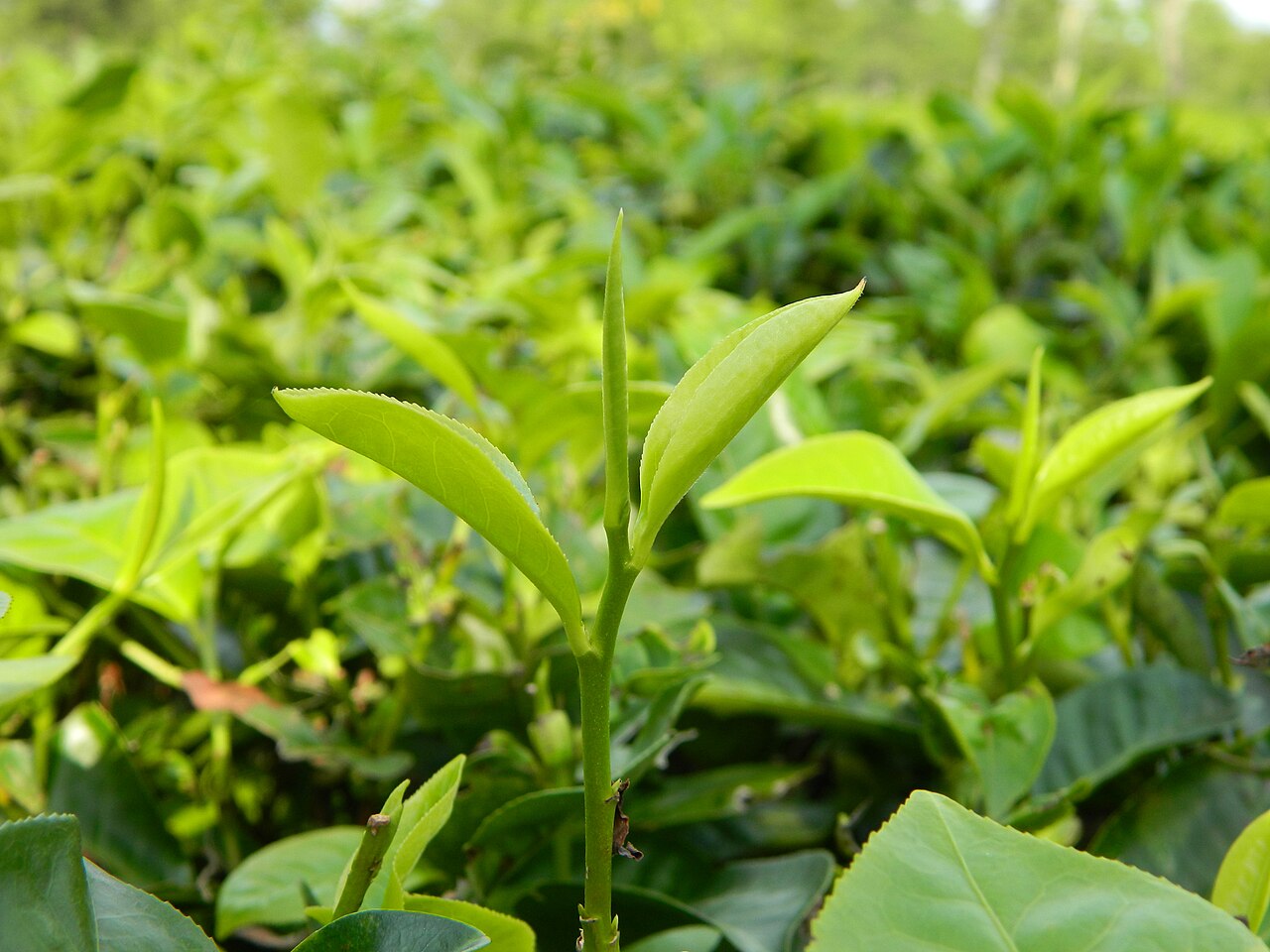
Image: tea plant shoot, two leaves and a bud. Nborkakoty, CC BY-SA 3.0, via Wikimedia Commons.
Comments