
The limiting factor in reading how a genome changes has never been the sequencing. It is that the sequences which change fastest, the repeats, are the ones a reference genome represents worst. Variant calling maps reads to a single reference; anything absent from it, or collapsed into one copy of a sequence that exists in thousands, is invisible. In Arabidopsis thaliana, whose roughly 150 million base pair genome varies by more than 10% in content between wild accessions, most of that variation sits in exactly those regions.
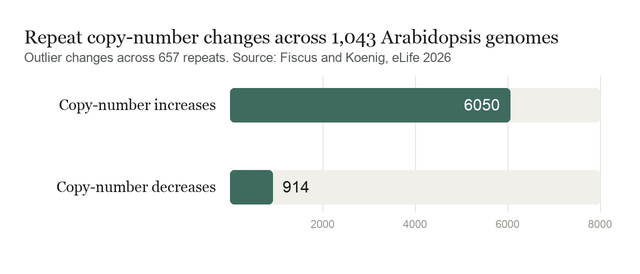
Christopher Fiscus and Daniel Koenig at the University of California, Riverside, sidestepped the reference. They counted every 12-letter sequence, or 12-mer, in the short reads of 1,043 wild accessions, used the counts to estimate how many copies of each of 657 known repeats each plant carries, and then treated copy number as a heritable trait. Two results stand out. Repeats expand far more often than they contract: 6,050 copy-number increases were detected against 914 decreases. And the variation is associated with more than 50 loci elsewhere in the genome, enriched for genes in DNA replication, DNA repair and DNA methylation, which behave less like mutations than like alleles that set the rate at which mutations arise.
Why it matters: Repeat content is what makes genomes differ in size by orders of magnitude and shapes gene expression and mutation rate along the way. This work moves from cataloguing differences to naming alleles that could govern how fast they accumulate.
The study, by Fiscus and Koenig, appears in eLife and draws on public short-read data from the 1001 Genomes Project. In simulations, 12-mer counts tracked engineered copy-number changes with a median R² of 0.98; against real Illumina reads the correlation with the reference assembly was 0.86, breaking down below 1× coverage.
Where the genome moves
Variability per 100 kilobase window spanned two orders of magnitude and tracked repeat density (Spearman's rho 0.80). The extremes were the known heterochromatic landmarks: pericentromeres and centromeres on all five chromosomes, the ribosomal DNA arrays, and the heterochromatic knobs.
Per repeat, variability ranged from 0.07 to 500; for universal single-copy genes, which should not vary, it ranged from 0.08 to 0.69. Of the 657 repeats, 98.6% changed in at least one accession; 348 only ever increased and 11 only decreased. Population structure explained little: repeat content clustered accessions by subpopulation in only half of the twelve groups, and the 25 most divergent genomes were scattered across seven of them. The dominant signal was sporadic, individual-level divergence, which is what one would expect if some plants carry alleles that raise their own rate of copy-number change.
Mapping the alleles that set the rate
The authors ran a genome-wide association study for each of 429 repeats, testing 1,325,632 SNPs, and found 29,891 associated SNPs across 384 of them. A SNP can be linked to the copy-number variant itself, a cis-acting signal, or to a mutation that changes the rate at which such variants arise, a trans-acting mutator. The cis signal was unmistakable: significant SNPs were enriched in pericentromeric regions with an odds ratio of 4.5, where the repeats themselves live.
The trans signal is the real contribution. A meta-analysis across 207 repeat GWAS yielded 228 significant SNPs, which collapsed to 57 discrete peaks after pruning for linkage disequilibrium; an independent GWAS on the first principal component of repeat abundance shared 19 of them. Under the peaks sat replication machinery (an origin recognition complex subunit, a sliding clamp), double-strand break repair genes (an SLX1 endonuclease, homologs of Fanconi anemia D2 and BRCA2) and methylation regulators (a chromomethylase, a ROS1-type demethylase, a subunit of RNA polymerase V). Two thirds of the loci pushed copy number in a consistent direction across repeat classes: 26 up, 9 down. The coherence is mechanistic: double-strand breaks feed transposition and the recombination that expands satellites, and methylation is the plant's main brake on transposons.
Selection, drift and the selfing trap
Alleles associated with copy-number change were enriched for rare variants (minor allele frequency below 0.10) relative to nonsynonymous SNPs, the signature of purifying selection. Across the twelve subpopulations, the number of copy-number changes per group correlated with the strength of genetic drift (Spearman's rho 0.76); the most divergent accessions sat outside the species' European core, where effective population sizes are smaller.
The model follows from the mating system. In an outcrossing species a mutator allele is quickly separated from the damage it causes; in a selfing one it travels with its consequences. As the authors write, a self-fertilizing lineage that acquires one or more mutator alleles may be doomed to accumulating large numbers of deleterious CNVs unless rescued by an outcrossing event that allows mutators to be recombined away from their deleterious genomic consequences. That could explain the episodic bursts of repeat expansion seen across plants.
What the study can't say yet
The selection inference is weaker than the headline suggests. The rare-allele excess is significant against nonsynonymous SNPs, with p of 0.031 for the meta-GWAS tags, but there was no significant excess when compared against putatively causal SNPs from the AraGWAS catalogue. The excess may reflect how GWAS ascertains variants rather than selection. The drift correlation rests on twelve points.
The data carry a technical bias the authors could not explain. Profiles clustered by sequencing centre, and because centre and population were confounded, biology and artefact could not be separated. Ultimately, we were unable to determine the cause of the bias. A linear correction was applied, acknowledged to remove some biology too. Repeating a subset of GWAS with 10-mers mapped different loci, and against a prior coverage-based survey of 211 accessions only 24 of 59 comparable GWAS shared a peak; the authors state it is unclear which method is more reliable.
Finally, the candidate genes are candidates. None has been tested experimentally, the method cannot say where a changed copy sits, and the data cannot distinguish expansions being more frequent from deletions being more strongly selected against.
Quick questions
What is a mutator allele? A variant that does not change the trait itself but raises the rate at which other mutations occur. The loci found here are candidates for that role, not confirmed examples.
Why count K-mers instead of assembling genomes? Assembling a thousand genomes well enough to compare repeats is still impractical; counting short sequences in raw reads needs neither assembly nor alignment.
What's the one-line takeaway? Across 1,043 wild Arabidopsis genomes repeats expand more than six times as often as they contract, and the variation maps to rare alleles in DNA repair, replication and methylation genes that are commonest where selection is weakest.
Fiscus CJ, Koenig D. "The genetic control of rapid genome content divergence in Arabidopsis thaliana." eLife, 2026;14. doi.org/10.7554/eLife.108238
PubMed PMID: 42720113.
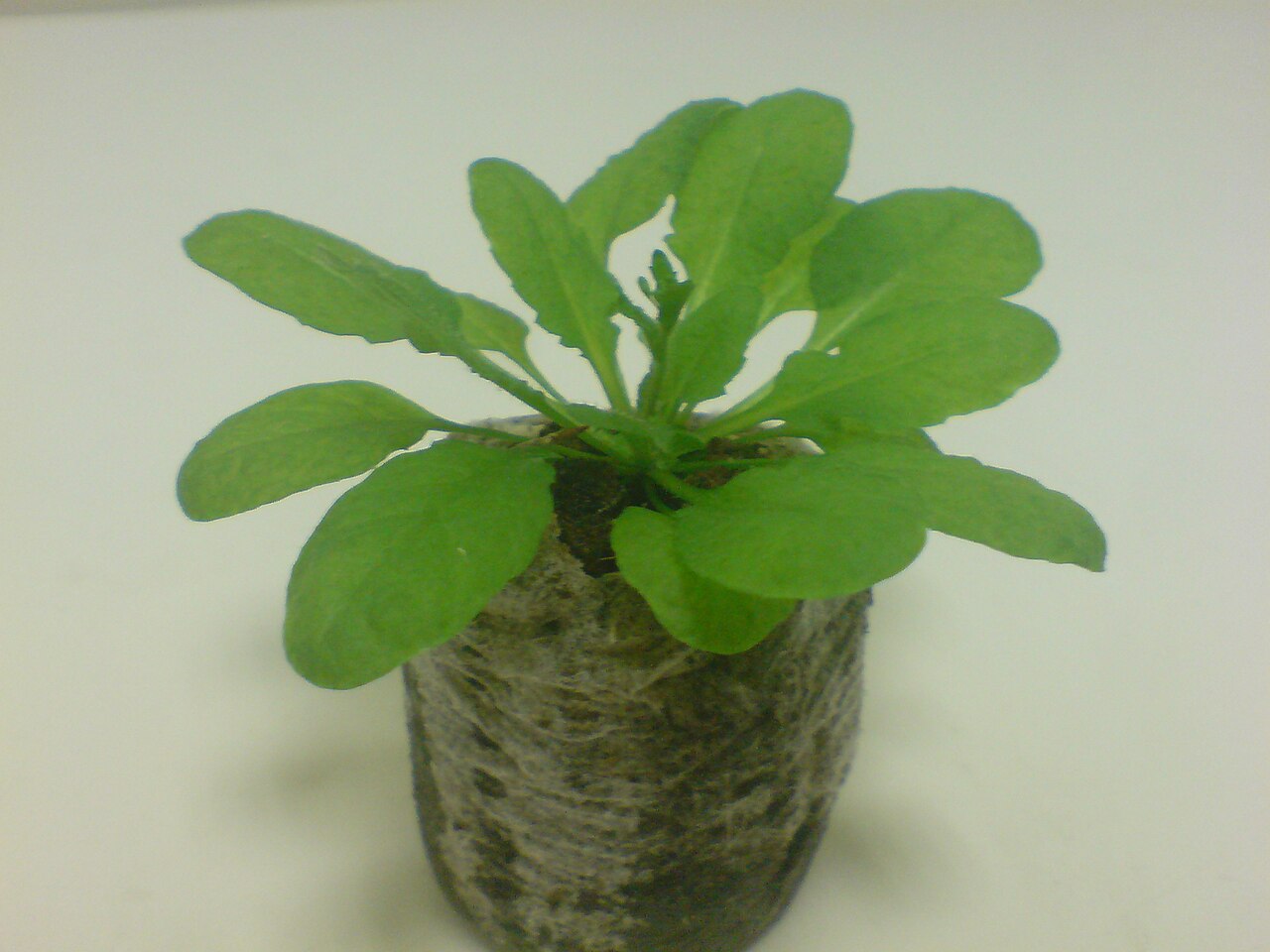
Image: young Arabidopsis thaliana plant. Reo On, CC BY-SA 3.0, via Wikimedia Commons.
Comments