

A plant spends most of its life making leaves. At some point the growing tip stops doing that and starts making flowers instead, and it does not go back. The switch is called the floral transition, the genes involved have been mapped in detail, and what has been missing is the shape of the change itself: whether the tip crosses a threshold, drifts across gradually, or does something with more structure to it.
A group at the Max Planck Institute for Plant Breeding Research in Cologne measured the timing rather than the parts list, combining quantitative imaging of the growing tip with genetics and the mathematics of dynamical systems. Their answer is that the switch is bistable, and that this leaves a specific, measurable fingerprint in the timing.
Why it matters: A bistable system has two stable states and nothing durable in between, which is what makes flowering hard to reverse once begun. The prediction that follows is counterintuitive: a system crossing such a point should visibly slow down as it approaches, not speed up.
The hesitation
The tip runs on a push and pull. APETALA2 holds flowering back; SOC1 and FRUITFULL push it forward. As the plant ages the balance tips and the inhibitor falls away.
It does not fall away smoothly. The measured decline in the inhibitor decelerates partway through, and that deceleration is the point of the paper. In dynamical systems this is called critical slowing down, and it happens because as the system approaches the transition, the state it is about to leave has already stopped being a true resting point but still leaves a trace, a hollow where an attractor used to be. The system lingers near it before moving on.
That lingering introduces a second timescale into a process that otherwise looks like it should run on the plant's ageing clock alone. And it is not a subtle statistical artefact: in mutants missing the floral activators, the inhibitor stays high for a long plateau, and the length of those plateaus tracks how badly flower development is impaired.
The model also had to be extended before it reproduced everything. Adding the inhibitor's ability to repress itself recovered oscillations in inhibitor levels seen in some mutants, which a simpler version could not produce.
Why bistability and not something simpler
The argument for bistability is not that it fits, but that the alternatives cannot generate the spread of behaviour observed. Across genotypes the system produces smooth declines, long plateaus and oscillations, and a monostable switch does not have the room to do all three. Bistability is what lets one network absorb genetic damage and still, in most cases, arrive at a flower.
The same property explains something growers would recognise. Once a plant has committed to flowering it stays committed even when light conditions get worse. A system with two stable states resists being knocked back by noisy signals, which is exactly the behaviour a plant needs from a decision it cannot undo.
The tip is not one thing
The other result concerns space. In a mutant that keeps inhibitor levels high yet still manages to make flowers, imaging showed the inhibitor was persistently lower at the boundaries of newly forming flower buds. Different regions of the same tip are therefore in different dynamical regimes at the same moment, which resolves the apparent contradiction: flowers can form at the edges while the centre is still holding out.
What the study can't say yet
The model is deliberately simplified, and the authors are direct about it. They treat the two activators as a single entity despite their differing timing, leave out a family of related genes, and omit a separate variable for the small RNA involved. As Rodríguez-Maroto and colleagues write in Nature Communications, the primary goal of this study was not to perfectly fit experimental data, but rather to understand the fundamental nature of the floral transition dynamics. Read that way the fine mismatches between model and measurement are expected rather than troubling, but it does mean the model is an argument about mechanism, not a predictive tool.
One signature of bistability remains untested here. Systems of this kind normally show hysteresis, where the level of signal needed to switch on differs from the level needed to switch back off, and the authors state that demonstrating it in this network still requires a quantitative analysis under perturbation. Older experiments in which flowering reversed are consistent with it, which is not the same as showing it.
The spatial finding is also the thinnest part. It rests on imaging one genotype, and the authors point to better live-imaging methods as what would be needed to assess it properly.
Quick questions
What does bistable mean here? The growing tip has two states it can rest in, making leaves or making flowers, with no stable position in between. That is why the change is abrupt and hard to reverse.
Why would a system slow down before switching? Because near the switch point the old state has lost its stability but still shapes the dynamics nearby. The system drifts through that region slowly before committing.
What's the one-line takeaway? Flowering in Arabidopsis behaves like a bistable switch whose approach is marked by a measurable slowdown in the inhibitor, and the length of that slowdown tracks how well flowers subsequently form.
Rodríguez-Maroto et al. "Time-dependent bistability leads to critical slowing down during floral transition in Arabidopsis." Nature Communications, 2026;17(1). doi.org/10.1038/s41467-026-76210-2
PubMed PMID: 42642442.
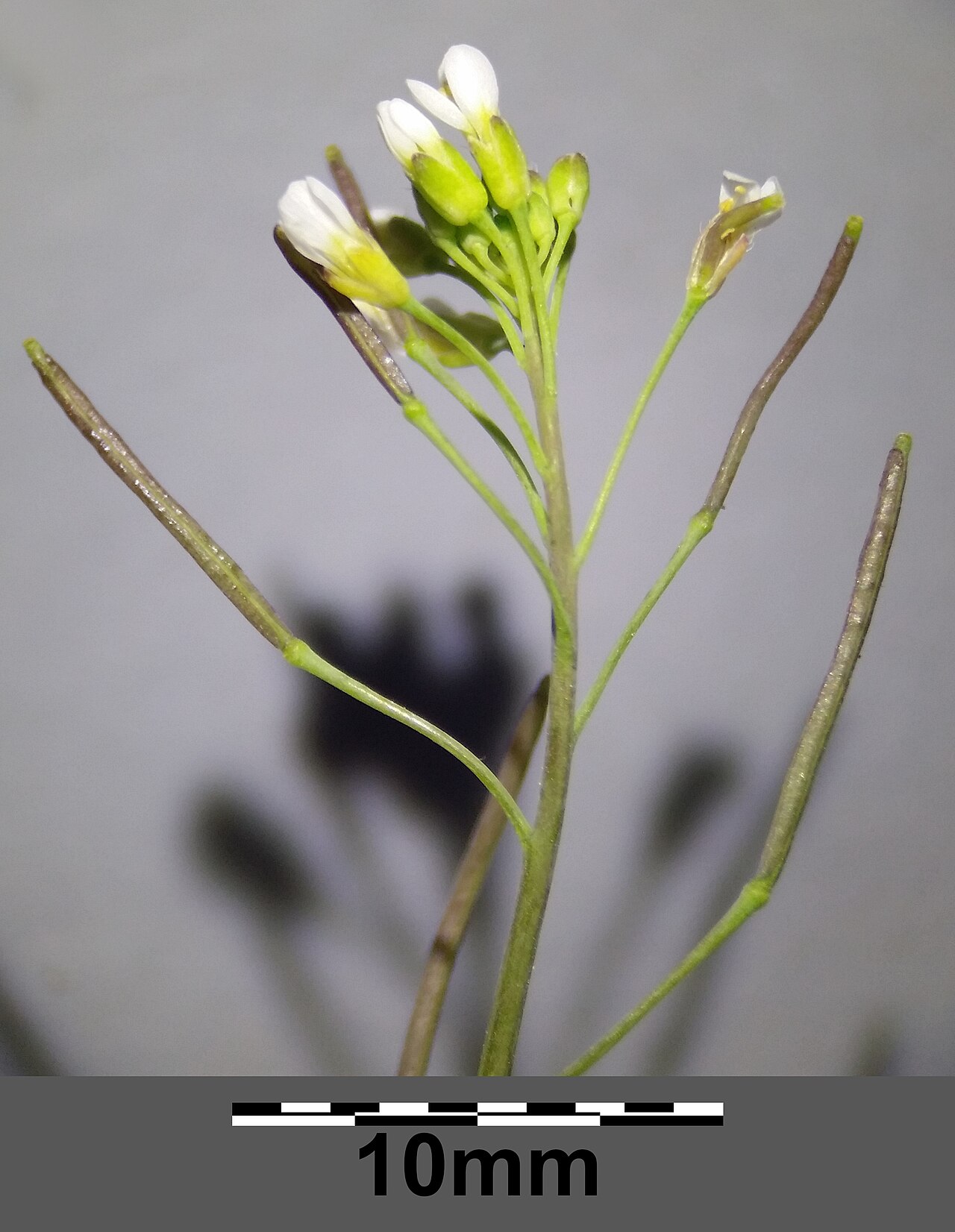
Image: Arabidopsis thaliana, Stefan.lefnaer, CC BY-SA 4.0, via Wikimedia Commons.
Comments