
The constraint on engineered disease resistance in crops is not whether a defence can be switched on. It is the cost of leaving it on. Plant defences consume resources and interfere with growth, so a plant built to defend itself constantly tends to yield less, which is the reverse of what a farmer wants. The useful design is a defence that stays silent until a pathogen actually arrives.
A team at the Chinese Academy of Agricultural Sciences built one and wired its trigger to a feature the virus cannot easily abandon. Many plant RNA viruses make shorter internal copies of their genome, called subgenomic RNAs, in order to produce their own proteins. The circuit listens for that step. When a virus starts making those copies, the plant's engineered defence switches on; with no virus, it stays off.
Why it matters: Viral disease is a substantial and largely untreatable cause of crop loss, since there is no equivalent of a fungicide for a plant virus. Resistance that activates only on infection is the difference between a defence a grower can afford to carry and one that costs yield every season.
The study, by Li et al. at the Institute of Plant Protection, Chinese Academy of Agricultural Sciences, appears in Science Advances.
A switch that has to be genuinely off
The hard engineering problem in a circuit like this is leakiness. A construct that produces a little defence protein all the time reintroduces the cost it was designed to avoid, and defence proteins are not harmless to the plant that makes them.
Their solution combines two layers, which is where the module's name comes from: translation inhibition paired with transcription activation. A repression element they optimised, dsBC, holds down protein production in the resting state, while the viral subgenomic RNA promoters provide the trigger that turns transcription on. The defence genes, which the authors call resistance-inducing proteins, are expressed only when that viral signal appears.
It is worth setting this against how virus resistance is usually engineered. One established route is RNA silencing, in which the plant carries a sequence matching the virus and degrades the viral RNA directly; another is breeding in natural resistance genes, which tend to be narrow and are often broken within a few seasons. Both act on the virus itself. This circuit does something different: it treats the virus's own replication as a sensor reading, and leaves the response to the plant's machinery.
What it was tested against
The circuit worked against three viruses of real agricultural consequence: pepino mosaic virus, a persistent problem in commercial tomato production, tobacco mosaic virus, and cucumber mosaic virus, which has one of the broadest host ranges of any plant virus. It was tested in tomato among other hosts, and showed cross-resistance to related viruses.
The central claim is a conjunction, and both halves matter: RIP expression was strictly triggered by viral infection, conferring robust resistance without detectable growth penalties. Resistance without a growth cost is the whole point of the architecture, and it is the part that most needs independent replication.
What the study can't say yet
Start with the hedge in that sentence. "Without detectable growth penalties" is not the same as without cost; it means no cost large enough to measure in the conditions tested. Growth penalties from defence expression often appear under stress, competition, or across a full season rather than in a healthy greenhouse plant, and the abstract reports no field trial or yield data.
The resistance is also specific by design. The trigger is a cognate viral promoter, so the circuit responds to the viruses it was built for and their relatives. A field carries whatever arrives, and a plant protected against three viruses is not a protected plant in general.
Then there is evolution. The trigger is a conserved feature of how these viruses replicate, which is a thoughtful choice because it is harder to discard than a surface protein. But viruses under selection have repeatedly escaped engineered resistance, and nothing here tests durability over successive infection cycles. That experiment takes seasons.
Finally, this is a transgenic approach. Each protected crop requires a transformed plant carrying the circuit, which places it inside the regulatory and public-acceptance process for genetically modified crops in every country that would grow it. That is not a scientific limitation, but it is the reason such a result is years from a field.
Quick questions
What is a subgenomic RNA? A shorter copy of part of the viral genome that many RNA viruses make in order to produce specific proteins. It is a necessary step in their life cycle, which is what makes it a reliable signal that a virus is present and replicating.
Why not just switch the defence on permanently? Because constant defence costs growth. Plants that express resistance genes all the time typically pay for it in size or yield, which is the tradeoff this design is built to avoid.
What's the one-line takeaway? A synthetic circuit that stays silent until a virus starts replicating conferred resistance to three major plant viruses without a measurable growth cost in the greenhouse, and it now needs field seasons to show whether that holds and whether viruses can escape it.
Li Z, Zhang J, Yang X, et al. "Specific and efficient translation inhibition-transcription activation resistance module against viruses in plants." Science Advances, 2026;12(39):eaeg0007. doi.org/10.1126/sciadv.aeg0007
PubMed PMID: 42789717.
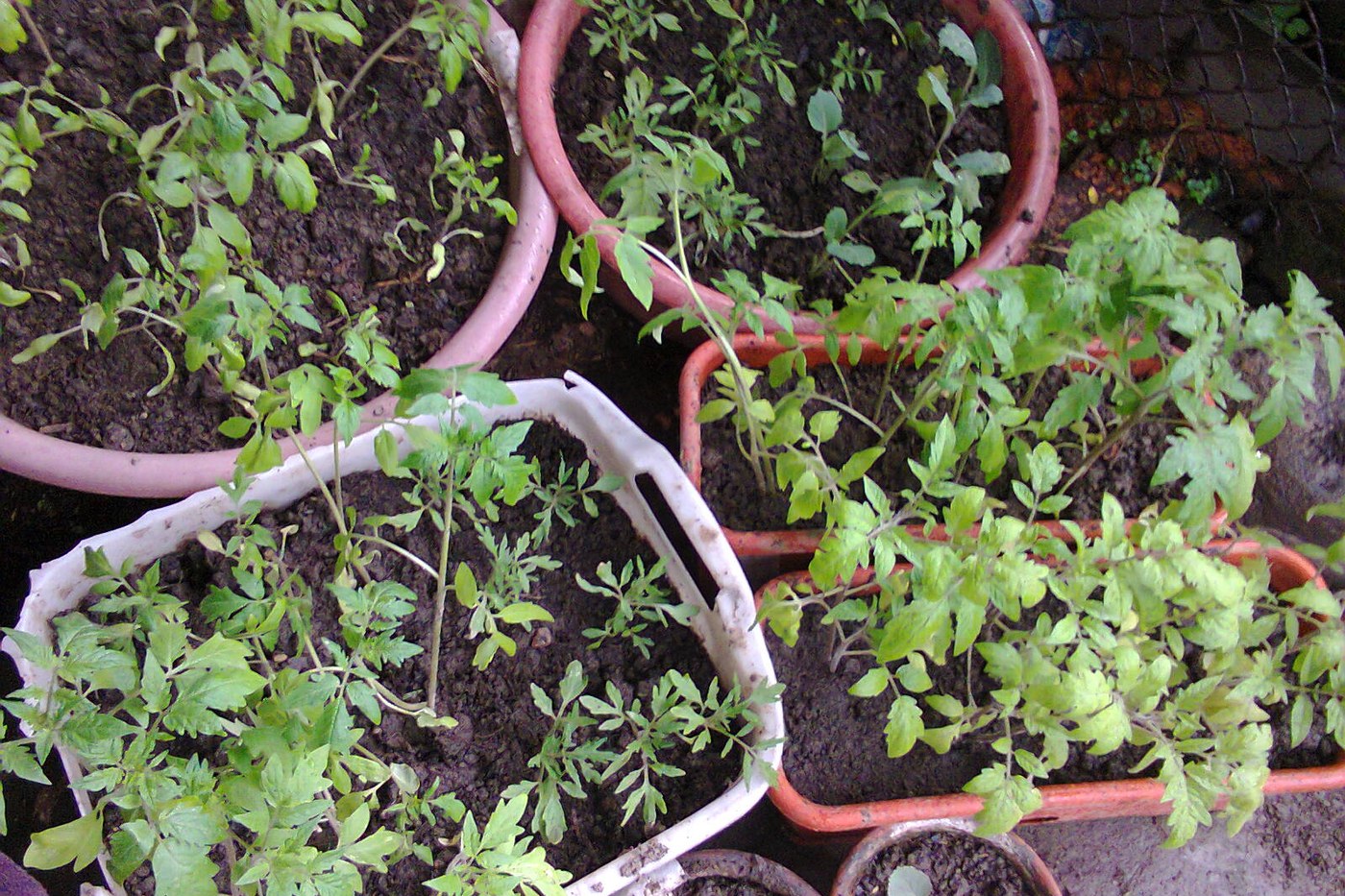
Photograph: tomato plant (Solanum lycopersicum). DenesFeri, CC BY-SA 4.0, via Wikimedia Commons.
Comments