
The standard account of procrastination treats it as an arithmetic problem rather than a character defect. A task carries an immediate cost, the unpleasantness of starting, and a delayed benefit, whatever finishing is worth. Delay follows when the first outweighs the second. The account is decades old and it makes a prediction nobody had properly tested: if the imbalance can be shifted, procrastination should shift with it, and which side you push should be visible in the result.
A group at Southwest University and the Third Military Medical University in Chongqing, with collaborators in Leiden and Worcester, ran the test. Adults with chronic procrastination received seven sessions of high-definition transcranial direct current stimulation over the left dorsolateral prefrontal cortex, a region tied to valuing future outcomes. The trial was double-blind, randomised and sham-controlled, and procrastination was measured not by questionnaire but by repeatedly sampling what participants were actually doing in daily life. Behaviour improved, and the improvement was still present six months later.
Why it matters: Most procrastination research measures self-reported intentions in a laboratory. Measuring real behaviour, against a sham control, with follow-up at six months, is a substantially harder test, and the mediation result speaks to which half of the theory is doing the work.
The finding reported by Chen et al. in eLife is specific about mechanism. Improvement tracked an increase in how much participants valued the task's outcome. It did not track any reduction in how unpleasant they found the task. Of the two levers the theory proposes, only one appeared to move.
The effect size is the thing to examine
On the willingness measure the interaction between stimulation and group produced a Cohen's d of 2.37, with a confidence interval running from 1.49 to 3.25. That number needs its benchmark. In psychology an effect of 0.2 is called small, 0.5 medium and 0.8 large. Antidepressants against placebo sit near 0.3. A d of 2.37 would place seven sessions of scalp stimulation among the most powerful behavioural interventions ever measured.
The more probable reading is that the sample is small. Forty-six people were enrolled in total, and the authors are direct about what that implies: small samples inherently bear a higher risk of being influenced by outliers and may overestimate effect sizes compared to large-scale meta-analytic expectations for tDCS. Small trials do not merely produce noisier estimates; conditional on reaching significance, they produce inflated ones. The direction of this result is better supported than its magnitude, and the magnitude is what makes it striking.
They are equally direct about the field: they also tend to be difficult to replicate and sensitive to not yet fully understood context conditions and interindividual differences. Transcranial direct current stimulation has a long record of impressive small studies that fade under replication, and nothing about this design exempts it from that history.
What the design does get right
Several choices raise this above the usual run of stimulation studies, and they deserve saying plainly because the caveats above are not a dismissal.
Sham control with double blinding addresses the obvious objection, that people who know they received a brain treatment try harder. Measuring behaviour through intensive experience sampling, repeatedly asking participants in the moment what they were doing, avoids the gap between how people describe their procrastination and how they actually behave. The six-month follow-up is unusual and matters most: an effect that survives half a year after seven sessions is not a transient response to being in an experiment.
The mediation analysis is also a real test rather than a decoration. The theory names two mechanisms, and the study asked which one carried the effect. Finding that outcome value moved while task aversiveness did not is a discriminating result, and it would have been easy for the data to show the opposite or both.
What the study can't say yet
Forty-six participants across two arms is roughly twenty per group. At that size, whether the estimate generalises is genuinely open, and the authors say so: Therefore, these findings warrant caution in generalization and necessitate rigorous replication in larger, adequately powered cohorts.
Participants were not medically screened for psychiatric conditions, which the authors also flag. Chronic procrastination overlaps with attention deficit disorders and depression, and without screening it is unknown what proportion of the sample had an untreated condition, or whether the response depended on it.
The trial was preregistered, but the original registration record is no longer accessible because of a service problem at the repository, and a replacement was prepared afterwards from the protocol documentation. The authors report this openly rather than omitting it. It does not suggest anything improper, and it does mean the safeguard preregistration exists to provide, an independently timestamped record of what was planned, cannot be checked as intended.
Finally, mediation analysis identifies statistical association along a proposed path, not causation within it. That outcome value tracked improvement is consistent with stimulation raising valuation, and also consistent with both shifting together for a third reason.
Quick questions
What is transcranial direct current stimulation? A weak constant current passed between scalp electrodes, thought to make neurons in the region beneath slightly more or less likely to fire. It does not induce activity directly, and the high-definition variant used here focuses the current more tightly.
Why does it matter which half of the theory moved? Because it points interventions somewhere. If procrastination eases when future rewards feel more valuable rather than when tasks feel less unpleasant, then techniques that make outcomes vivid are the ones worth testing.
What's the one-line takeaway? A double-blind sham-controlled trial in 46 adults found seven sessions of prefrontal stimulation reduced real-world procrastination six months later, apparently by raising the value of the outcome rather than lowering the dread of the task, with an effect size large enough that the small sample is the first thing to question.
Chen Z, Ren Z, Li W, et al. "Modulating task-outcome value to mitigate real-world procrastination via noninvasive brain stimulation." eLife, 2026;14. doi.org/10.7554/eLife.108241
PubMed PMID: 42747014.
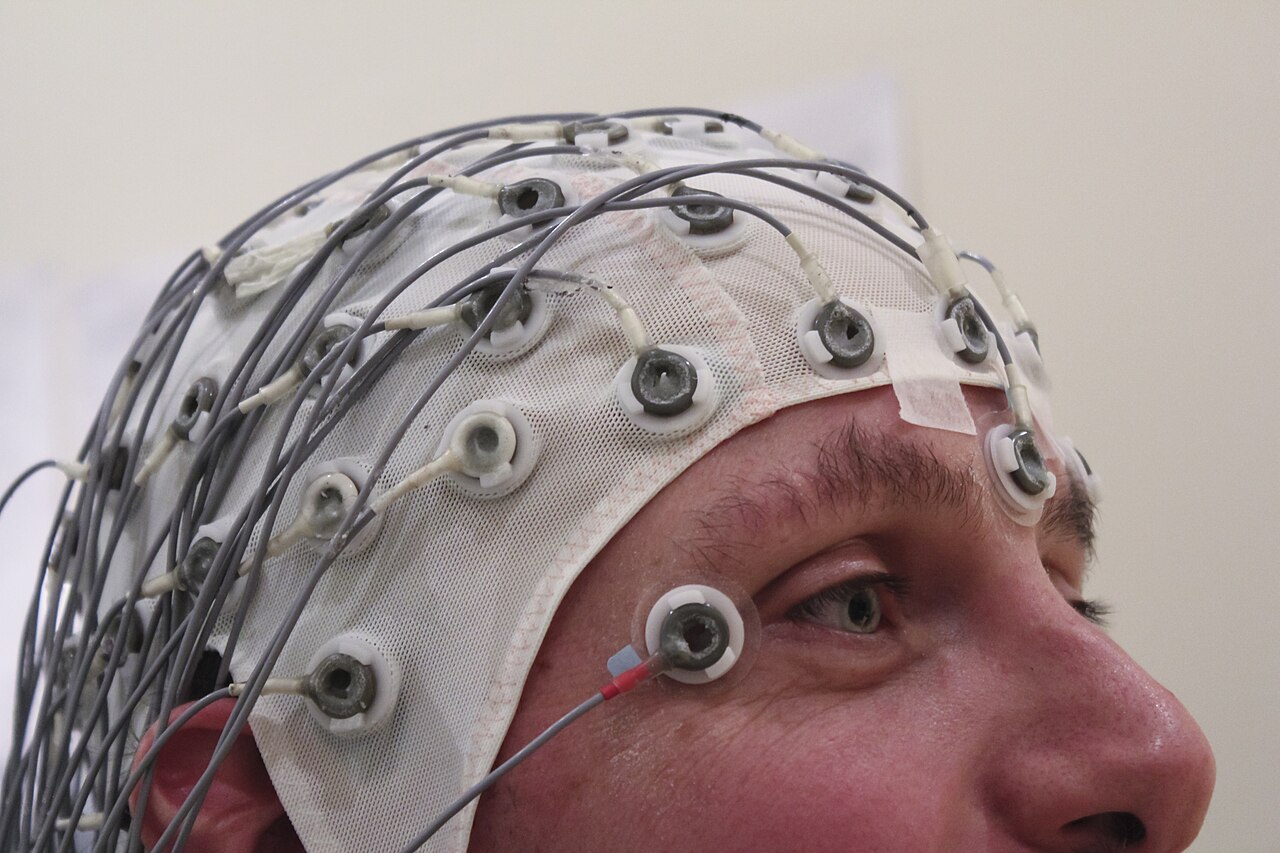
Image: EEG recording cap. Chris Hope, CC BY 2.0, via Wikimedia Commons.
Comments