


Walking to the kitchen for a glass of water and walking to the kitchen to turn off the light are the same route through the same rooms. Your memory of them is not the same. That poses a problem for the hippocampus, which holds a map of space built from cells that fire at particular locations. If the map were all there is, two errands along one corridor would be indistinguishable. If the map changed with every errand, it would stop being a map.
A group at the Max Planck Institute for Brain Research and the University of Lausanne recorded from rats running the same maze under different arrangements of rewarded locations, and found the brain solving this by keeping two codes in the same cells along separate axes.
Why it matters: A stable map and a distinguishable memory look like competing requirements. Putting the two signals on independent dimensions of population activity satisfies both without either interfering with the other.
Two signals, one population
Recording from many neurons at once lets you treat their combined activity as a point in a high-dimensional space, where the directions of variation matter more than what any one cell does. Read that way, position and the current arrangement of rewards occupied largely independent directions in hippocampal activity. The animal's location was encoded as before; the reward arrangement was encoded alongside it, without displacing it.
The consequence is that each reward arrangement gets its own version of the map while all versions stay spatially aligned. A given place is still that place in every version.
The same signal appeared in two other regions: the medial prefrontal cortex and the nucleus reuniens, a small thalamic nucleus sitting between prefrontal cortex and hippocampus. In both it formed persistent states that survived across walking and sitting still, and were reinstated when a previously experienced arrangement came round again.
What it is not encoding
This distinction is easy to miss and the authors are careful about it. Prefrontal cortex and reuniens did not track where the animal was heading on the current trip. They tracked the arrangement of rewarded locations for the current block of trials, which persists across many journeys.
So this is not a destination signal. It is closer to a signal for which situation the animal takes itself to be in, which is why a stable code that ignores trial-by-trial variation is the appropriate shape for it.
Cutting the thalamic link
Correlated activity across three regions does not establish that any one supplies it. Silencing the nucleus reuniens settled the direction of flow: the hippocampal reward-arrangement signal weakened, the separation between arrangement-specific maps shrank, and so did the arrangement-biased activity that normally appears before the animal starts moving.
Spatial coding was untouched. That double result is what makes the case, because a manipulation that degraded everything would show only that the region matters generally. Removing one code while sparing the other implies the two really are separable in the machinery, not just in the analysis.
Deciding between two theories
Hippocampal activity that depends on more than position has been known for decades, and two accounts compete. One says a fading trace of recent experience gets folded into place-cell firing, which predicts signals that vary smoothly with time and position. The other says experience is sorted into discrete internal states, which predicts something that need not follow spatial or temporal structure at all.
Three observations favour the second. The reward-arrangement code sat on dimensions distinct from position and lacked the continuous spatial organisation the position code has. It could be decoded about equally well anywhere on the maze, rather than grading along it. And it persisted while the animal was still, and in pre-movement activity, which a trace of recent movement should not do.
What the study can't say yet
The awkward result is behavioural. As Golipour and colleagues report in Nature Communications, NR silencing produced no apparent behavioral deficit in the present linear maze task. A signal was removed and the animals performed the same.
They do not paper over it. Earlier work on this maze found performance depends on orbitofrontal cortex and on dopamine release in the striatum, while hippocampal lesions leave learning intact, so the hippocampus appears dispensable for this particular task. The proposal that the signal supports mental simulation or planning of upcoming routes, and would matter in more complex environments, is a hypothesis the study frames rather than a result it delivers. Read strictly, this is a well-characterised representation without a demonstrated function.
The design also controlled reward arrangement specifically. Whether the same orthogonal arrangement handles other things that vary within one environment, such as motivation or intended action, is a reasonable extrapolation and untested here. And these were male rats on a linear maze, the simplest geometry available.
Quick questions
What does orthogonal mean here? That two kinds of information vary independently across the population, so changing one leaves the other unchanged. Position and reward arrangement can both be read out without either corrupting the other.
Why does the thalamus come into it? The nucleus reuniens is a route between prefrontal cortex and hippocampus. Silencing it removed the hippocampal signal while sparing spatial coding, which places it in the path carrying that information.
What's the one-line takeaway? Hippocampal cells encode which set of goals is currently in force along a dimension separate from the one encoding location, the thalamus is required for it, and removing it changed the code without changing behaviour.
Golipour et al. "Prefrontal-thalamic goal states organize spatially aligned hippocampal maps." Nature Communications, 2026;17(1). doi.org/10.1038/s41467-026-77240-6
PubMed PMID: 42668299.
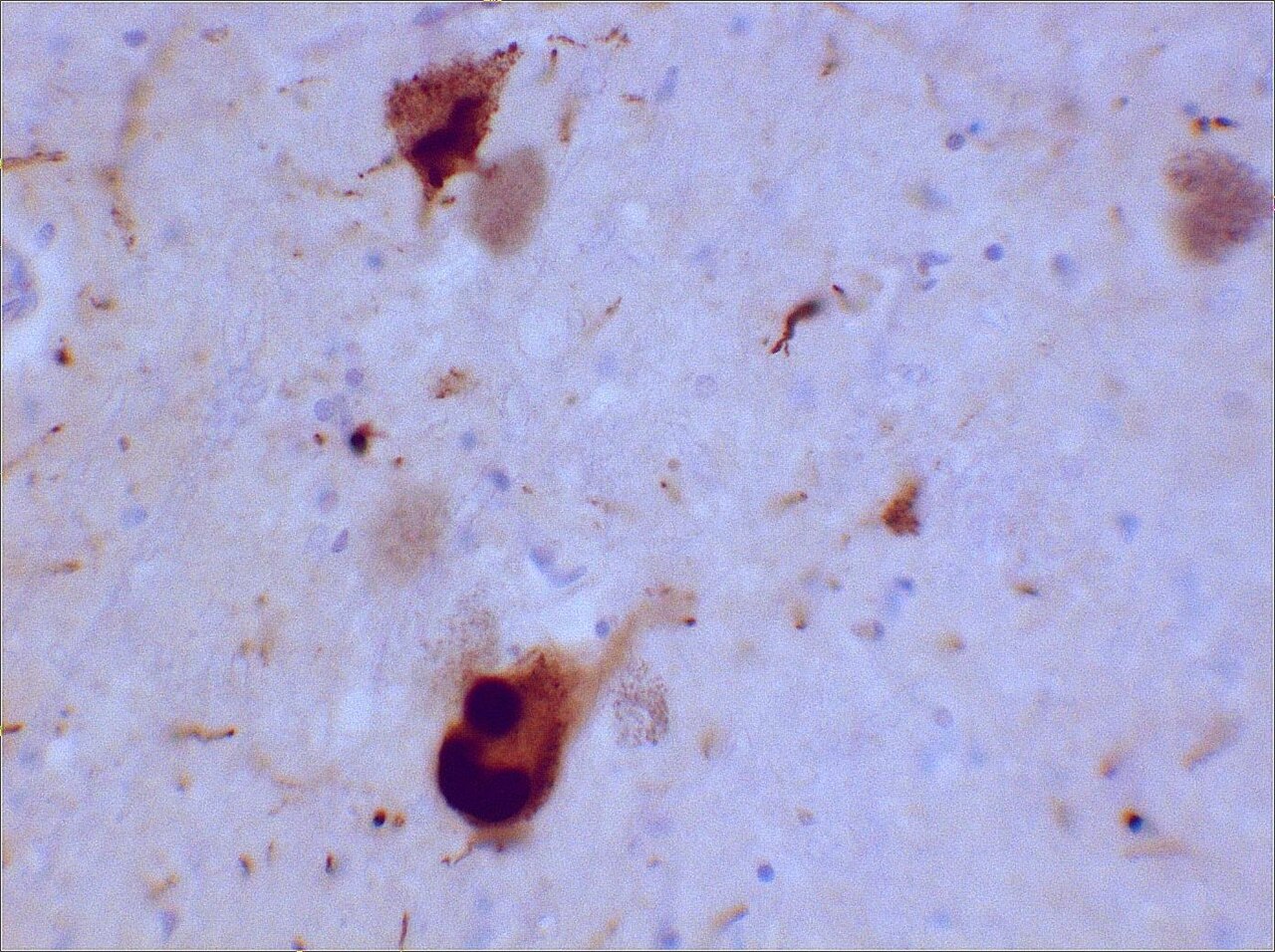
Image: Rat hippocampus immunostaining, GerryShaw, CC BY-SA 3.0, via Wikimedia Commons.
Comments