Inflammation is usually cast as the body's answer to infection. For Campylobacter jejuni, the leading bacterial cause of food poisoning worldwide, the sequence appears to run the other way. A healthy gut resists colonisation so effectively that ordinary laboratory mice cannot be infected at all unless something is first done to them, and what has to be done is to inflame the intestine.
A group at Michigan State University and Northern Illinois University used that awkward fact as the experiment. Giving conventional mice a short course of dextran sodium sulfate, a chemical that induces transient colitis, was enough: DSS-mediated inflammation disrupted colonization resistance and the pathogen grew rapidly in the colon within three days, making the inflammation worse as it went. The question the paper answers is what inflammation removes.
Why it matters: If colonisation resistance rests on a specific chemical made by resident bacteria rather than on immune cells, it can be restored by supplying that chemical. Multidrug-resistant strains of this pathogen are spreading, which makes any non-antibiotic route worth mapping.
The answer, reported by Sinha et al. in Science Advances, is indole, a small molecule some gut bacteria make from the amino acid tryptophan. Inflammation reshaped the microbial community, enriching mucin-degrading species and depleting the taxa that produce short-chain fatty acids and indole. Measured directly, colonic indole fell in inflamed and infected mice.
Why the experiment had to be built this way
The hypothesis did not start in mice. An earlier study by the same group, in ferrets, had suggested that intestinal inflammation promotes this pathogen's expansion during infection, but ferrets are a difficult system in which to run genetics. Mice are tractable and have the opposite problem: they are so resistant that there is nothing to measure. Inducing colitis converted an animal that cannot be infected into one that can, which is what made the mechanism accessible, and is also the study's central compromise.
The microbial shift under inflammation is informative in its own right. Alongside the loss of indole and short-chain fatty acid producers came an enrichment of mucin-degrading bacteria, species that feed on the mucus layer lining the gut. That layer is itself a physical barrier, so inflammation appears to degrade two defences at once: it thins the wall and removes the chemical.
A metabolite that switches off a pathogen's power supply
What makes the case more than correlational is that indole does something specific rather than acting as a general poison. In culture, it shut down the genes the bacterium uses to generate energy: nitrate respiration, aerobic respiration, lactate utilisation and the acetate switch. Four routes to ATP, all suppressed.
The prediction that follows is testable, and the team tested it. If those pathways are how the pathogen survives an inflamed gut, then mutants lacking them should be unfit there specifically. They were. The metabolite's targets and the bacterium's requirements matched, which is the kind of convergence that distinguishes a mechanism from an association.
Restoring the molecule restored the resistance. administration of indole or the indole-producing probiotic Escherichia coli Nissle 1917 significantly decreased C. jejuni colonization in vivo. In culture, wild-type Nissle grown with tryptophan accumulated about 1 millimolar indole and suppressed the pathogen, while a mutant unable to make indole did not, which puts the effect on the molecule rather than on the probiotic's presence.
What the study can't say yet
The dose-response deserves attention before anyone reaches for a supplement. Across the range the authors describe as physiologically relevant, 0.25 to 1 millimolar, the lowest concentration had little effect. Growth fell within six hours at 1 millimolar and within nine at 0.5. The protective effect therefore sits at the upper end of the physiological range, not across it, and a gut that has lost its indole producers is unlikely to sit there.
The model is artificial by construction, and unavoidably so. Mice had to be given chemical colitis before they could be infected, because they are otherwise resistant. Dextran sodium sulfate injures the epithelium directly; it is not inflammatory bowel disease and not the gastroenteritis this pathogen causes in people. So the study establishes that inflammation opens a door in mice that is normally shut, without establishing that the same door is what opens during human infection.
Directionality also remains partly circular. Inflammation depletes indole producers, the pathogen expands, and the expansion worsens inflammation. Which step initiates the loop in a natural infection, where there is no experimenter adding a chemical irritant, is not resolved here.
Nothing in this work tests a human intervention. E. coli Nissle 1917 is a long-established probiotic with a safety record, which shortens the path to a trial, but reducing colonisation in a mouse is not the same as preventing or shortening illness in a person, and the authors claim only the former: intestinal inflammation facilitates C. jejuni colonization while microbiota-derived metabolites, particularly indole, play a critical role in suppressing pathogen growth and pathogenicity.
Quick questions
What is colonisation resistance? The ability of an established gut community to prevent an incoming pathogen from taking hold, through competition for nutrients, occupation of niches and chemicals like this one. It is why most exposures do not become infections.
Where does indole come from? Gut bacteria carrying the enzyme tryptophanase convert dietary tryptophan into it. Species that make it are among those depleted when the gut becomes inflamed.
What's the one-line takeaway? Inflaming a mouse gut strips out the bacteria that produce indole, and without indole Campylobacter jejuni can run the energy pathways it needs to colonise, which supplying indole or an indole-making probiotic reverses.
Sinha R, Bhattarai B, Zimpel CK, et al. "Microbiota-derived indole limits Campylobacter jejuni colonization by inhibiting respiration and metabolism." Science Advances, 2026;12(38):eaei6934. doi.org/10.1126/sciadv.aei6934
PubMed PMID: 42748259.
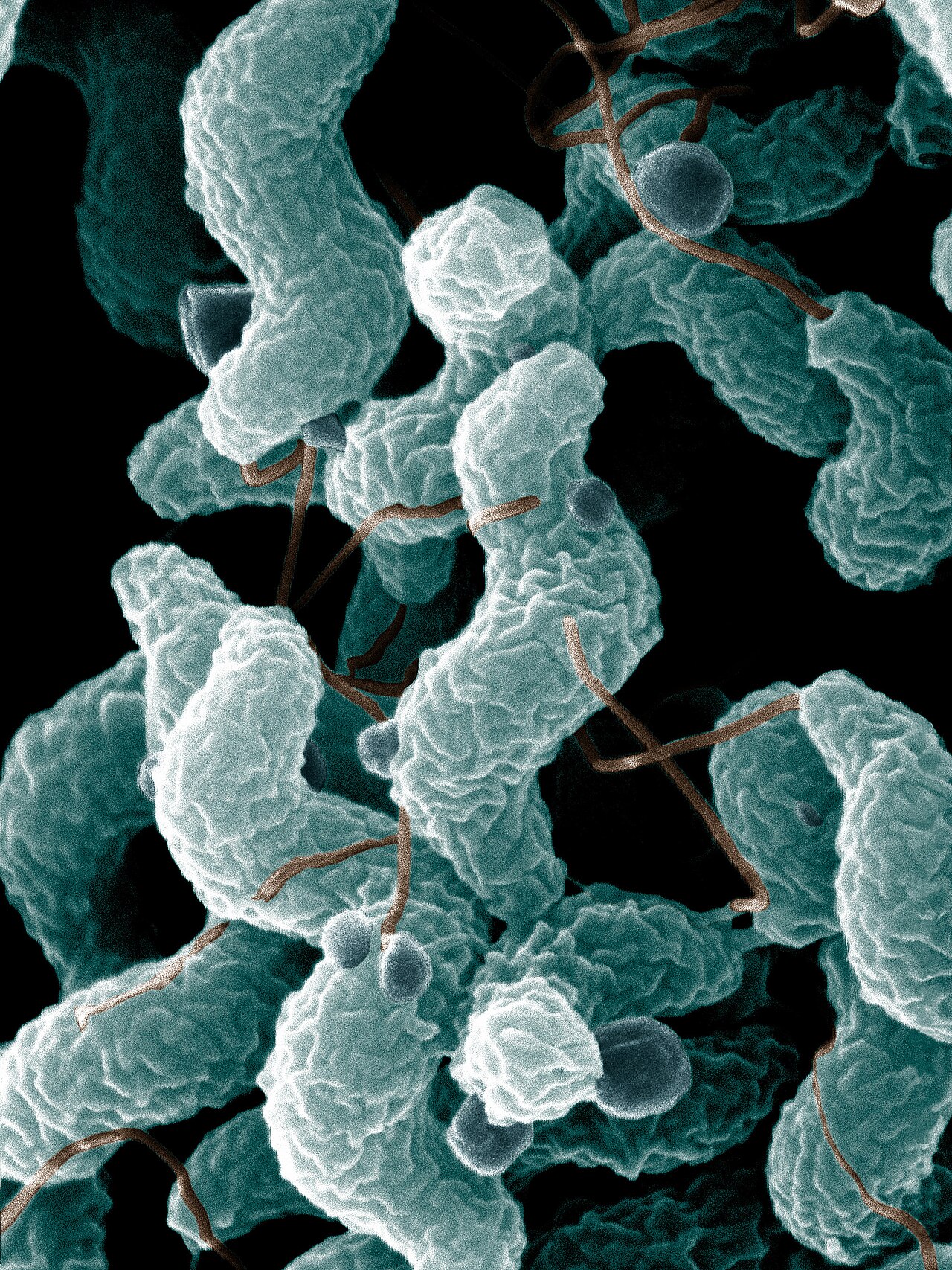
Image: Campylobacter jejuni. De Wood, Pooley, USDA ARS, public domain, via Wikimedia Commons.
Comments