

Collodaria are marine protists that drift in the open ocean carrying hundreds to thousands of photosynthetic algae inside them. They are the most abundant radiolaria in the upper hundred metres of the water column, and because the algae are packed far more densely inside a host than they are in the surrounding water, each colony is a small concentrated site of primary production in ocean regions that are otherwise nutrient-poor.
How much the host actually gets out of this has been disputed for decades, and not narrowly. Some studies put the symbionts' contribution at up to 80 percent of daily carbon needs in solitary species and around 20 percent in colonial ones. Another concluded it was under 1 percent, which would mean the algae are not feeding the host at all and must be there for something else, such as vitamins or protective compounds.
Why it matters: A gap that wide is not a disagreement about a number. It means nobody knew what the relationship is for. Estimates that far apart usually indicate the wrong quantity was being measured.
Measuring molecules instead of carbon
Earlier work followed carbon with radioisotopes or by imaging isotope distribution inside cells. Both show where labelled carbon ends up but not what it has become, and a bulk figure for carbon transfer cannot distinguish a sugar the host burns for energy from a signalling molecule present in trace amounts.
A group at Friedrich Schiller University Jena used a heavy stable isotope of carbon with high-resolution mass spectrometry, which identifies individual metabolites and reports what fraction of each one carries the label. That fraction, the degree of labelling, is measured separately for every compound, so the question changes from how much carbon moves to which molecules it moves as.
They collected colonies by plankton net in the bay of Villefranche-sur-Mer and ran four incubations: labelled bicarbonate in the light for 12 hours, the same followed by 12 hours of darkness, a longer 24-hour exposure, and separately an incubation with labelled dissolved compounds extracted from the free-living form of the symbiont, to test uptake straight from seawater.
A clean division
After 12 hours in the light, roughly a third of the glucose and fructose in the colony carried the label, rising above 35 percent at 24 hours. So the algae do supply the host, and they supply it as simple sugars.
The dark incubation is the more informative one. Label in glucose and fructose fell to about 27 percent while label in ribose more than doubled, and two compounds that had shown none in the light, threonic acid and gonyol, now carried it. The sugars are not being stockpiled. They are made in the light, consumed, and converted onward into the molecules the cell runs on.
Feeding the colonies dissolved organic compounds gave the opposite pattern. The sulfur compound DMSP reached nearly 50 percent labelling, and several molecules picked up label only by this route: ectoine, glycine and alanine betaines, creatine. Every one of them is an osmolyte, the class of small compounds cells use to manage osmotic stress. Meanwhile the sugars showed nothing at all.
As Nikitashina and Pohnert summarise in Nature Communications, Osmotrophy served as a source of osmolytes but not sugars or amino acids. Two supply routes, two non-overlapping sets of molecules.
What the study can't say yet
The experiments deliberately excluded feeding. Collodaria normally eat small plankton and detritus, and the authors state plainly that everything here was measured in the absence of that third route. So this describes what the algae and the seawater contribute, not the full budget, and it cannot settle the 80-percent-versus-1-percent argument outright.
The method also cannot tell host from symbiont. A colony is analysed whole, so a labelled sugar might sit in either partner. The authors argue the carbohydrates are likely in both, reasoning from how little of the colony's mass the algae account for, which is an inference rather than a measurement.
One result stayed stubbornly blank: no amino acid picked up label under any condition, including from the lysate that demonstrably contained labelled amino acids. Either the colony makes them too slowly to detect over these timescales or it turns them over too fast. The paper offers both possibilities without choosing.
And the dissolved compounds were a stand-in. They came from lab-grown algae at roughly a tenth of the density found inside a colony, which makes them a reasonable proxy for what drifts past in the sea but not a measurement of it.
Quick questions
What is osmotrophy? Taking up dissolved organic molecules directly from the surrounding water, rather than eating particles or making the molecules yourself.
Why does DMSP matter beyond this colony? It is a major part of the ocean's sulfur cycle and the precursor of the gas that gives sea air its smell. Radiolaria were known to hold more of it than expected; this suggests they take much of it from the water rather than making it.
What's the one-line takeaway? The algae supply their host with sugars, which are burned rather than stored, while the osmolytes come from the surrounding seawater, and neither route substitutes for the other.
Nikitashina and Pohnert. "Metabolic partitioning between photosynthesis and osmotrophy in Collodaria photosymbiotic holobionts." Nature Communications, 2026;17(1). doi.org/10.1038/s41467-026-76549-6
PubMed PMID: 42618577.
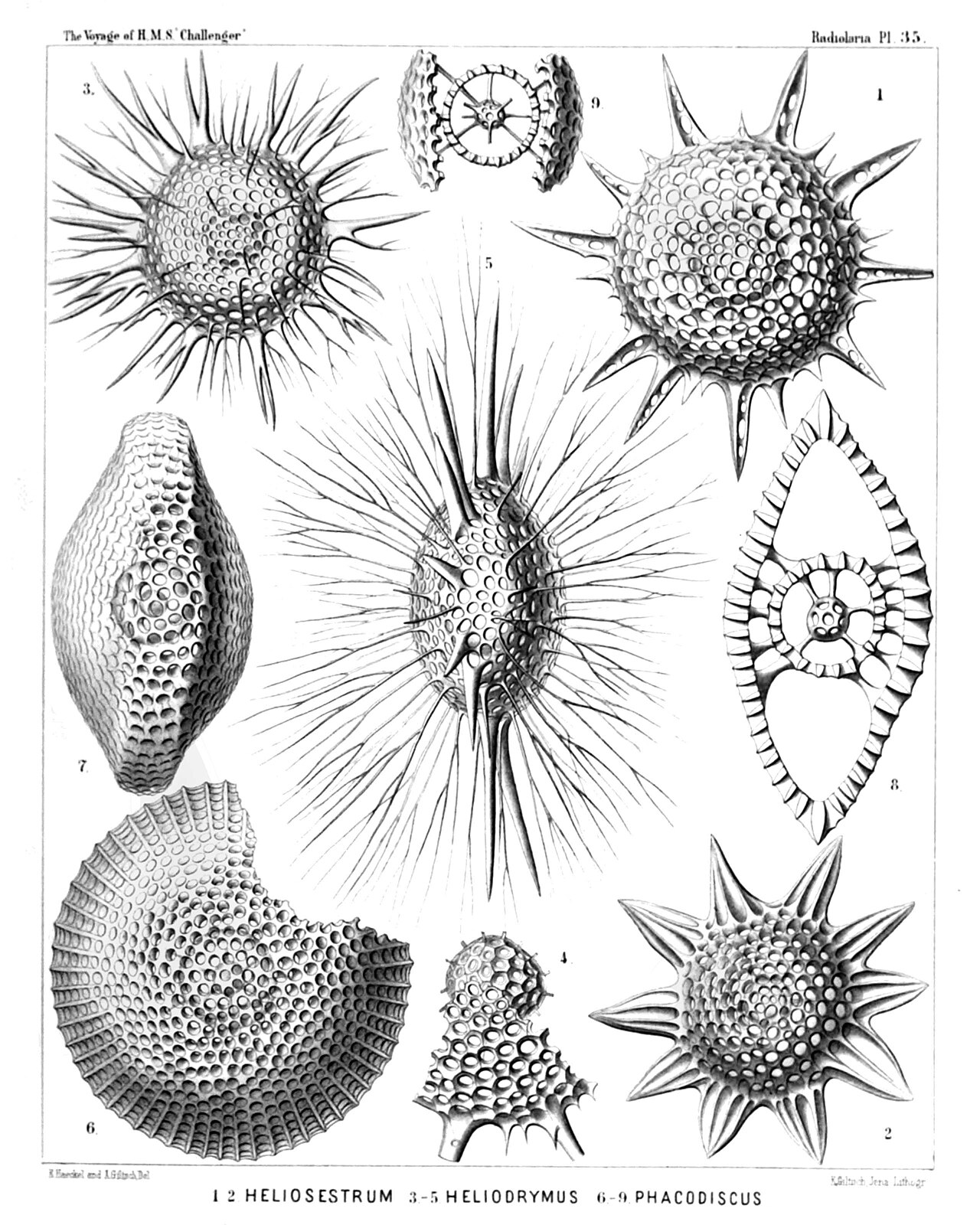
Image: Radiolaria, Challenger Report Plate 35, Ernst Haeckel, public domain, via Wikimedia Commons.
Comments