

The standard account of why a meadow holds many species rather than one is niche differentiation. Species that use resources differently compete more with their own kind than with each other, and that self-limitation keeps the strongest competitor from taking everything. The theory carries a requirement: roughly, you need at least as many independent limiting factors as you have coexisting species.
Nobody has been able to check that requirement, because checking it means knowing how many resources species actually compete over. Studies pick the axes in advance, water, light, nutrients, and a chosen list cannot tell you what was left off it.
Why it matters: If real communities run on fewer axes than they have species, then the textbook explanation for local diversity is incomplete, and something other than niche differences is holding these communities together.
Reading the axes off the competition itself
The approach here inverts the problem. Rather than name resources, it starts from the matrix of who suppresses whom and asks how many independent dimensions are needed to reproduce it.
Each species gets two sets of numbers: an effect, how strongly it suppresses its neighbours, and a response, how strongly neighbours suppress it. Multiply one species' effect by another's response and you predict the interaction between them. Doing this along one axis reproduces some of the matrix; adding axes reproduces more. The number of axes needed to account for 95 percent of the variation is what the authors call niche dimensionality, a stand-in for the number of things species are effectively competing over.
They ran it on 12 plant assemblages from around the world, spanning deserts to forests and annuals to trees, each with three to ten species.
Three axes, at most
Every single dataset was captured by three dimensions or fewer, regardless of habitat or whether the work was done in a field, a garden or a greenhouse. The first dimension alone accounted for 86.7 percent of the variation on average, ranging from 59.6 to 99.3 percent across the twelve.
Dimensionality did rise with the number of species, but far more slowly than the one-per-species that theory expects. And the obvious worry, that the method simply compresses everything, was tested directly: randomised interaction matrices came out with higher dimensionality than the real ones, not lower.
Taken at face value this says many-species coexistence in these communities should be difficult, which sits awkwardly beside the fact that the communities exist. The authors note it may explain a long-standing frustration in the field, that models fitted to real interaction data rarely predict the coexistence actually observed.
Niches that move
The second half of the paper is where the tension eases. Two of the datasets contain the same species measured under two conditions: ten species under normal and simulated drought conditions, and eight under full light and artificial shade.
Dimensionality rose in the harsher condition, from two to three in one pair and one to two in the other. More striking, the species did not keep their places. Comparing which species were strong effectors and which were sensitive responders across conditions gave weak, non-significant correlations, meaning the competitive roles were reshuffled rather than preserved.
That undercuts a common assumption. Niche theories built on environmental tolerance or on functional traits treat a species' niche as a fixed property it carries around. Here the niche is partly a property of the conditions.
A simple model makes the consequence concrete. Two species confined to a single niche dimension cannot coexist in a constant environment, and simulations confirm one always wins. Alternate the environment between the two conditions, each favouring a different species, and both persist.
What the study can't say yet
The central ambiguity is stated outright. As Stouffer and colleagues put it in Nature Communications, Less clear is whether the emergent pattern is more a consequence of the plant assemblages exhibiting a striking lack of fundamental niche differences or competing over a small number of truly limiting resources. Those are different claims about nature, and this method cannot separate them.
The 95 percent threshold is a convention, and the authors say so, noting it may be conservative and that no better rule of thumb exists. A different cutoff would give different numbers, though the qualitative gap between dimensions and species is large enough to survive reasonable choices.
The rescue is also partial. Environmental variation helps, but the paper is explicit that it is not sufficient for long-term coexistence, since a species exposed too long to conditions it dislikes still goes extinct. Two conditions is also not a gradient; what happens across continuous environmental variation is untested.
Quick questions
What is a niche dimension here? Not a named resource, but an independent axis along which species differ enough to affect each other differently. It is inferred from the pattern of competition rather than measured directly.
Does this mean niche theory is wrong? No. It means the number of axes realised in real communities is smaller than assumed, and that environmental change may supply variation the axes alone do not.
What's the one-line takeaway? Across 12 plant communities worldwide, competition was organised on three axes or fewer, always fewer than the number of species, and a changing environment reshuffles which species occupy which position.
Stouffer et al. "The dimensionality of plant-plant competition." Nature Communications, 2026;17(1). doi.org/10.1038/s41467-026-76980-9
PubMed PMID: 42649222.
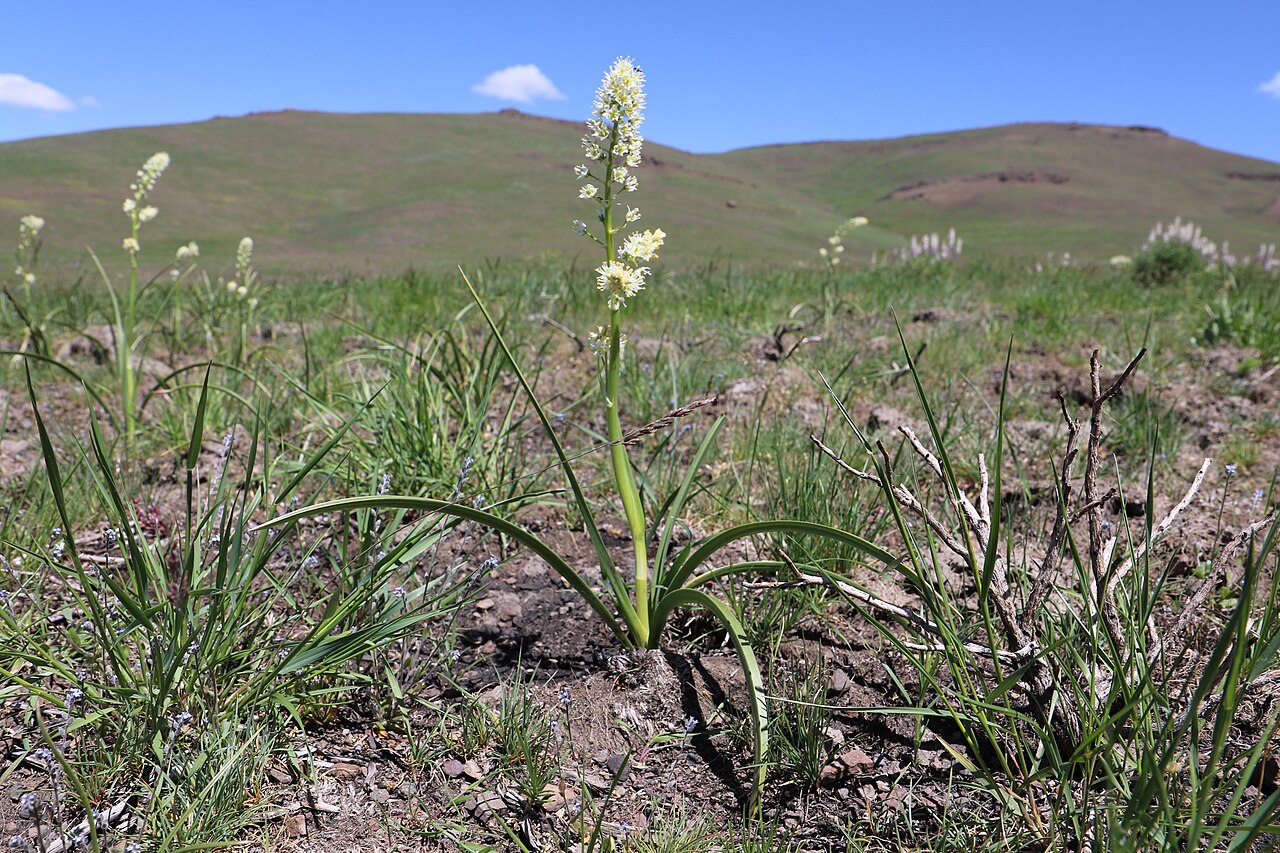
Image: Death camas and associated meadow plants, BLM Idaho, public domain, via Wikimedia Commons.
Comments