

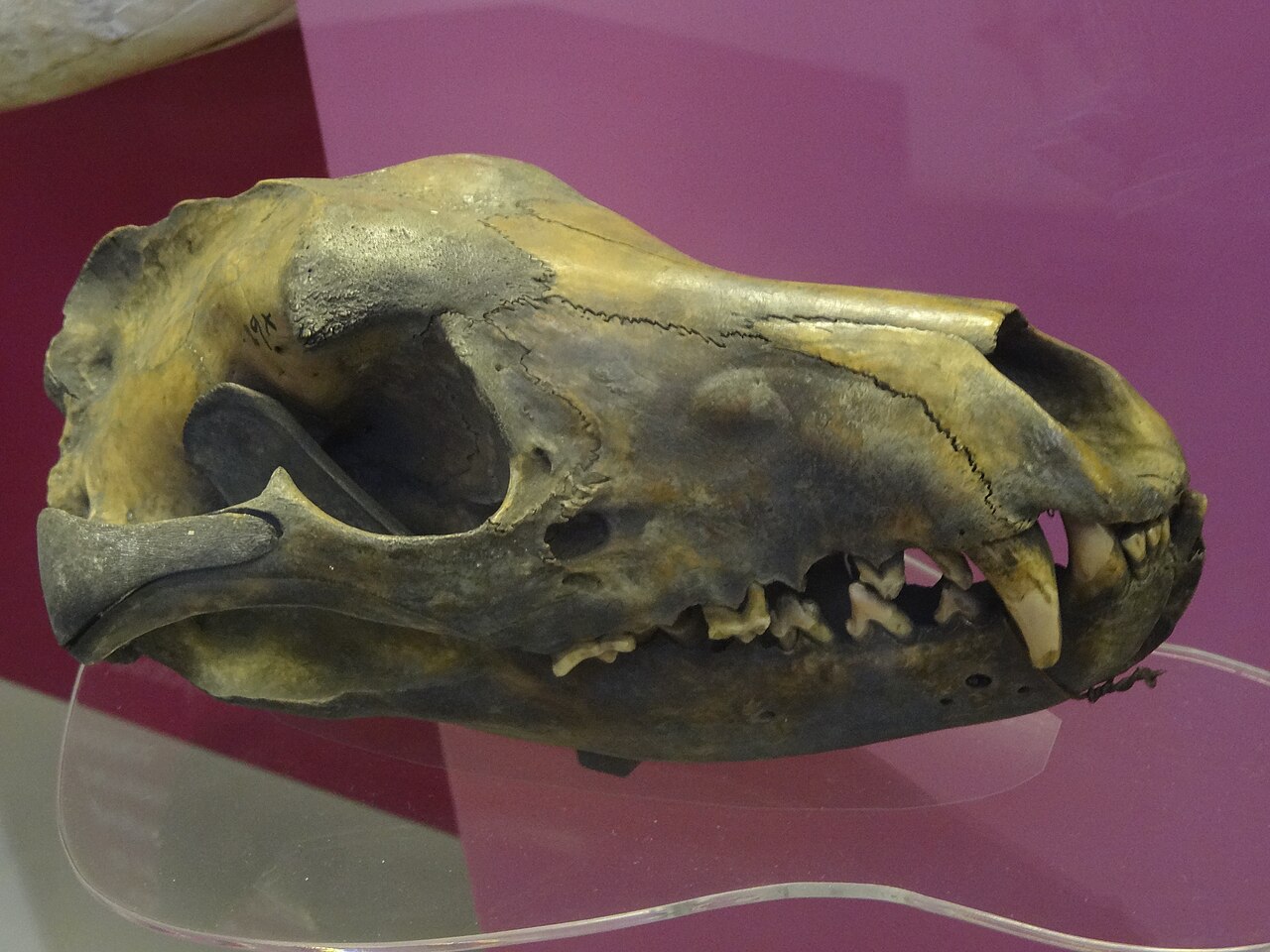
The thylacine is the standard illustration of convergent evolution. A marsupial that looked like a wolf, separated from actual wolves by around 160 million years of independent evolution, its species name meaning dog-headed. The resemblance is not only impressionistic: skull shape studies support it, the bones grow in similar ways, and the two lineages even share signatures of selection on genes that pattern skull growth.
An Australian-led team measured the skull more carefully than before, and concluded the resemblance does not extend to what the skull was for.
Why it matters: Convergence is supposed to mean similar shapes arising from similar pressures. If the shapes are similar but the function is not, the textbook example is illustrating something other than what it is used to illustrate.
The head is too big
The finding that drives the rest is one that morphometric studies routinely discard. These methods normally strip out absolute size to compare shape, and biomechanical work compares bite force relatively rather than in absolute terms. Keeping the size in changes the picture.
A thylacine weighed about 17 kilograms. Its skull is the size you would expect on an animal of 24.5 to 66.7 kilograms, comparable to a grey wolf, a puma or a leopard. The canids whose skull shape it most resembles are jackals and foxes weighing 6 to 14 kilograms.
The obvious objection is that shape and size travel together, so a large skull might simply come with this shape. The authors tested that at length and rejected it: differences between the major groups explained far more shape variation than size did, and the scaling relationships themselves differ between groups, so the thylacine and the larger canids are not sitting on one shared trend.
A combination nothing living has
Divided into regions, the skull is a mosaic. The snout groups with canids; the braincase groups with other marsupials. No canid or marsupial in the sample combines the two the way the thylacine does.
The snout is long and slender, which mechanically means a fast bite and a weak one. A longer jaw closes more quickly but resists twisting forces poorly, a profile associated with catching small, quick prey rather than wrestling large animals. Among canids these traits come as a package with small size. Large-prey specialists have big skulls that are not slender; small-prey specialists have slender skulls that are not big. The thylacine has both, and the authors argue the large skull is what compensates, giving the fragile snout more bone to spread an impact across.
Two further features point the same way. The snout flares outward at the canines and then pinches in behind them, a shape the authors call a terminal rosette, which shifts mass forward and puts more bone where the canines strike. And the snout is unusually tall, good at handling force from above and below, poor at handling it sideways. Its canines are sturdier than a grey wolf's.
The picture is a fast, hard snap delivered at the canine tips, absorbed by a large skull, at prey around 45 percent of its own body mass. Not a wolf's method at all.
Relatives in the wrong places
Nothing alive combines these traits. The closest matches by shape and size, the maned wolf and the Ethiopian wolf, each fail on something else: one is half again as heavy and eats roughly half fruit, the other lacks the tall snout and the outsized skull.
The comparisons that do fit are extinct, and mostly distant. Several vanished mammal lineages had this build, and so do animals as unrelated as crocodiles and some pterosaurs, all fast snappers. As Weisbecker and colleagues write in Nature Communications, It is therefore possible that the thylacine cranium showed a complement of biomechanical adaptations to carnivory that is now extinct among mammals.
Which forces a reinterpretation of the genetics. Thylacines and wolves really do share selection signals on skull-patterning genes. If their skulls did different jobs, that shared selection was not selection for the same function, and the convergence needs another explanation.
What the study can't say yet
This is inference from bone, and no thylacine has been observed hunting since 1936. Every functional claim rests on mechanical principles and on comparison with living animals, which the paper's own conclusion says may not apply here. The behaviour is a reconstruction, not an observation.
One trait resists explanation entirely. The opening through which nerves reach the face is far larger than in any living marsupial, which usually indicates reliance on whiskers, except that the thylacine's whiskers were short and fine. A link to precise canine placement has been proposed in sabretoothed cats but never directly tested. The authors state that no clear explanation can be offered, because too little is known about how this structure relates to biting even in living mammals.
The claim that the wide zygomatic arches brace the jaw joint is also flagged as untested. And the sample, though it is the largest set of thylacine skull measurements published, is a set of museum specimens with no associated behavioural record. The team also notes in their methods that these specimens were collected without consultation with Indigenous communities, and commits to addressing that in future work.
Quick questions
Why does absolute skull size matter? Because it sets how much bone and muscle are available in real terms. Two animals can share a skull shape while one has far more material to resist force, which changes what the skull can do.
Does this mean the convergence was imaginary? No. The shape similarity is real and measured. What is challenged is the assumption that similar shape came from selection for similar function.
What's the one-line takeaway? The thylacine had a skull far larger than its body warranted on a slender, tall snout flared at the canines, a combination absent from every living mammalian carnivore and suggesting a fast snapping bite rather than a wolf's.
Weisbecker et al. "Skull morphology of the extinct Tasmanian tiger suggests unique biting style." Nature Communications, 2026;17(1). doi.org/10.1038/s41467-026-76614-0
PubMed PMID: 42675082.
Image: Thylacine skull, Jonathan Cardy, CC BY-SA 3.0, via Wikimedia Commons.
Comments